

Marketing consultation gives a business an outside, expert view of its marketing strategy, channels, positioning, data and growth opportunities. Instead of immediately paying an agency to execute campaigns, a consultation helps you diagnose what is working, identify what is wasting budget and decide what should happen next.
For example, a good marketing consultant does more than recommend “post more on social media” or “run Google Ads.” The work should connect your business goals to audience research, search demand, competitors, website performance, conversion data and realistic budgets.
That distinction matters in 2026. Businesses now have to coordinate traditional search, AI search, paid media, content, email, social, analytics and conversion optimization. As a result, the value of a marketing consultation increasingly comes from prioritization: deciding which opportunities deserve money and attention first.
This guide explains what a marketing consultation includes, how much consultants typically cost, the different types of consultants, what deliverables to expect, when to hire one and how to evaluate whether the engagement produced a return.
Want data before your consultation? Analyze your website and research competitors with CBOOMARANK before paying for strategy recommendations.
Marketing Consultation: Quick Answer
A marketing consultation is a structured review of your current marketing position and the opportunities most likely to improve growth. Depending on the engagement, the consultant may review your website, SEO, competitors, advertising, analytics, customer acquisition funnel, content, brand positioning and conversion process.
In practice, the output may be a single advisory session, an audit, a written strategy, a 30- or 90-day action plan, or ongoing strategic guidance.
| Consultation type | Typical purpose | Common output |
|---|---|---|
| One-off consultation | Diagnose a specific problem | Recommendations and prioritized next steps |
| Marketing audit | Review multiple channels | Findings, risks, opportunities and roadmap |
| Strategy consultation | Build a growth plan | Channel, audience, positioning and budget strategy |
| Specialist consultation | Improve SEO, PPC, content, analytics or another specialty | Specialized recommendations and implementation plan |
| Ongoing advisory | Guide an internal team over time | Recurring reviews, decisions and optimization priorities |
What Does a Marketing Consultation Include?
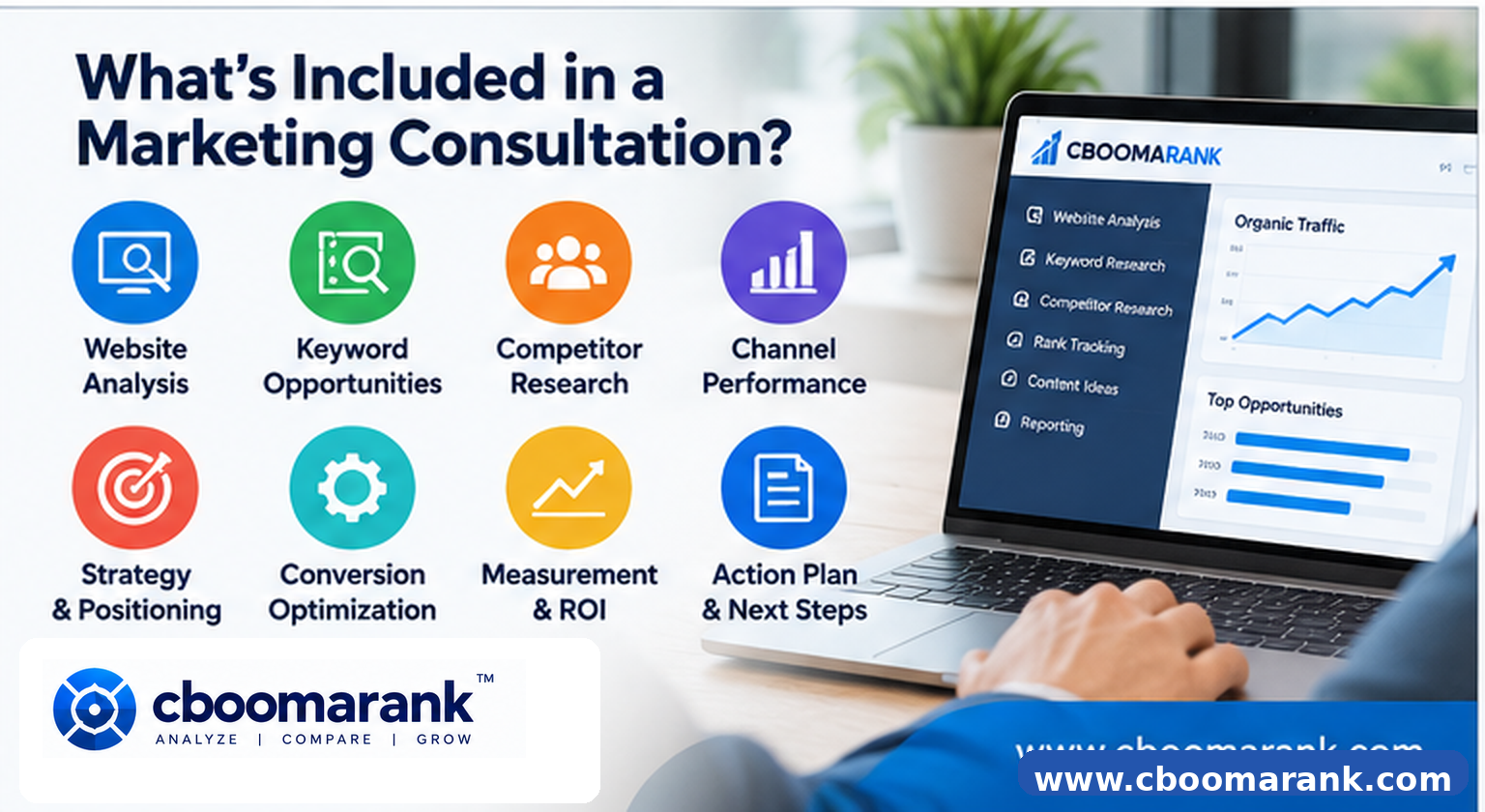
The scope depends on the business problem. However, useful consultations typically combine business context with real marketing data rather than relying on generic advice.
1. Business goals and revenue model
The consultant should first understand how your company makes money. For example, an ecommerce store optimizing product sales needs a different acquisition strategy from a B2B SaaS company with a six-month sales cycle.
Useful discovery questions include:
- What are your revenue and growth goals?
- Which products or services have the highest margins?
- Who is your most profitable customer?
- How long does the buying process take?
- Which channels currently generate leads or sales?
- What does a qualified lead look like?
- Where do prospects abandon the funnel?
2. Website and conversion review
Your website is often the central point where search, advertising, referrals, email and social traffic become leads or sales. Therefore, a marketing consultation should examine whether the website supports the campaigns sending visitors to it.
The review may include landing pages, calls to action, navigation, page speed, mobile usability, forms, trust signals, analytics implementation and conversion paths.
CBOOMARANK’s website analysis can provide additional context before or after the consultation by identifying SEO and website issues that deserve attention.
3. Search and keyword opportunity review
For example, search data can reveal what prospects actively want. A consultant may review commercial keywords, informational demand, search intent, competitor rankings and content gaps.
For instance, a company may believe its main opportunity is a broad, high-volume keyword. However, the consultant may discover that a smaller set of high-intent keywords is more likely to generate revenue.
This is where keyword research should connect to the wider strategy instead of existing as a spreadsheet that nobody uses.
4. Competitor analysis
Likewise, competitor research helps answer practical questions: Which channels are competitors investing in? Which topics attract search visibility? Which offers are prominent? Where are the content gaps? How are competitors positioning themselves?
The objective is not to copy competitors. Instead, competitor analysis provides evidence about what the market already rewards and where differentiation may be possible.
Use CBOOMARANK Competitor Research to investigate competing websites alongside your consultation process.
5. Channel performance review
A consultant may assess SEO, paid search, social media, email, referral traffic, content marketing and other acquisition channels. Importantly, the goal is not to recommend every available channel.
Instead, the consultant should identify which channels are realistic for your audience, economics, team and budget.
Our guide to digital marketing benchmarks, channels, costs, KPIs and ROI provides additional context for evaluating channel performance.
6. Measurement and attribution
Marketing recommendations are much harder to evaluate when conversion tracking is incomplete. Therefore, a consultation may include a review of analytics, event tracking, lead-source attribution, CRM data and campaign naming conventions.
At a minimum, you should know which marketing activities generate meaningful business outcomes rather than only impressions and clicks.
Marketing Consultation Costs in 2026
However, marketing consultation costs vary significantly by experience, geography, specialization, project scope and whether you hire an independent consultant or an agency.
As a directional benchmark, Upwork currently reports typical marketing-consultant rates of approximately $20–$60 per hour based on historical worldwide contracts. Upwork also shows planning ranges of roughly $150–$450 for a one-off consultation or channel review and around $500–$1,500 for a marketing audit and strategy roadmap.
Meanwhile, Clutch’s 2026 digital-marketing pricing data reports many agencies around $25–$49 per hour, while specialized services such as SEO, PPC, content and email can be priced higher. These figures should be treated as market references rather than fixed quotes.
| Engagement | Directional cost | Typical use |
|---|---|---|
| Short consultation | $150–$450 per project | Focused diagnosis or channel review |
| Independent consultant | $20–$60/hour typical marketplace range | Advisory, audits and strategic work |
| Marketing audit + roadmap | $500–$1,500 per project | Multi-channel review and prioritized plan |
| Specialized strategy project | Often $1,500+ depending on scope | Positioning, go-to-market or acquisition planning |
| Agency engagement | Varies widely by service and geography | Strategy combined with implementation capacity |
Important: these are directional 2026 market benchmarks, not a universal rate card. Senior specialists, high-complexity industries, international strategy work and enterprise engagements can cost substantially more.
What Determines Marketing Consultation Cost?
Consultant experience
A consultant who has repeatedly solved the same business problem may charge more per hour but require fewer hours to reach a useful conclusion.
Scope of work
Reviewing one landing page is very different from auditing SEO, PPC, analytics, email, social media, positioning and conversion across an international business.
Specialization
Technical SEO, marketing automation, enterprise analytics and complex paid-media strategy may command higher fees because the required expertise is narrower.
Data quality
If analytics, conversion tracking or CRM data is unreliable, the consultant may need additional discovery work before making recommendations.
Deliverables
A one-hour strategy call costs less than a documented market analysis, competitor review, keyword strategy, funnel audit and 90-day implementation roadmap.
Marketing Consultation vs Marketing Agency
In practice, a consultant and an agency can solve different problems.
| Marketing consultant | Marketing agency |
|---|---|
| Primarily advises and diagnoses | Often combines strategy with execution |
| Can provide independent review | Usually recommends services it can deliver |
| Useful before committing a large budget | Useful when you already know what must be executed |
| Can support an internal team | Can provide external production capacity |
| Often narrower team structure | May include specialists across multiple disciplines |
However, these models are not mutually exclusive. In fact, a consultant can help define the strategy before an agency executes it. Alternatively, an experienced agency may include strategic consulting as part of its engagement.
When Should You Hire a Marketing Consultant?
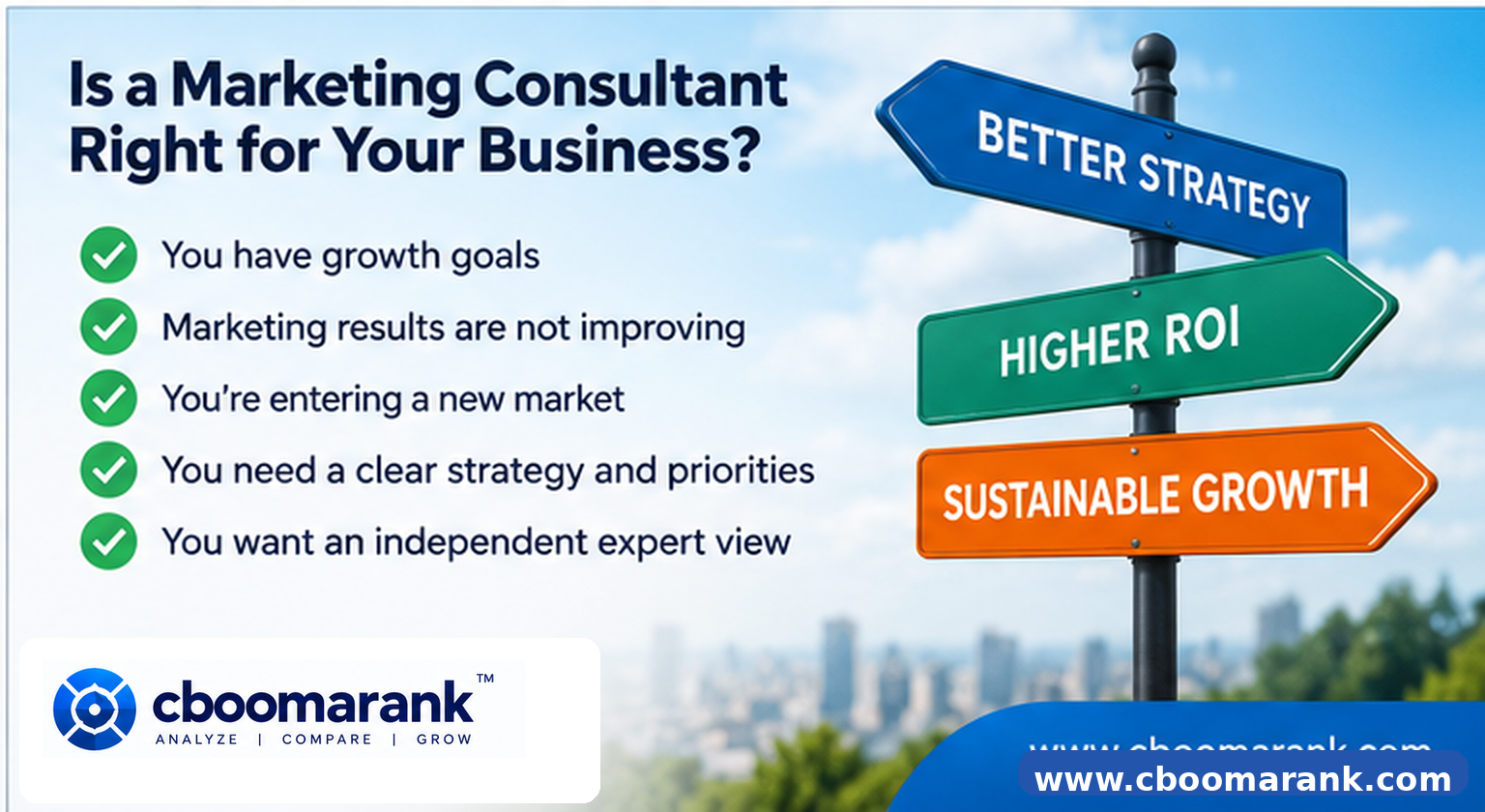
Your marketing spend is increasing but results are not
When costs grow faster than qualified leads or revenue, an independent review can identify whether the problem is targeting, positioning, traffic quality, conversion, measurement or execution.
You are entering a new market
A new country, product category or customer segment introduces unfamiliar competitors and search behavior. Consequently, research before execution can reduce expensive assumptions.
You have many marketing ideas but no priorities
Teams often accumulate an overwhelming list of tactics: SEO, social media, newsletters, paid search, video, partnerships, webinars and AI content. A consultant can help rank those opportunities by business value and feasibility.
You are hiring an agency
A consultation before signing a long agency contract can help define scope, KPIs, expected outcomes and the questions you should ask prospective providers.
Your internal team needs senior guidance
A strong team may not need full outsourcing. Instead, periodic strategic consultation can help managers validate decisions, solve difficult problems and improve prioritization.
Your website receives traffic but does not convert
More traffic will not automatically fix a weak offer, unclear conversion path or poor landing-page experience. Therefore, a consultant should investigate the entire customer journey rather than recommending traffic growth alone.
When Marketing Consultation May Not Be Necessary
However, consulting is not always the next logical purchase.
You may not need a consultant when the business problem is already clear and purely operational. For example, if a tracking tag is broken and the exact repair is known, implementation help may be more useful than strategy.
Likewise, a very early-stage company with no validated offer may benefit more from customer conversations and direct market testing than an expensive marketing strategy engagement.
Finally, do not hire a consultant solely because marketing feels complicated. First define the decision you need help making.
How to Prepare for a Marketing Consultation
Therefore, preparation improves the quality of the advice you receive.
- Write down the business problem. Be specific about what is not working.
- Gather analytics. Include traffic, conversions, advertising performance and sales data where available.
- List active marketing channels. Note spend, ownership and current results.
- Identify major competitors. Include direct competitors and search competitors.
- Document your customer journey. Explain how prospects discover, evaluate and buy from you.
- Define constraints. Share budget, team size, technology and timeline limitations.
- Prepare questions. Focus on decisions, not simply asking for general marketing advice.
Prepare with real website and competitor data.
Questions to Ask During a Marketing Consultation
In addition, good questions reveal how the consultant thinks and whether recommendations are connected to business outcomes.
- What do you believe is our biggest marketing constraint?
- Which channel should receive more investment, and why?
- Which activity should we stop or reduce?
- Which metrics should management monitor weekly or monthly?
- Where are competitors outperforming us?
- Which assumptions require testing?
- What should we accomplish in the next 30, 60 and 90 days?
- Which recommendations can our current team implement?
- Which recommendations require specialist support?
- How will we know whether the strategy is working?
Marketing Consultation Deliverables to Expect
Ultimately, the best deliverable is not necessarily the longest presentation. Instead, it should make decisions easier.
Useful outputs may include:
- Executive summary
- Website and conversion findings
- Competitor analysis
- Keyword and search-opportunity map
- Channel performance review
- Customer-segment priorities
- Positioning recommendations
- Measurement plan
- Budget allocation recommendations
- 30-, 60- or 90-day roadmap
- Prioritized quick wins
- Risks and assumptions requiring validation
How to Evaluate a Marketing Consultant
Look for diagnosis before tactics
A consultant who recommends a specific channel before understanding your business may be selling a service rather than solving a problem.
Ask for relevant experience
Industry expertise can help, but problem expertise is equally important. A consultant who has solved similar acquisition, conversion or positioning problems may be valuable even if the exact industry differs.
Evaluate how evidence is used
Recommendations should connect to data, customer behavior, competitor evidence or reasonable tests. Unsupported certainty is a warning sign.
Ask what not to do
Prioritization requires exclusion. A useful consultant should be willing to explain which activities are unlikely to justify your resources.
Clarify conflicts of interest
If the consultant also sells implementation, ask how recommendations are separated from the services they hope to sell afterward.
Marketing Consultation for SEO
Similarly, an SEO-focused marketing consultation should look beyond rankings alone. Search performance connects technical health, content, keywords, authority, competitors, conversion and increasingly AI-generated discovery experiences.
The consultant may examine:
- Technical SEO problems
- Keyword opportunities
- Search intent alignment
- Content gaps
- Competitor visibility
- Internal linking
- Backlink profile
- Conversion performance from organic traffic
- Search and AI visibility
If SEO software selection is part of the discussion, see our guide to Semrush alternatives for keywords, audits, competitors and AI search.
Marketing Consultation for Paid Advertising
Meanwhile, a paid-media consultation can identify whether advertising problems come from bidding, creative, targeting, tracking, landing pages or the economics of the offer itself.
Before increasing spend, the consultant should understand conversion rate, acquisition cost, lifetime value and how quickly revenue returns from advertising investment.
This helps prevent a common mistake: increasing traffic to a funnel that already loses too many prospects.
Marketing Consultation for Content Strategy
Likewise, content consulting should connect topics to audience needs, search demand, business expertise and conversion opportunities.
A useful content strategy includes more than a publishing calendar. It should explain which audiences the content serves, which problems each topic addresses, how content supports product or service discovery and how performance will be measured.
How to Measure Marketing Consultation ROI
Finally, consulting ROI is not always immediate because the deliverable is often a better decision rather than a completed campaign. Nevertheless, you should measure whether the consultation changes business outcomes.
Possible indicators include:
- Lower customer acquisition cost
- Higher qualified-lead volume
- Improved conversion rate
- Reduced wasted advertising spend
- Higher organic visibility
- Better marketing-attributed revenue
- Faster execution by the internal team
- Fewer low-value initiatives
- Better measurement and reporting
For example, avoiding a poorly designed $20,000 campaign can create value even if the consultation itself does not directly generate revenue.
Marketing Consultation Red Flags
- Guaranteed rankings, revenue or viral growth
- Recommendations made before reviewing your business
- Heavy emphasis on vanity metrics without conversions
- No explanation of assumptions or risks
- Generic templates presented as custom strategy
- Refusal to define measurable outcomes
- Pressure to buy a long implementation contract immediately
- No documentation of key recommendations
Marketing contains uncertainty. Therefore, credible consultants should distinguish between evidence, professional judgment and experiments that still need validation.
Marketing Consultation Checklist
| Before | During | After |
|---|---|---|
| Define the business problem | Challenge assumptions | Prioritize recommendations |
| Gather analytics | Ask what should stop | Assign owners |
| List channels and spend | Clarify trade-offs | Set deadlines |
| Identify competitors | Request evidence | Track KPIs |
| Prepare questions | Define success | Review results |
Use CBOOMARANK Before and After Your Marketing Consultation
A consultant’s recommendations become more useful when they are supported by measurable website, search and competitor data.
CBOOMARANK is designed to connect website analysis, SEO auditing, keyword research, competitor research, reporting and content workflows. That means you can use the platform to prepare for a consultation, validate recommendations and continue monitoring execution afterward.
Start with CBOOMARANK Website Analysis
Compare CBOOMARANK Plans & Pricing
Marketing Consultation Frequently Asked Questions
What is a marketing consultation?
A marketing consultation is an advisory engagement in which a specialist reviews a business’s marketing position, challenges, opportunities and data, then recommends priorities and next steps.
How much does a marketing consultation cost?
Costs vary by scope and expertise. As a current marketplace reference, Upwork lists typical marketing-consultant rates around $20–$60 per hour, with some one-off consultation projects around $150–$450. More complex audits, strategy projects and senior consulting engagements can cost significantly more.
How long does a marketing consultation take?
A focused session may take one or two hours. A full audit or strategy engagement can take days or several weeks because the consultant needs time to analyze data, competitors, channels and business constraints.
What should I bring to a marketing consultation?
Bring your goals, analytics, sales information, current marketing plan, channel budgets, major competitors, previous campaign results and the specific decisions you need help making.
Is a marketing consultant the same as a marketing agency?
No. A consultant primarily advises and develops strategy, while an agency often combines strategy with implementation. However, some consultants execute campaigns and some agencies offer standalone strategic consulting.
Can a marketing consultant help with SEO?
Yes, particularly when the consultant specializes in search. SEO consultation may cover technical issues, keyword strategy, content, competitors, authority, analytics and conversion from organic traffic.
When should a small business hire a marketing consultant?
A small business may benefit when it has enough customer and performance data to make strategic decisions but lacks senior marketing expertise internally. Consulting can also help before committing to a major agency contract or advertising budget.
Final Takeaway
A marketing consultation is most valuable when you need better decisions before spending more money. The consultant should help clarify what is working, what is not, where the strongest opportunities are and which activities should receive priority.
Cost matters, but the cheapest consultation is not necessarily the best value. Instead, evaluate the quality of the diagnosis, the relevance of the consultant’s experience, the evidence behind recommendations and whether the final roadmap is practical for your team and budget.
Most importantly, treat consulting as the beginning of a measurable improvement process rather than a one-time presentation. Use website, keyword, competitor, conversion and revenue data to verify whether the recommendations actually improve performance.
Ready to gather the data before your next marketing consultation?
Analyze Your Website with CBOOMARANK or view plans and pricing.
Sources and Further Reading
- Upwork — Marketing Consultant Hourly Rates
- Upwork — Marketing Consultant Project Cost Examples
- Clutch — Digital Marketing Agency Pricing Guide 2026
- Clutch — Business Consulting Pricing Guide 2026
Pricing references reviewed September 2026. Consultant and agency rates vary by geography, experience, specialization, project complexity and scope. Always request a current proposal for your specific engagement.
