

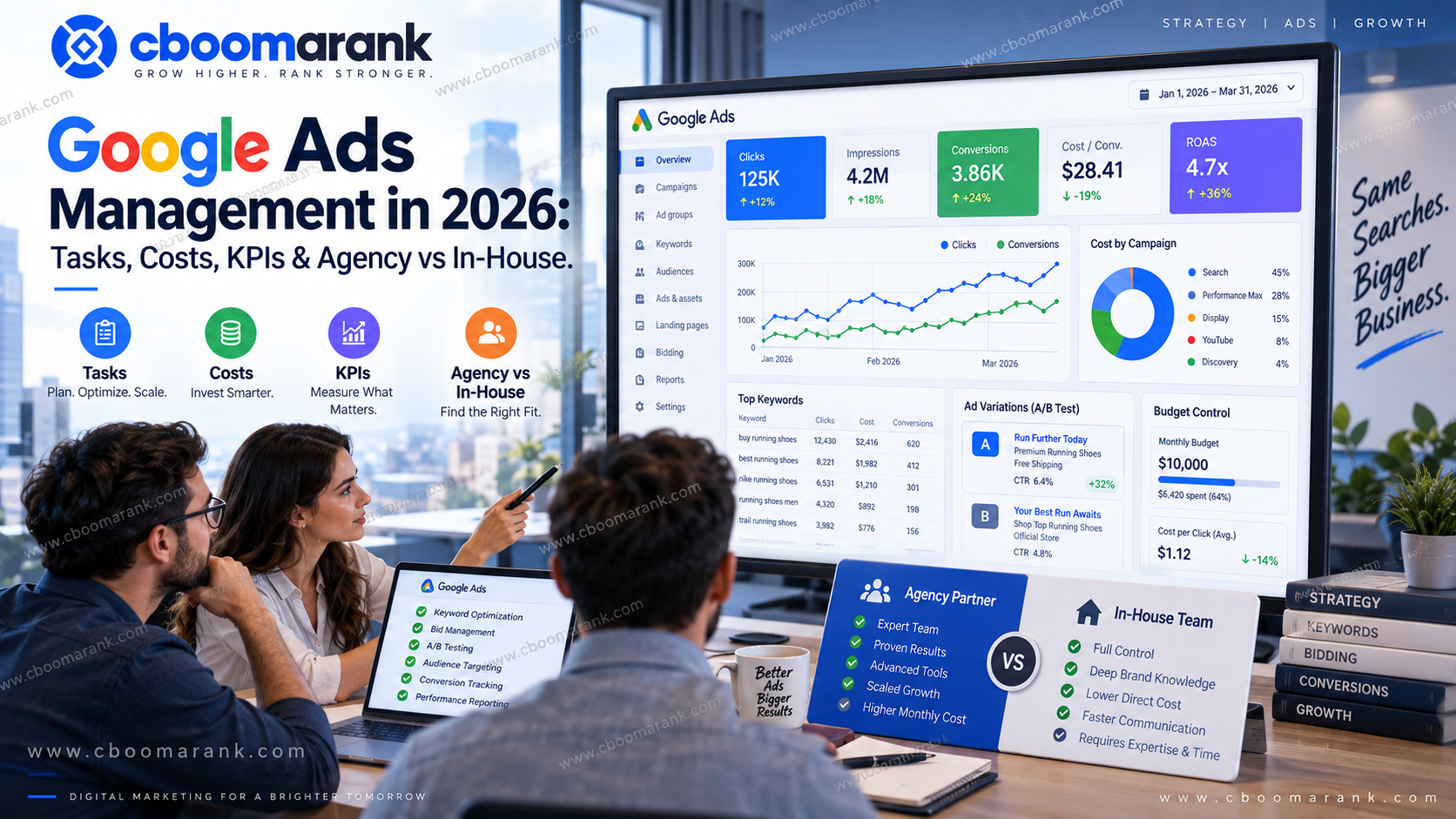
Google Ads management is the ongoing process of planning, launching, measuring and improving paid advertising campaigns so ad spend supports measurable business goals. Effective management goes far beyond switching campaigns on and off. It includes conversion measurement, budget control, bidding strategy, search-term analysis, ad testing, landing-page evaluation and regular performance reviews.
For businesses using Google Search, Shopping, Performance Max, Demand Gen and other campaign types, disciplined management helps connect advertising activity with leads, sales and revenue. However, the right approach depends on campaign objectives, available conversion data, budget size and whether the account is managed internally or by an external specialist.
Google Ads Management at a Glance
A well-managed Google Ads account combines accurate measurement, controlled spending, continuous optimization and business-focused reporting. Therefore, success should not be judged only by clicks or impressions. Campaign data should show whether advertising is producing valuable customer actions at an acceptable cost.
What Does Google Ads Management Include?
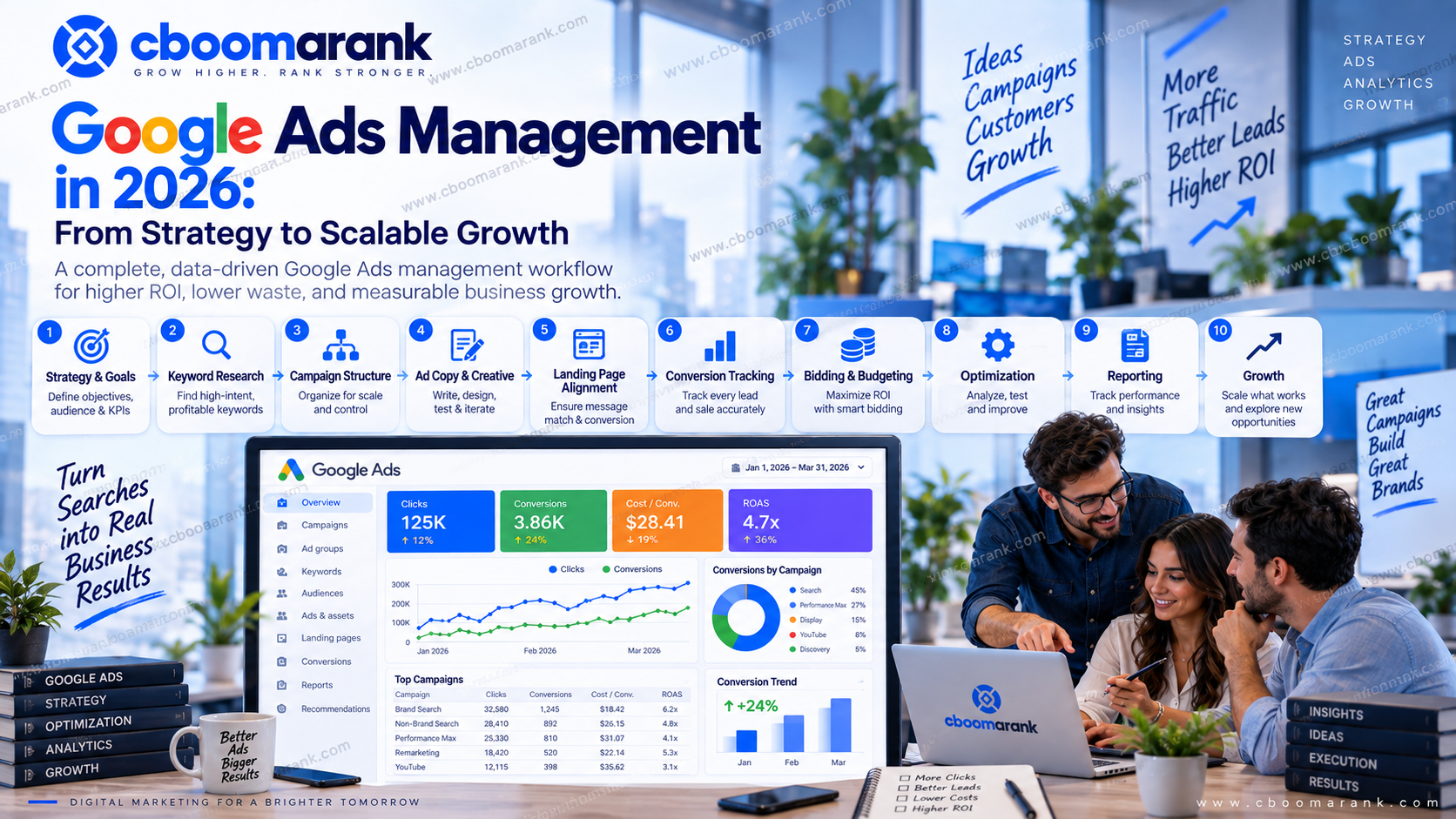
Google Ads management covers the work required before, during and after campaigns launch. First, the account needs clear conversion goals and reliable measurement. Next, campaign structure, targeting, bidding and budgets need to support those goals. Finally, performance should be reviewed regularly to identify wasted spend and new growth opportunities.
1. Conversion Measurement
Management starts by defining the actions that matter to the business. Depending on the campaign, these may include purchases, qualified leads, phone calls, registrations or other valuable customer actions.
2. Budget Management
Budgets should reflect commercial priorities rather than being distributed evenly by habit. Strong campaigns may justify additional investment, while inefficient areas need investigation before more money is committed.
3. Search and Audience Management
Managers review keywords, search terms, audience signals, locations and other targeting variables to reduce irrelevant traffic and identify profitable demand.
4. Ad and Landing-Page Optimization
Better ads are only part of the process. Landing pages should also match user intent, load reliably and make the next action clear to prospective customers.
Importantly, Google explains that conversion measurement helps advertisers understand which campaigns, ads and keywords drive valuable customer activity. As a result, reliable conversion data is one of the most important inputs into campaign management. See the Google Ads conversion measurement documentation.
Google Ads Management Tasks Before Launch
Campaign performance is heavily influenced by decisions made before the first click occurs. Therefore, managers should confirm the commercial objective, conversion setup, campaign structure, targeting and landing-page experience before significant spend begins.
Define the business objective
A campaign should have a specific job. For example, a retailer may prioritize revenue, while a service company may prioritize qualified leads. Without that distinction, reporting can become disconnected from actual business value.
Confirm conversion tracking
Before conversion-focused bidding is trusted, the underlying conversion actions should be checked carefully. Duplicate actions, incorrect values or low-quality goals can distort optimization decisions.
Choose campaign and targeting structure
Next, campaigns can be organized around products, services, locations or other meaningful commercial divisions. The structure should make budgets, reporting and future optimization easier rather than unnecessarily complex.
Establish the initial budget and bidding strategy
For example, Google Ads budgets control overall campaign spending, while bidding strategies determine how bids are handled according to the selected goal. Google currently supports automated strategies designed around goals such as conversions, conversion value, clicks and visibility. See Google’s automated bidding guidance and budget and bidding guidance.

Google Ads Management Tasks After Launch
Once campaigns begin collecting data, management shifts from setup to diagnosis and improvement. At this stage, managers should avoid making major decisions because of a single unusual day or metric. Instead, adjustments should be based on meaningful trends and enough data to support a decision.
Review search terms and traffic quality
Search-term reviews help reveal whether ads are appearing for queries that match the offer. Irrelevant searches may indicate a need for negative keywords, tighter targeting or changes to campaign structure.
For additional detail, read CBOOMARANK’s Negative Keywords in Google Ads guide.
Monitor conversion performance
Managers should compare spending with both the volume and quality of conversions generated. However, the correct primary KPI depends on the business model. Lead-generation accounts may emphasize cost per acquisition, while ecommerce campaigns often give greater weight to conversion value and ROAS.
Evaluate ad quality and relevance
Ad messaging, user intent and landing-page experience all deserve regular attention. Although diagnostic measures such as Quality Score should not become the sole management objective, they can help reveal areas that require investigation.
See How to Improve Google Ads Quality Score for a focused guide.
Assess budgets and bidding
Performance can change as competition, conversion rates, seasonality and business priorities change. Consequently, budgets and bidding targets should be reviewed rather than left unchanged indefinitely.
Review Google Ads recommendations critically
In addition, Google Ads provides an optimization score and recommendations covering areas such as bidding, budgets, ads, assets and targeting. Nevertheless, each recommendation should still be evaluated against the advertiser’s real commercial objective before it is applied. Google states that optimization score is based on account statistics, settings, campaign status and available recommendations. See Google’s optimization score documentation.
Google Ads Management KPIs That Matter
No single KPI explains every Google Ads account. Instead, managers should use a combination of metrics that connects traffic, spending and business outcomes.
| KPI | What It Shows | Why It Matters |
|---|---|---|
| Conversions | Completed valuable actions | Shows whether campaigns are generating the outcomes selected by the advertiser. |
| Conversion rate | Percentage of interactions that produce a conversion | Helps evaluate the effectiveness of traffic and landing pages. |
| CPA / Cost per conversion | Average advertising cost for each conversion | Helps assess whether lead or customer acquisition economics are sustainable. |
| Conversion value | Reported value assigned to conversions | Provides a stronger commercial view when different conversions have different values. |
| ROAS | Conversion value relative to advertising cost | Useful for value-focused campaigns where reliable conversion values are available. |
| CTR | Percentage of impressions that generate clicks | Can help indicate whether targeting and messaging attract attention, although clicks alone do not prove profitability. |
| CPC | Average cost paid per click | Helps explain traffic costs but should be evaluated alongside conversion performance. |
| Impression share | Eligible impressions that the campaign actually received | Can help identify visibility limitations associated with budget or Ad Rank. |
CPA vs ROAS in Google Ads Management
CPA and ROAS answer different questions. CPA focuses on how much a conversion costs, whereas ROAS compares reported conversion value with advertising cost. Therefore, the appropriate management target depends on whether conversions are broadly similar in value or vary substantially.
For example, a lead-generation campaign may emphasize CPA when each qualified inquiry has similar commercial value. By contrast, an ecommerce business selling products at very different prices may benefit from value-based measurement and ROAS.
For value-focused campaigns, Google’s Target ROAS bidding uses reported conversion values to optimize toward an advertiser’s return target. Moreover, Google notes that conversion values must be configured before Target ROAS can be used effectively. See the current Target ROAS documentation.
How Often Should Google Ads Campaigns Be Managed?
Similarly, management frequency should reflect account size, traffic volume, spending and business risk. A high-spend account may require frequent monitoring, while a smaller account may not generate enough new data to justify significant daily changes.
Importantly, frequent monitoring does not mean constant editing. Automated bidding systems need reliable conversion data and time to respond to changes. Therefore, managers should distinguish routine monitoring from strategic adjustments.
Daily monitoring
Check for major spending anomalies, broken tracking, rejected ads, unexpected traffic changes or other urgent issues.
Weekly management
Review search terms, conversion trends, budget allocation, campaign status and meaningful performance changes.
Monthly strategic review
Compare results with business goals, assess landing pages, evaluate campaign structure and determine whether budgets, targets or targeting should change.
Google Ads Management Costs
However, Google Ads management cost should be separated from advertising spend. The media budget pays for ad delivery, whereas a management fee covers work such as strategy, measurement, optimization, reporting and account administration.
Common pricing approaches include fixed monthly fees, percentage-of-spend fees, tiered plans, project pricing and hybrid arrangements. However, the cheapest management option is not necessarily the most efficient. Businesses should compare scope, reporting quality, measurement capability, account ownership and strategic involvement.
If your main question is about selecting a specialist rather than operating the campaigns themselves, read Google Ads Experts: Costs, Services and How to Choose in 2026. That article targets the provider-selection intent, while this guide focuses specifically on the operational Google Ads management process.
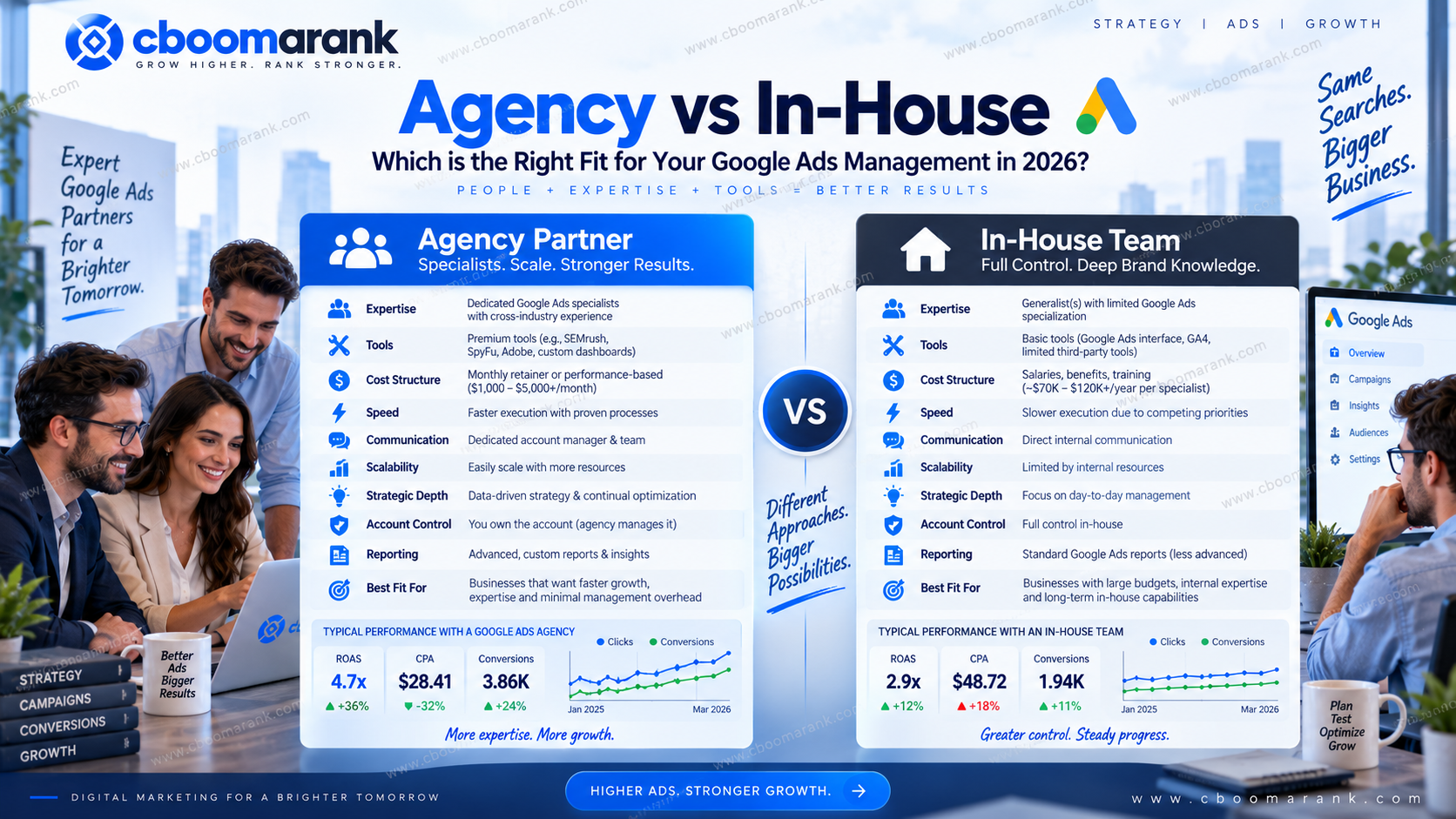
Google Ads Management: Agency vs In-House
| Consideration | In-House | Agency / External Manager |
|---|---|---|
| Business knowledge | Usually close to products, customers and internal priorities. | Requires onboarding but may bring experience from multiple accounts. |
| Availability | Can respond quickly when dedicated internal resources exist. | Depends on the provider’s service model and communication process. |
| Specialist expertise | Depends on the experience and training of internal staff. | May provide access to dedicated paid-media specialists. |
| Cost structure | Salary, training, software and internal overhead. | Management fee plus advertising spend. |
| Control | Direct internal control of campaigns and reporting. | Requires clear account ownership, permissions and reporting standards. |
| Scalability | Additional complexity may require more hiring or training. | Can be easier to scale when the provider has sufficient capacity. |
The decision should be based on capability rather than labels. A capable internal team can outperform a weak agency, while an experienced external manager may provide skills that would be expensive to build internally.
Google Ads Management Checklist
A practical management process should confirm that measurement, targeting, spending and business outcomes remain aligned. Use these areas as recurring checkpoints:
Measurement: verify conversion actions, values and tracking health.
Budget: compare spending with campaign priorities and actual results.
Search traffic: review search terms and negative-keyword opportunities.
Bidding: confirm that the bidding objective matches the selected conversion goal.
Ads: review messaging, assets, eligibility and relevance.
Landing pages: confirm message match, usability and conversion paths.
Reporting: compare CPA, ROAS, conversion volume and other KPIs with commercial targets.
Strategy: identify new campaigns, audiences, keywords or products worth testing.
Common Google Ads Management Mistakes
Optimizing for clicks instead of business outcomes
More traffic is not automatically better traffic. Therefore, management decisions should connect clicks with conversion quality, value and cost.
Changing campaigns too frequently
Constant adjustments can make performance trends difficult to interpret. Instead, managers should distinguish urgent problems from changes that require more data.
Ignoring conversion tracking quality
Automation cannot compensate for unreliable goals. If duplicate or low-quality conversions are treated as primary objectives, campaign optimization can move in the wrong direction.
Using the same strategy for every campaign
Campaigns may target different products, markets and stages of the customer journey. Consequently, budgets and success metrics should reflect those differences.
Giving an external provider ownership of the account
Advertisers should understand account ownership and access arrangements before outsourcing campaign management. This helps protect business continuity if the working relationship later changes.
How Google Ads Management Fits Into a Wider Search Strategy
More broadly, paid advertising should not operate in isolation from the rest of a business’s search and website strategy. Search queries can reveal demand patterns, landing-page behavior can expose usability problems, and competitor activity can identify new positioning opportunities.
For example, businesses starting with paid search can also read the Google Ads Beginner’s Guide for 2026. For channel-selection questions, see Google Ads vs Facebook Ads.
Connect Advertising Decisions With Better Search Data
CBOOMARANK helps businesses evaluate search visibility, keywords, competitors and website performance alongside wider digital-marketing decisions.
Frequently Asked Questions About Google Ads Management
What is Google Ads management?
Google Ads management is the ongoing process of setting up, monitoring and improving advertising campaigns so budgets, targeting, bidding, conversion measurement and reporting remain aligned with business goals.
What does a Google Ads manager do?
A manager may handle campaign setup, conversion tracking, search-term reviews, budgets, bidding, ads, landing-page analysis, reporting and ongoing optimization.
How much does Google Ads management cost?
There is no universal management fee. Providers may use fixed monthly pricing, percentage-of-spend pricing, tiered packages, project fees or hybrid models. Advertising spend is normally separate from the management charge.
Which KPIs matter most for Google Ads management?
The answer depends on the campaign objective. Common metrics include conversions, CPA, conversion value, ROAS, conversion rate, CPC and impression share.
Should Google Ads be managed in-house or by an agency?
Either approach can work. Important considerations include expertise, measurement quality, availability, cost, account ownership and the ability to connect campaign decisions with business goals.
Is Google Ads management the same as SEO?
No. Google Ads management focuses on paid advertising, while SEO focuses on organic search visibility. However, both channels can inform each other through keyword, landing-page and search-demand insights.
Final Thoughts on Google Ads Management in 2026
In summary, strong Google Ads management is less about making constant changes and more about making disciplined decisions from reliable data. Accounts should have clear conversion goals, controlled budgets, appropriate bidding, relevant traffic and reporting that connects advertising performance with business outcomes.
As campaigns mature, managers should continue testing opportunities while protecting measurement quality and account ownership. Ultimately, the strongest management process makes it clear where money is being spent, what results are being generated and what should happen next.
