

Introduction
Google Ads and Facebook Ads are two of the most powerful paid advertising platforms available to businesses in 2026. Both can drive leads, sales, traffic, brand awareness, app installs, and ecommerce revenue. But they work in very different ways.
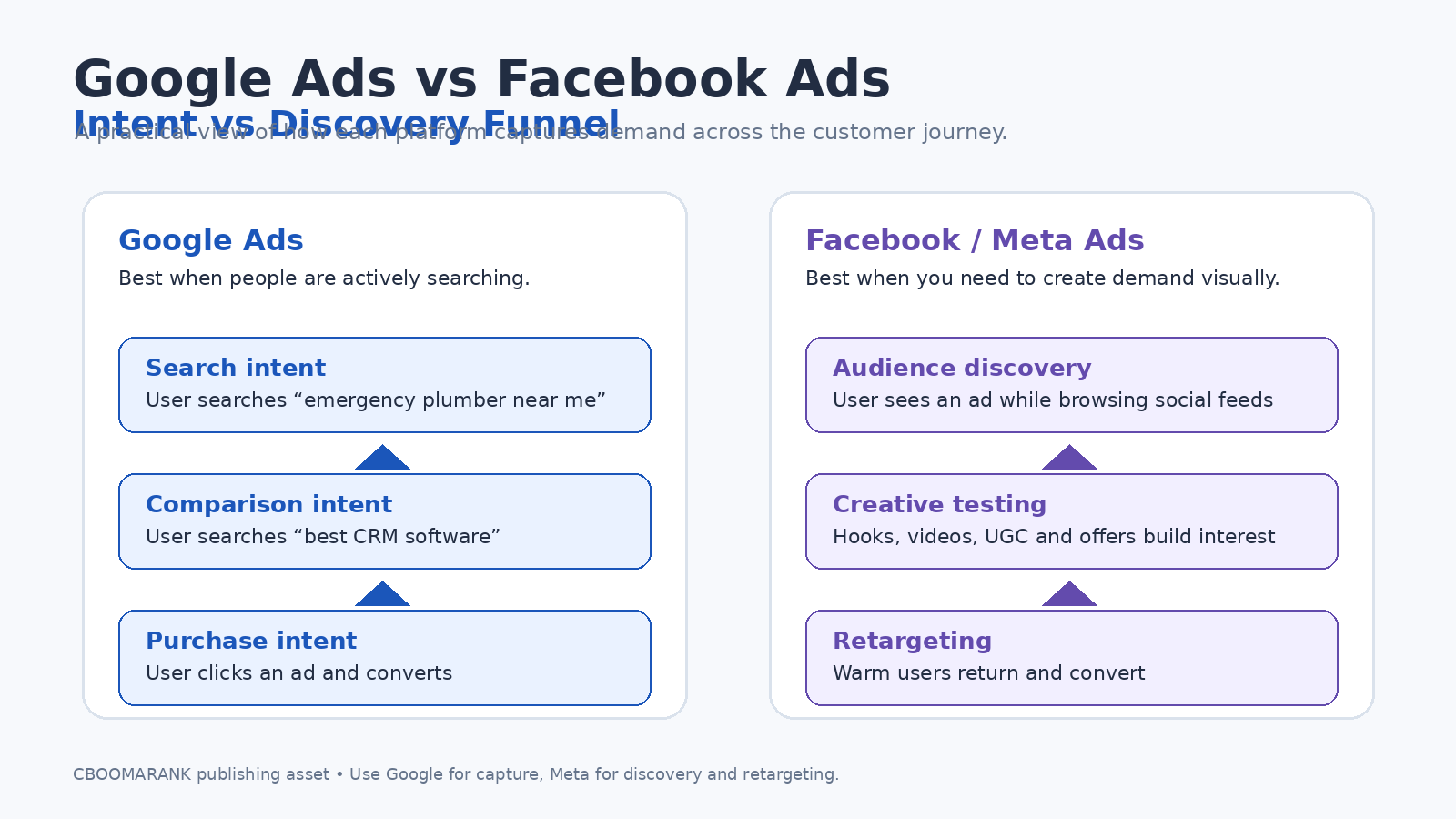
Google Ads is strongest when people already know what they want and are actively searching for it. Facebook Ads, now managed through Meta Ads, is strongest when you want to create demand, reach people by interest or behavior, show visual offers, and retarget users across social placements.
The real question is not simply which platform is better. The better question is: which platform fits your offer, budget, audience, funnel stage, creative capacity, and conversion tracking setup? In this guide, we compare Google Ads vs Facebook Ads across intent, cost, targeting, AI automation, creative requirements, ecommerce, local services, B2B, retargeting, and overall value.
For more PPC foundations, read CBOOMARANK’s PPC Advertising Ultimate Guide and Google Ads Beginner’s Guide.
Quick Answer: Which Is Better?
Google Ads is usually better for capturing high-intent demand. Facebook Ads is usually better for creating demand, testing visual offers, and retargeting warm audiences.
| Business Goal | Better Starting Choice | Why |
| Get leads from people already searching | Google Ads | Search campaigns can match users with active intent. |
| Promote a new brand or product | Facebook Ads | Visual social placements help create awareness and demand. |
| Sell ecommerce products with strong visuals | Facebook Ads or both | Meta is strong for discovery; Google Shopping/Performance Max can capture purchase intent. |
| Local emergency/service searches | Google Ads | High-intent queries such as “near me” and service keywords convert well. |
| Retarget website visitors | Both | Google remarketing and Meta retargeting can both recover warm prospects. |
| Scale with AI automation | Both | Google has Performance Max and AI Max; Meta has Advantage+ automation. |
What Is Google Ads?
Google Ads is Google’s paid advertising platform. It allows advertisers to show ads across Search, YouTube, Display, Discover, Gmail, Maps, Shopping surfaces, apps, and partner websites depending on campaign type and settings. Google Ads is commonly used for search-intent campaigns, ecommerce shopping ads, YouTube campaigns, remarketing, app promotion, local services, and full-funnel performance marketing.
Official Google references: Google Ads overview, where ads can appear, and Performance Max campaigns.
- Search Ads: Text ads shown when users search keywords on Google.
- Shopping Ads: Product ads for ecommerce stores with product feeds.
- YouTube Ads: Video ads for awareness, consideration, and remarketing.
- Display Ads: Visual ads across websites, apps, Gmail, and Google properties.
- Performance Max: A goal-based campaign type that can reach multiple Google channels from one campaign.
- AI Max for Search: Google’s AI-powered layer for Search campaigns that expands matching, creative, and URL routing controls.
What Are Facebook Ads / Meta Ads?
Facebook Ads are paid ads managed through Meta Ads Manager. They can appear across Facebook, Instagram, Messenger, WhatsApp, Threads, Reels, Stories, feeds, and Meta Audience Network depending on objective, placement availability, and campaign settings. Although many advertisers still say “Facebook Ads,” the platform now includes a wider Meta ecosystem.
Official Meta references: Meta Advantage+, Meta Advantage+ placements, Meta ad pricing and budgets, and Meta Conversions API.
- Facebook Feed, Reels, Stories and video placements.
- Instagram Feed, Stories, Reels and Explore placements.
- Messenger placements for conversations and lead generation.
- WhatsApp-related ad destinations for business messaging where available.
- Meta Audience Network placements beyond Meta-owned apps.
- Advantage+ campaign automation for creative, audience, bidding, and placement optimization.
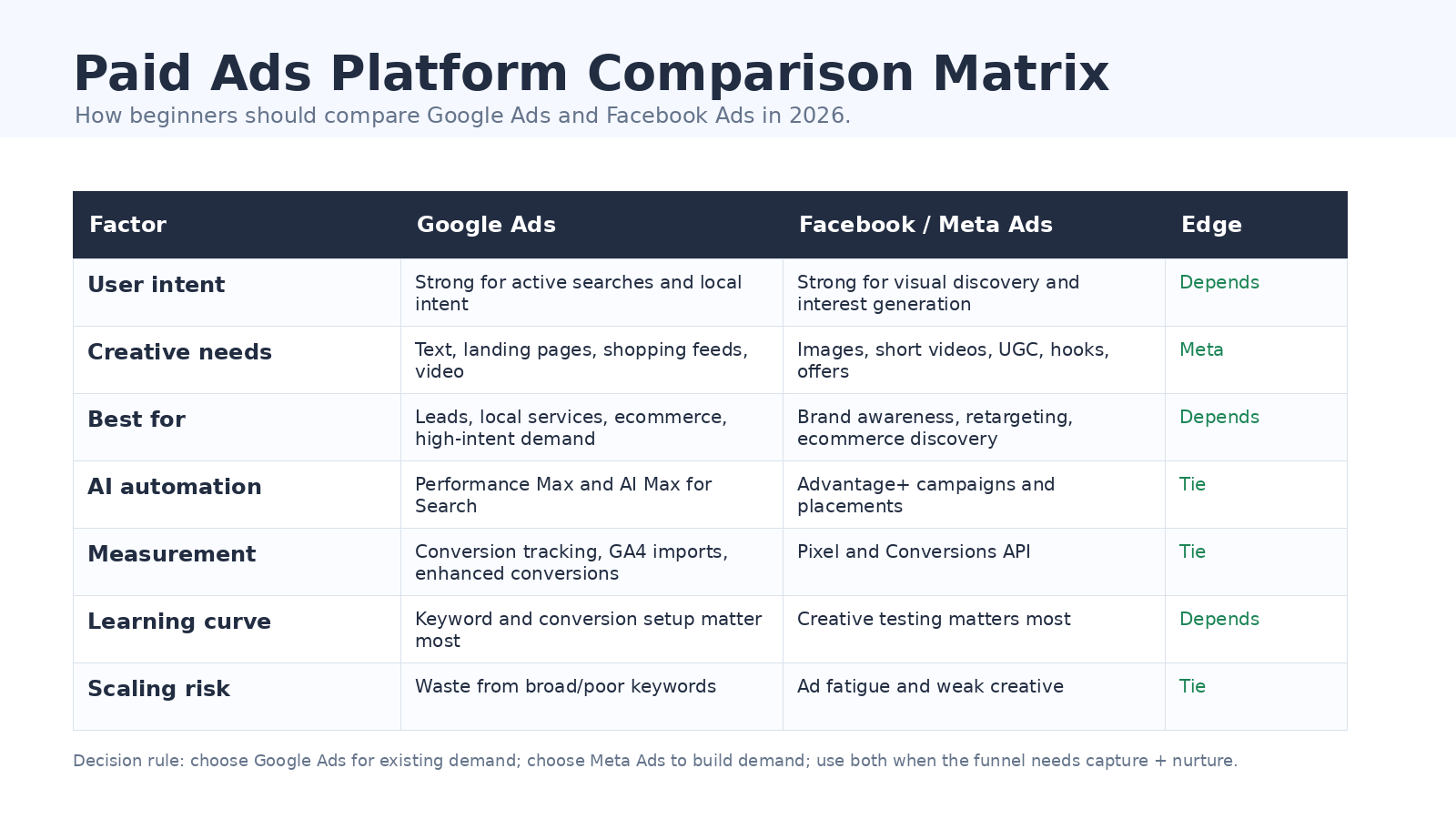
Supporting image 1: Paid ads platform comparison matrix.
ALT text: Comparison matrix showing Google Ads versus Facebook and Meta Ads across intent, creative needs, AI automation, measurement, and scaling risk.
Google Ads vs Facebook Ads: Main Differences
| Comparison Factor | Google Ads | Facebook / Meta Ads |
| Primary strength | Capturing existing demand from search intent. | Creating demand through social discovery and visual creative. |
| User mindset | Users often search with a problem, product, brand, or service in mind. | Users are usually browsing, watching, chatting, or scrolling. |
| Best ad formats | Search ads, Shopping ads, YouTube, Display, Performance Max. | Image ads, video ads, Reels, Stories, carousel ads, lead ads, Advantage+ Shopping. |
| Targeting style | Keywords, search intent, audience signals, product feeds, remarketing. | Interests, broad audiences, lookalikes, engagement, pixel events, Advantage+ automation. |
| Creative dependency | Landing page and keyword relevance are critical; creative varies by campaign type. | Creative quality is often the biggest performance driver. |
| Common weakness | Can become expensive when keywords are competitive or poorly matched. | Can suffer from ad fatigue and lower intent if the offer is weak. |
| Best beginner use | Search campaign for high-intent keywords with conversion tracking. | Simple lead, traffic, engagement, or sales campaign with several creative tests. |
1. Search Intent: Google Ads Usually Wins
Search intent is the biggest difference between the two platforms. With Google Ads, users often tell you what they want by typing a query. Someone searching “best accountant for small business” or “emergency roof repair near me” is much closer to action than someone casually scrolling Instagram. That makes Google Ads especially strong for urgent services, local businesses, legal services, finance, software comparisons, ecommerce product searches, and B2B queries. Facebook Ads can still generate leads, but it often requires more education, stronger creative, and a clear reason for users to stop scrolling.
2. Demand Creation: Facebook Ads Usually Wins
Facebook Ads is powerful when customers do not yet know they need your product. A new skincare brand, online course, coaching program, fashion line, app, or ecommerce product can use Meta placements to introduce an offer visually. Meta is also strong for storytelling. You can test hooks, lifestyle visuals, testimonials, product demonstrations, founder videos, UGC-style clips, and carousel ads. If your product looks good, solves a visible problem, or needs emotional persuasion, Facebook Ads may create demand faster than Google Search.
3. Targeting: Different Strengths
Google Ads targeting is strongest when built around intent signals: keywords, product feeds, search terms, location, remarketing lists, customer match, and audience signals. Facebook Ads targeting is strongest when built around audiences and behavioral signals: interests, engagement, lookalike audiences, broad targeting, website events, video viewers, page engagement, and purchase history. In 2026, both platforms rely heavily on machine learning, which means advertisers should provide clean conversion data, strong creative, accurate feeds, and clear campaign goals.
4. AI Automation: Both Platforms Are Now AI-Heavy
Google Ads has Performance Max, automated bidding, broad match, responsive search ads, AI Max for Search, asset generation support, and conversion-based optimization. Performance Max is designed to access multiple Google Ads channels from one goal-based campaign, while AI Max expands Search campaign automation. Meta Ads has Advantage+ automation, Advantage+ placements, Advantage+ Shopping, automated creative enhancements, dynamic creative testing, and AI-assisted audience delivery. The practical takeaway is simple: beginners should not fight automation. They should feed each platform with accurate tracking, high-quality creative, clear conversion goals, and enough testing budget.
5. Cost and Budget Control
Neither platform has a universal fixed cost because CPC, CPM, CPA, and ROAS depend on industry, audience, competition, quality, creative, landing pages, offer, and tracking. Google Ads budgets are usually set as average daily budgets at the campaign level, and Google’s system can optimize bids within that budget. Meta Ads supports daily and lifetime budgets, and advertisers can choose objectives that help Meta optimize delivery. For beginners, the safest approach is to start with a controlled test budget, track cost per lead or sale, and scale only when conversion quality is proven.
6. Creative Requirements
Google Search campaigns often need strong ad copy, tightly matched keywords, relevant landing pages, and conversion tracking. Meta Ads usually needs stronger visual creative because users are not actively searching. A weak image or video can kill Meta performance even if targeting is good. For Facebook and Instagram, plan several creative angles: problem/solution, testimonial, product demonstration, founder story, offer-led ad, comparison ad, and retargeting ad. For Google, plan keyword groups, negative keywords, landing pages, offer clarity, ad extensions, and conversion actions.
7. Ecommerce: Use Both When Possible
For ecommerce, the best answer is often both platforms. Meta Ads can introduce products through images, Reels, Stories, and creator-style content. Google Shopping, Search, and Performance Max can capture users who are actively looking for products. A smart ecommerce funnel uses Meta to create awareness and retarget product viewers, then uses Google to capture search demand and shopping intent. Strong product feeds, landing pages, reviews, shipping clarity, and accurate tracking matter on both platforms.
8. Local Businesses: Google Often Starts Stronger
Local service businesses usually benefit from Google Ads first because prospects often search when they need help. Examples include plumbers, dentists, lawyers, roofers, accountants, real estate agents, restaurants, clinics, and repair services. Facebook Ads can still help with local awareness, promotions, event advertising, testimonials, and retargeting, but Google captures urgent intent better. A local business can start with Google Search, then add Meta retargeting and community awareness campaigns after the website has enough visitors.
9. B2B and SaaS: Choose Based on Funnel Stage
For B2B and SaaS, Google Ads works well for comparison searches, problem-aware keywords, branded competitor terms where policy allows, and high-intent product categories. Facebook Ads works better for educational assets, webinars, reports, case studies, retargeting, and audience nurturing. Many B2B campaigns fail because they ask cold audiences to book a demo too soon. A better strategy is to use Meta for education and retargeting, then use Google Search to capture prospects who are actively comparing solutions.
10. Measurement and Tracking
Tracking is the foundation of paid advertising. Google Ads supports multiple conversion tracking methods, including website conversions and imported analytics conversions. Meta uses the Pixel and Conversions API to help measure events across the customer journey and reduce tracking gaps caused by browser limitations or ad blockers. Beginners should define conversions before launching: leads, calls, purchases, sign-ups, booked appointments, add-to-cart events, and qualified inquiries. Without tracking, both platforms become expensive guessing games.
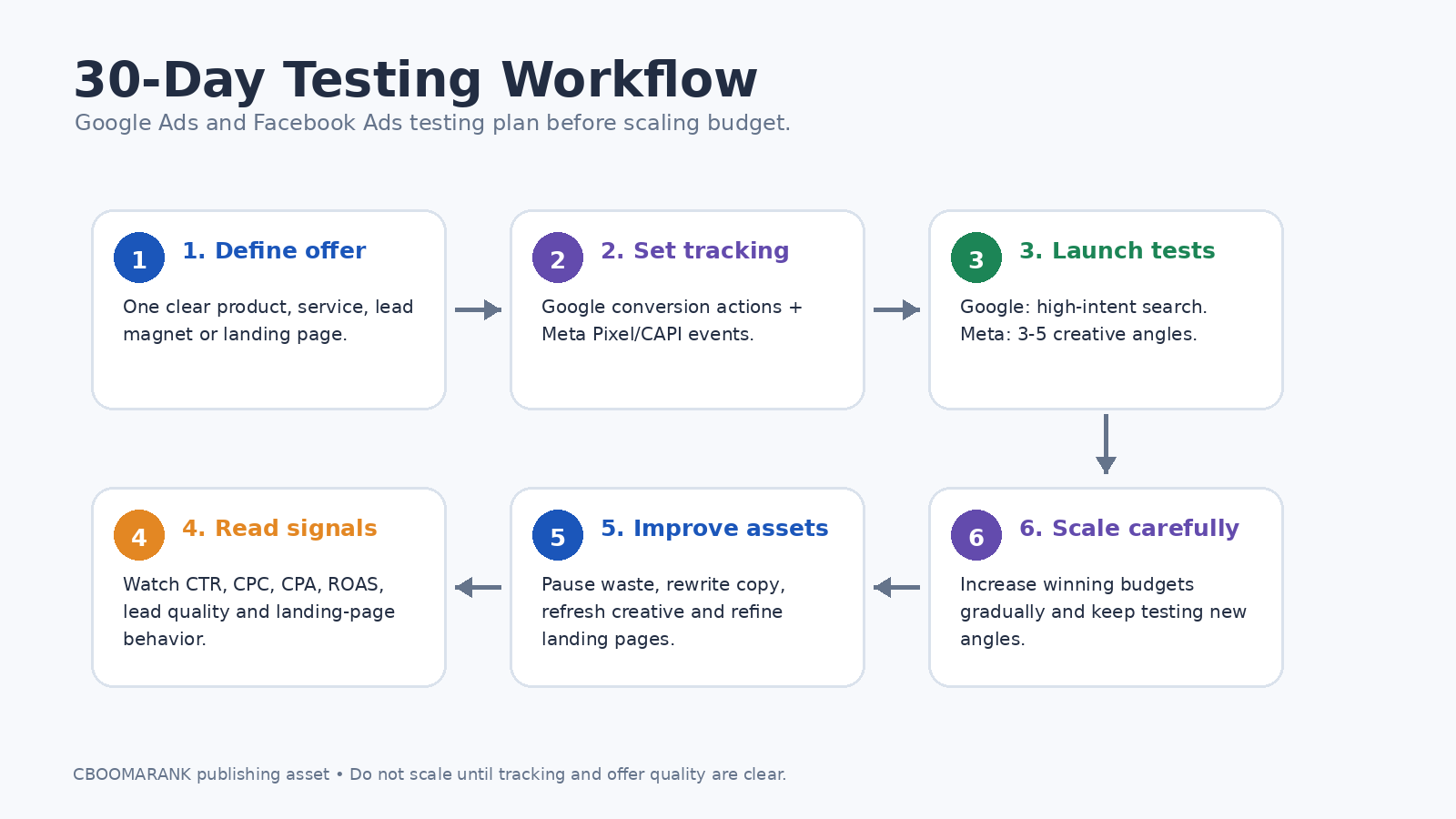
Supporting image 2: 30-day testing workflow for Google Ads and Facebook Ads.
ALT text: Thirty-day paid advertising testing workflow covering offer setup, conversion tracking, launch tests, performance signals, creative improvements, and budget scaling.
Best Platform by Business Type
| Business Type | Recommended Starting Platform | Reason |
| Local emergency services | Google Ads | Search intent is urgent and high value. |
| Ecommerce with strong visuals | Facebook Ads + Google Shopping/PMax | Meta builds demand; Google captures product intent. |
| B2B SaaS | Google Ads + Meta retargeting | Google captures comparison intent; Meta nurtures prospects. |
| New consumer brand | Facebook Ads | Visual storytelling and discovery are essential. |
| Professional services | Google Ads | Searchers often look for direct solutions and providers. |
| Online course or coaching | Facebook Ads | Education, testimonials, and lead magnets perform well visually. |
| Affiliate marketing | Google Ads carefully, Meta for content funnels | Policy compliance, landing pages, and disclosure are critical. |
| Agency lead generation | Google Ads + retargeting | High-intent leads plus follow-up ads usually work best. |
Pros and Cons of Google Ads
| Pros | Cons |
| Strong search intent and lead quality potential. | Competitive keywords can be expensive. |
| Excellent for local services, ecommerce, and B2B demand capture. | Requires keyword research, negative keywords, and landing page relevance. |
| Works across Search, YouTube, Display, Shopping, Gmail, Discover, and Maps. | Poor tracking or broad targeting can waste budget quickly. |
| Powerful AI automation through Performance Max, Smart Bidding, and AI Max. | Automation needs clean data and enough conversions to learn. |
| Easy to connect with GA4 and conversion tracking. | Beginners may struggle with campaign structure and match types. |
Pros and Cons of Facebook / Meta Ads
| Pros | Cons |
| Excellent visual discovery platform for new products and offers. | Users may have lower immediate purchase intent. |
| Strong creative testing through video, images, Reels, Stories, and carousels. | Creative fatigue can increase costs quickly. |
| Powerful retargeting and audience-building options. | Tracking can require Pixel and Conversions API setup. |
| Advantage+ automation can simplify targeting and placements. | Results depend heavily on offer quality and creative angles. |
| Useful for brand awareness, lead magnets, ecommerce, and social proof. | Lead quality can vary if forms or audiences are too broad. |
Recommended CBOOMARANK Internal Links
- PPC Advertising Ultimate Guide
- Google Ads Beginner’s Guide for 2026
- Best Free SEO Tools for Beginners
- SEO Pricing Guide
- Ubersuggest vs Semrush
- CBOOMARANK Blog
External Authoritative References
- Google Ads overview
- Google Ads Help: Where your ads can appear
- Google Ads Help: Performance Max campaigns
- Google AI Max for Search campaigns
- Google Ads Help: Budgets overview
- Google Ads Help: Conversion tracking
- Meta Advantage+ Ads
- Meta Advantage+ Placements
- Meta Ads pricing and budgets
- Meta Conversions API
- FTC Endorsement Guides for digital advertising compliance
Recommended 30-Day Beginner Testing Plan
- Choose one offer and one primary conversion goal before launching either platform.
- Set up tracking first: Google conversion actions for Google Ads, and Meta Pixel plus Conversions API where possible for Meta Ads.
- Launch Google Search campaigns around a small set of high-intent keywords with negative keywords and a relevant landing page.
- Launch Meta campaigns with at least three to five creative angles instead of one ad variation.
- Measure cost per qualified lead, purchase value, return on ad spend, click-through rate, landing-page conversion rate, and lead quality.
- Pause the worst-performing segments, improve landing pages, refresh creatives, and scale only when results are stable.
Best Value Recommendation
For most beginners, Google Ads is the best first choice when there is clear search demand and the business needs leads or sales quickly. Facebook Ads is the best first choice when the product requires visual storytelling, demand creation, or audience education. The best overall strategy for a serious business is often to use both: Google Ads to capture demand, and Facebook/Meta Ads to create demand, retarget visitors, test offers, and build brand familiarity.
Final Verdict
Google Ads is better for intent. Facebook Ads is better for discovery. Google Ads reaches people when they are actively looking for a solution; Facebook Ads reaches people while they are discovering content, products, and brands. In 2026, both platforms are heavily powered by AI automation, so success depends less on manual tricks and more on accurate conversion tracking, strong offers, clean landing pages, useful creative assets, and disciplined testing.
A local plumber, dentist, law firm, B2B software company, or urgent service provider should usually test Google Ads first. A fashion brand, online course, beauty product, fitness offer, ecommerce store, or creator-led product may see faster learning from Facebook Ads. Businesses with enough budget should not treat the platforms as enemies. They should treat them as different parts of the same paid marketing funnel.
FAQ
Is Google Ads better than Facebook Ads?
Google Ads is better when users are actively searching for your product or service. Facebook Ads is better when you need visual discovery, audience education, and retargeting.
Which platform is cheaper?
There is no universal cheaper option. Google may cost more per click in competitive niches, while Meta may require more creative testing. Compare cost per qualified lead or sale, not just CPC.
Which is better for small businesses?
Small local service businesses often start with Google Ads because of search intent. Visual ecommerce brands and awareness-focused businesses may start with Facebook Ads.
Which is better for ecommerce?
Many ecommerce brands should use both. Meta helps create demand with visuals and retargeting, while Google Shopping, Search, and Performance Max capture purchase intent.
Do I need a big budget to start?
No, but you need enough budget to gather useful data. Start controlled, track conversions, and avoid scaling until the offer and landing page show real results.
Can I run both platforms together?
Yes. A strong funnel often uses Meta for awareness and retargeting, then Google Ads for high-intent searches and product comparison intent.
Which platform has better AI features?
Both are advanced. Google has Performance Max, automated bidding, and AI Max for Search. Meta has Advantage+ automation for audiences, placements, and creative delivery.
What is the biggest beginner mistake?
The biggest mistake is launching ads without conversion tracking. The second biggest mistake is judging campaigns only by clicks instead of qualified leads, sales, or revenue.
Which platform is best for retargeting?
Both can work well for retargeting. Meta is strong for visual reminders across Facebook and Instagram, while Google remarketing can support Display, YouTube, and other Google inventory.
Should agencies recommend Google Ads or Facebook Ads first?
Agencies should recommend based on business goals. Use Google for active demand, Meta for demand creation, and both for full-funnel growth when budget allows.
