

A paid-search competitor can bid on the terms that produce your most valuable leads even when its website rarely appears in organic results. PPC competitor analysis separates paid auction overlap from organic search competition, then connects observable ad messaging to the landing-page experience. The aim is not to guess a rival’s private spending or copy its creative. It is to form better hypotheses about customer intent, differentiation, and the next test in your own account.
Key question: Understand competitor search ads, keyword intent, and landing-page opportunities without guessing private budgets. This guide concentrates on evidence-led research into paid-search visibility rather than another general competitor-tool list. The steps below are structured so website owners, agencies and marketers can reproduce the method without claiming access to private competitor data.
Use the CBOOMARANK six-topic research workbook to document observations, locations, keywords and decisions. For broader website research, visit CBOOMARANK or review CBOOMARANK plans.
PPC competitor analysis: Quick Answer and Scope
A paid-search competitor can bid on the terms that produce your most valuable leads even when its website rarely appears in organic results. PPC competitor analysis separates paid auction overlap from organic search competition, then connects observable ad messaging to the landing-page experience. The aim is not to guess a rival’s private spending or copy its creative. It is to form better hypotheses about customer intent, differentiation, and the next test in your own account.
How to Use This PPC intelligence workflow in Eight Steps
| Stage | Action | Evidence to keep |
|---|---|---|
| 1 | Define the market, offer, and campaign goal | Record the product line, conversion, geography, device, and buyer stage before reviewing a single ad. |
| 2 | Find competitor ads in Google’s Ads Transparency Center | Search the advertiser or domain in Google’s public Ads Transparency Center and select relevant regions and ad forma |
| 3 | Compare advertisers using Auction Insights | If you run eligible Google Ads campaigns, review the Auction Insights report for the corresponding keywords, ad gro |
| 4 | Research paid keyword intent without inventing bids | Classify relevant queries by buying stage: comparison, pricing, alternatives, near-me, demo, and problem-resolution |
| 5 | Decode promises and differentiators in ad copy | For each observed creative, extract the offer, intended customer, proof, friction reducer, and call to action. |
| 6 | Audit landing pages for message match and trust | Visit public landing pages and compare headline promise with the preceding ad. |
| 7 | Segment findings by mobile, location, and journey | A rival’s ads can differ by city, country, device, season, and query. |
| 8 | Convert research into three controlled PPC tests | Choose one headline test, one landing-page test, and one query or audience refinement. |

Step 1: Define the market, offer, and campaign goal — Ppc Competitor Analysis
Record the product line, conversion, geography, device, and buyer stage before reviewing a single ad. A competitor for “emergency IT support London” may be irrelevant to a team selling managed security services in Canada. Start with five to ten commercial queries and mark which ones correspond to existing landing pages; this prevents a visually impressive audit from chasing irrelevant auction participants.
Create a separate query cluster for agency buyers, in-house teams, and consumer audiences. For every cluster, document the intended conversion and where the promise is explained on your own website. If that connection cannot be described in one sentence, the query probably needs more research.
Step 2: Find competitor ads in Google’s Ads Transparency Center
Search the advertiser or domain in Google’s public Ads Transparency Center and select relevant regions and ad formats. Capture what is visibly disclosed: advertiser identity, creative format, message, and date. The library is evidence of advertising creative, not a direct export of another company’s keyword bids, ROAS, conversion rates, or complete target audience. Note these limitations in every stakeholder report.
A screenshot should include enough interface context to establish the region and collection date. If you cannot locate an advertiser, do not conclude it runs no ads; regional filtering, verification requirements and other collection limits can explain the absence.
What to document in your PPC competitor analysis notes
Include the chosen keyword or offer, the relevant URL, the measurement setting, the important finding and the next decision. If an observation is unavailable, use “not observed” rather than inventing a value.
Step 3: Compare advertisers using Auction Insights — Ppc Competitor Analysis
If you run eligible Google Ads campaigns, review the Auction Insights report for the corresponding keywords, ad groups, or campaigns. Examine overlap rate, impression share, position-above rate, and outranking share in context. Google’s definitions depend on auction eligibility; a higher impression share does not prove the rival pays more per click or generates a better business outcome. Save the time period, device segment, and targeting settings alongside any screenshot.
Treat your own Auction Insights account as the authoritative source for the auctions in which you participated. Segment high-value campaigns rather than averaging a broad account and ask whether impression share changed with bids, eligibility or budget limitations.
Step 4: Research paid keyword intent without inventing bids
Classify relevant queries by buying stage: comparison, pricing, alternatives, near-me, demo, and problem-resolution. Competitor-estimation products can suggest terms, but they are modeled observations, not a list of every keyword an advertiser targets. Validate likely themes through actual search results, your own paid-search query reports, and user questions. Keep branded searches separate from generic high-intent searches.
A spreadsheet column labeled “estimated keyword” should never be quietly relabeled “confirmed bid keyword.” Ask sales teams which phrases customers use before buying, then use your actual search-terms report to check intent where account permissions allow.
Step 5: Decode promises and differentiators in ad copy — Ppc Competitor Analysis
For each observed creative, extract the offer, intended customer, proof, friction reducer, and call to action. Look for repeated patterns, such as setup speed or industry-specific experience, but do not assume frequency equals effectiveness. A useful comparison records the exact observed wording, the collection date, and a hypothesis about what concern it addresses. Write alternative messages in your own brand voice rather than reproducing competitor text.
Build a claim map with columns for observed message, customer objection, proof on the landing page and an original alternative. Compare specificity rather than loudness: a measurable service promise is more useful than generic statements about being industry leading.
Step 6: Audit landing pages for message match and trust
Visit public landing pages and compare headline promise with the preceding ad. Inspect relevant proof, pricing clarity, CTA placement, accessibility, page speed, mobile form friction, and consent notices. A landing page can be persuasive yet fail because its form does not work or its claims lack evidence. Use a consistent scorecard and add screenshots or dated observations for every criticism.
For each public page, examine the first mobile viewport, navigation friction, form length, privacy information and confirmation state. Note broken fields or unclear pricing as observed issues, but avoid asserting private bounce or conversion numbers.
What to document in your PPC competitor analysis notes
Include the chosen keyword or offer, the relevant URL, the measurement setting, the important finding and the next decision. If an observation is unavailable, use “not observed” rather than inventing a value.
Step 7: Segment findings by mobile, location, and journey — Ppc Competitor Analysis
A rival’s ads can differ by city, country, device, season, and query. Repeat a small sample of important observations rather than assuming a single search represents the whole campaign. Avoid excessive automated scraping or attempts to bypass platform restrictions. Where data cannot be verified, label it an estimate and keep the source visible.
Create a row for each geography/device combination and keep observations separate. If results are inconsistent, reduce confidence in the claim instead of filling gaps with generalized competitor tactics. This keeps a regional campaign from inheriting assumptions based on another market.
Step 8: Convert research into three controlled PPC tests
Choose one headline test, one landing-page test, and one query or audience refinement. Specify the expected result, the primary conversion metric, budget boundaries, and a stopping rule. A test that raises CTR but lowers lead quality should not be celebrated as a win. Compare changes using sufficient data and seasonality context, not a one-day fluctuation.
Before starting a test, agree what improvement would justify keeping the change and which outcome would require a rollback. A disciplined PPC test also records the baseline lead qualification rate and guards against accidental overspending.
Ppc Competitor Analysis: Worked Business Example
Imagine a business selling SEO reporting software to agencies in the United Kingdom. One advertiser emphasizes free audits, another highlights client reporting, while a third offers an agency onboarding call. The research team records which claims appear, compares public landing pages for proof and CTA friction, and discovers that its own page buries the export demonstration below a long feature list. The next action is a controlled page-message test, not a claim that a competitor has a better conversion rate.
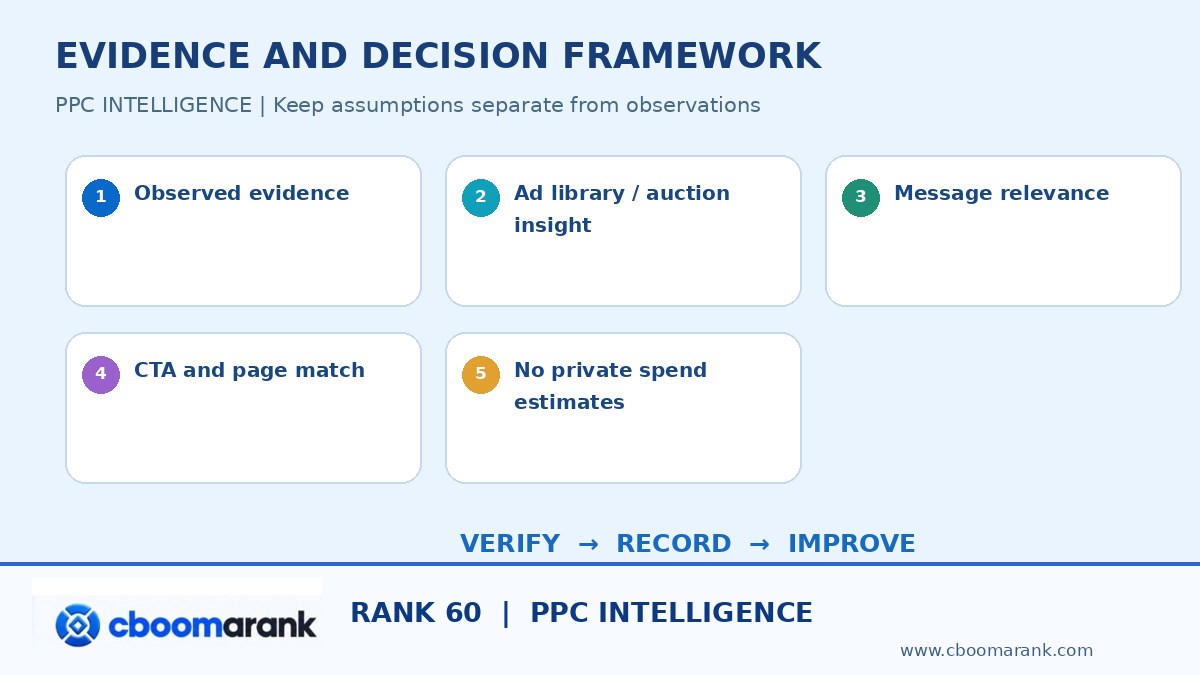
The figures or scenarios in this example are illustrative rather than measurements of a named company. A strong implementation distinguishes a recorded observation, a hypothesis, a controlled test and a verified result. That approach protects credibility when someone asks how the conclusion was reached.
Ppc Competitor Analysis: Quality-Control Checklist
Before reporting findings, check the following frequent interpretation errors. Correcting these mistakes is often more valuable than collecting another large export.
1. Auction overlap is not market share
A competitor appearing in your eligible auctions does not represent every advertiser in your total market. Add a note identifying the exact source and scope of the observation, then revisit it when comparing the next measurement period. This prevents the team from turning a narrow or uncertain signal into a larger unsupported claim.
2. Creative exposure is not proof of conversion
Ad libraries reveal creative samples; they do not reveal private conversions or profit. Add a note identifying the exact source and scope of the observation, then revisit it when comparing the next measurement period. This prevents the team from turning a narrow or uncertain signal into a larger unsupported claim.
3. Paid and organic are separate
An informational publisher may compete organically while a service vendor competes in paid auctions. Add a note identifying the exact source and scope of the observation, then revisit it when comparing the next measurement period. This prevents the team from turning a narrow or uncertain signal into a larger unsupported claim.
4. Country and device matter
Capture location, device, and timestamp for every observation. Add a note identifying the exact source and scope of the observation, then revisit it when comparing the next measurement period. This prevents the team from turning a narrow or uncertain signal into a larger unsupported claim.
5. Landing-page performance is private
Score visible usability and trust, not invented conversion rates. Add a note identifying the exact source and scope of the observation, then revisit it when comparing the next measurement period. This prevents the team from turning a narrow or uncertain signal into a larger unsupported claim.
6. Treat estimates as estimates
Third-party keyword and spend numbers should be labeled modeled data. Add a note identifying the exact source and scope of the observation, then revisit it when comparing the next measurement period. This prevents the team from turning a narrow or uncertain signal into a larger unsupported claim.
7. Respect brand and user privacy
Do not attempt unauthorized access to campaigns, accounts, or personal information. Add a note identifying the exact source and scope of the observation, then revisit it when comparing the next measurement period. This prevents the team from turning a narrow or uncertain signal into a larger unsupported claim.
How to Convert PPC competitor analysis Research into a 30-Day Plan
Days 1–7: Establish a reliable baseline
Choose the highest-value audience segment, define measurement settings, verify access to first-party reports where available, and collect a small number of repeatable observations. Keep a record of missing data and why those gaps matter. Do not change ten different factors before the baseline is clear.
Days 8–14: Prioritize opportunities and limitations
Separate improvements you control from external factors you merely observe. Score candidate actions by expected business impact, confidence in the evidence, effort and risk. Review indexing or tracking integrity before concluding that content or bids must change.
Days 15–21: Run narrow, measurable improvements
Implement the smallest meaningful change to content, targeting, measurement, location coverage or landing-page usability. Record what was changed and when. Preserve the previous state or a backup so the team can reverse mistakes and avoid confusing a technical issue with an SEO result.
Days 22–30: Measure, report and choose the next cycle
Compare consistent time periods and appropriate sample sizes. Explain improvements in clicks, useful visitors and qualified enquiries as well as rankings or visibility. Keep the report honest about uncertainty, and decide which process should repeat next month.
Frequently Asked Questions About Ppc Competitor Analysis
Can I see a competitor’s exact Google Ads keywords?
Not comprehensively from public tools. Use observed ads, your own Auction Insights, and third-party estimates as different forms of evidence.
How can I estimate what rivals spend?
You can model scenarios from estimated traffic and CPC, but private actual spend is not publicly verifiable in ordinary campaigns.
Does the Ads Transparency Center show performance?
It provides transparency into observed creative and advertisers, not an authenticated report of campaign conversions.
How many competitors should I examine?
Start with three to five advertisers competing for commercially important queries, then expand only when a new segment requires it.
Should I copy successful competitor ads?
No. Use observable patterns to form hypotheses, then write original truthful messages and test them with your own audience.
Where does PPC research connect to SEO?
Search intent, offer framing, customer questions, and landing-page relevance can inform organic content without equating paid auction metrics with organic rank.
What should I report to management?
Show an evidence table, screenshots and collection dates, three prioritised experiments, and uncertainty notes for anything inferred.
Useful Official References for PPC competitor analysis Research
- Google Ads Auction Insights guide — consult the source for current definitions and limitations.
- Google Ads Transparency Center — consult the source for current definitions and limitations.
- Meta Ad Library — consult the source for current definitions and limitations.
Explore related analysis: CBOOMARANK guide and related SEO research article. These resources provide broader context; this post is focused on the specific task above.
Final Verdict: Make PPC competitor analysis Useful
A reliable research process documents query intent, measurement settings, sample limitations, business relevance and the action that follows. Be skeptical of rankings or competitor estimates that lack a source. Repeat the process with the same definitions, compare it with qualified visitors and conversions, and prioritize work that improves the user experience rather than chasing a single score.
Find research workflows at www.cboomarank.com, compare CBOOMARANK pricing and access, and download the research workbook to build a repeatable action plan.
Editorial note (October 2026): Software features, search interfaces and plan entitlements change. Vendor statements are not third-party test results. CBOOMARANK publishes this guide and offers SEO research products; verify current features and availability before purchasing.
