

A rank tracker should do more than print a list of positions. For daily Google monitoring, you need consistent query configuration, dependable update frequency, usable historical trends, device and location controls, and reporting that explains why a change matters. This buyer guide provides a practical evaluation framework instead of pretending that every tool updates every keyword daily or that one platform is best for all businesses.
Key question: Compare daily-tracking capabilities, location controls, reporting and true costs without unverified benchmark claims. This guide concentrates on choosing platforms specifically for daily monitoring, not repeating a generic all-in-one seo software ranking. The steps below are structured so website owners, agencies and marketers can reproduce the method without claiming access to private competitor data.
Use the CBOOMARANK six-topic research workbook to document observations, locations, keywords and decisions. For broader website research, visit CBOOMARANK or review CBOOMARANK plans.
rank tracker: Quick Answer and Scope
A rank tracker should do more than print a list of positions. For daily Google monitoring, you need consistent query configuration, dependable update frequency, usable historical trends, device and location controls, and reporting that explains why a change matters. This buyer guide provides a practical evaluation framework instead of pretending that every tool updates every keyword daily or that one platform is best for all businesses.
How to Use This Rank-tracker buyer guide in Eight Steps
| Stage | Action | Evidence to keep |
|---|---|---|
| 1 | Define the monitoring requirement before shopping | Count the keywords, target domains, regions, cities, devices, projects and reporting stakeholders. |
| 2 | Compare Semrush Position Tracking for monitoring workflows | Semrush provides a Position Tracking workflow with location, device and competitor perspectives. |
| 3 | Evaluate SE Ranking for agency-scale workflows | SE Ranking is commonly evaluated by agencies for keyword tracking, competitive visibility and reporting. |
| 4 | Check Ahrefs Rank Tracker update frequency carefully | Ahrefs has rank-tracking functionality, competitor comparisons, and location-aware keyword monitoring, but its help |
| 5 | Consider specialist trackers and lightweight alternatives | Tools focused primarily on SERP history, local maps, or agency reporting may outperform broad suites for specialize |
| 6 | Test with one consistent evaluation set | Use the same twenty meaningful queries, two devices, two countries or cities, and ten business days where possible. |
| 7 | Review the true cost of keyword and location credits | One keyword monitored in two devices and ten locations may consume substantially more tracking capacity than one ke |
| 8 | Select based on actionable reports, not rank vanity | An executive report should link changes in monitored positions to search impressions, organic clicks, landing pages |
Step 1: Define the monitoring requirement before shopping — Rank Tracker
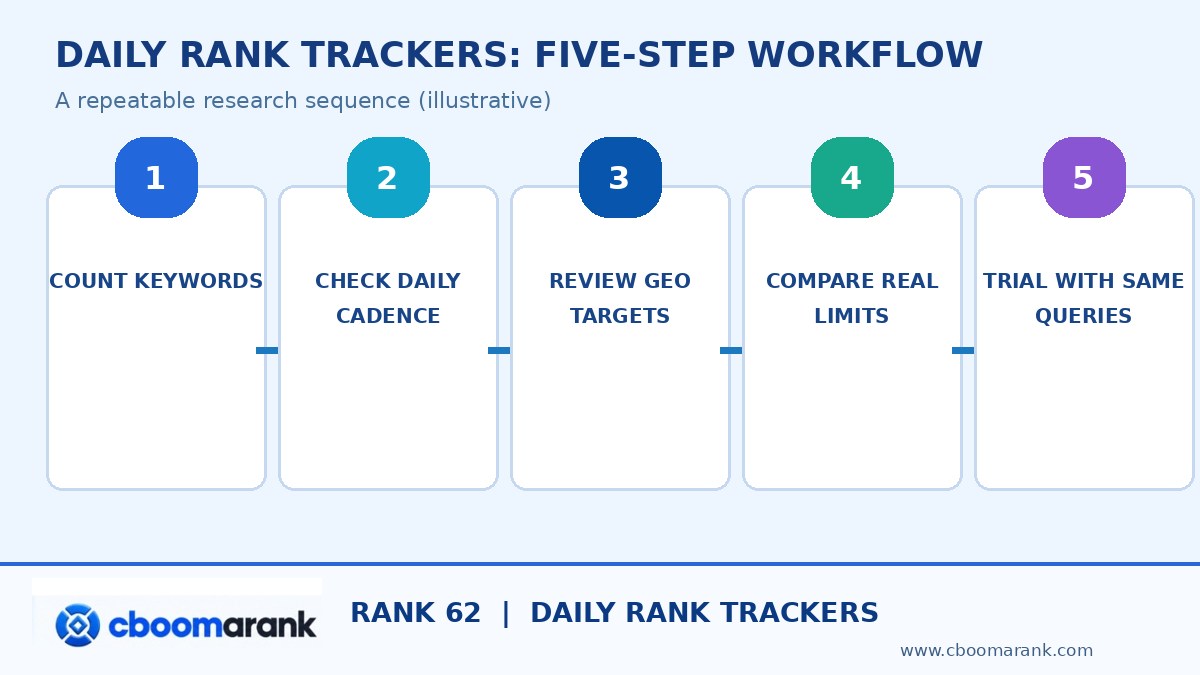
Count the keywords, target domains, regions, cities, devices, projects and reporting stakeholders. Daily tracking of 100 terms in one country differs sharply from 20,000 terms across 40 cities and mobile/desktop. List whether you need Google organic web positions, maps, local packs, AI-search visibility, or competitor URLs; those data products are not interchangeable.
Make the inventory realistic. A project with ten tracked locations and two devices could have much more consumption than a project that only checks one national desktop setting; vendors define accounting differently.
Step 2: Compare Semrush Position Tracking for monitoring workflows
Semrush provides a Position Tracking workflow with location, device and competitor perspectives. Evaluate its actual plan limits, target granularity, update cadence and report exports for your project. The fact that a larger SEO suite contains rank tracking can be valuable if the same team also needs content, keyword and technical audit workflows; it can also be unnecessary cost for a very narrow monitoring brief.
Use the vendor trial to verify how the selected country and device are configured and whether keyword tags survive export. Check whether daily refreshes apply to the entry-tier subscription you would actually buy.
What to document in your rank tracker notes
Include the chosen keyword or offer, the relevant URL, the measurement setting, the important finding and the next decision. If an observation is unavailable, use “not observed” rather than inventing a value.
Step 3: Evaluate SE Ranking for agency-scale workflows — Rank Tracker
SE Ranking is commonly evaluated by agencies for keyword tracking, competitive visibility and reporting. Compare how many projects and daily tracked terms the specific plan supports, and whether local targets or user seats increase the bill. Ask for a trial configured with your own actual phrases and markets, then compare export usability and alert quality, not just a published feature checklist.
Request a sample multi-client reporting workflow, including permissions, branding controls and history retention. A feature that exists in a premium tier should not count as present for a smaller team on a different plan.
Step 4: Check Ahrefs Rank Tracker update frequency carefully
Ahrefs has rank-tracking functionality, competitor comparisons, and location-aware keyword monitoring, but its help center states weekly updates are the default on subscription plans. If daily updates are mandatory, do not assume the regular workflow meets that requirement. Verify any add-on or contractual option and use the official current terms before selecting a tool.
Ask whether the paid plan supports your required frequency before judging visual dashboard quality. A weekly default can be perfectly valid for strategy but is not equivalent to guaranteed daily monitoring.
Step 5: Consider specialist trackers and lightweight alternatives — Rank Tracker
Tools focused primarily on SERP history, local maps, or agency reporting may outperform broad suites for specialized needs. Examples to evaluate include AccuRanker, Nightwatch, Wincher and local-specific grid products, but confirm live plan limits before making claims about each vendor. Maintain an option for Search Console baseline reporting where daily paid tracking is not justified.
For specialist tools, check the meaning of a local result and how location grids are charged. A platform optimized for map packs should not be treated as a replacement for desktop organic web ranking by default.
Step 6: Test with one consistent evaluation set
Use the same twenty meaningful queries, two devices, two countries or cities, and ten business days where possible. Record whether each system captures the same intended URLs, distinguishes SERP features and makes export dates clear. A mismatch is not automatically a defect: inspect geo/device defaults and whether position is a snapshot or an average.
During a trial, log missing results as well as matching results. Request provider documentation before declaring one platform more accurate on a small comparison sample without knowing the reference SERP conditions.
What to document in your rank tracker notes
Include the chosen keyword or offer, the relevant URL, the measurement setting, the important finding and the next decision. If an observation is unavailable, use “not observed” rather than inventing a value.
Step 7: Review the true cost of keyword and location credits — Rank Tracker
One keyword monitored in two devices and ten locations may consume substantially more tracking capacity than one keyword in one location, depending on the vendor. Ask exactly how projects, locations, devices, schedules, API calls, users, and historical retention are billed. Build a small calculation sheet before purchasing.
Use the workbook to multiply proposed keywords by required device and location combinations only where the vendor bills that way. Separate optional seats, API access and additional reports from the base subscription.
Step 8: Select based on actionable reports, not rank vanity
An executive report should link changes in monitored positions to search impressions, organic clicks, landing pages and qualified lead flow. Assess whether the tool provides reliable exports, tagging and alerts and whether your team will actually respond to them. A cheaper weekly monitor can be better than expensive daily data nobody uses.
Run the final tool shortlist past the person who will own the workflow. A perfect feature score is worthless if the team cannot retrieve its export, understand its alerts or connect the reported trend to a business decision.
Rank Tracker: Worked Business Example
An agency tracks 300 keywords for five clients across desktop and mobile in London and Toronto. Before choosing a vendor, the agency calculates how the provider counts unique keyword-location-device combinations, requests a sample export for clients, and compares ten days of consistent results. If the agency needs only weekly strategic monitoring, a default weekly tracker can be adequate; for daily paid-search landing-page coordination, daily snapshots may be worth paying for.
The figures or scenarios in this example are illustrative rather than measurements of a named company. A strong implementation distinguishes a recorded observation, a hypothesis, a controlled test and a verified result. That approach protects credibility when someone asks how the conclusion was reached.
Rank Tracker: Quality-Control Checklist
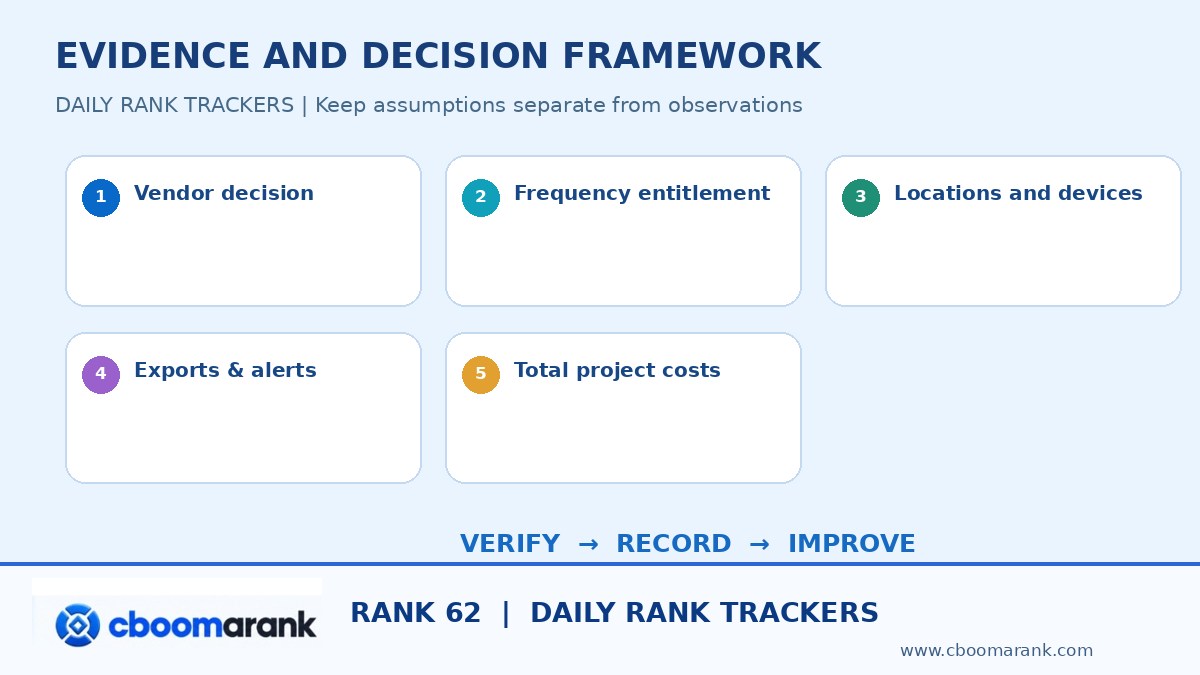
Before reporting findings, check the following frequent interpretation errors. Correcting these mistakes is often more valuable than collecting another large export.
1. Daily is a contractual requirement
Check actual update frequency on the selected tier. Add a note identifying the exact source and scope of the observation, then revisit it when comparing the next measurement period. This prevents the team from turning a narrow or uncertain signal into a larger unsupported claim.
2. Targets multiply usage
Confirm how locations and devices count against limits. Add a note identifying the exact source and scope of the observation, then revisit it when comparing the next measurement period. This prevents the team from turning a narrow or uncertain signal into a larger unsupported claim.
3. Averages differ from snapshots
Do not expect tracker snapshots to equal Search Console aggregate positions. Add a note identifying the exact source and scope of the observation, then revisit it when comparing the next measurement period. This prevents the team from turning a narrow or uncertain signal into a larger unsupported claim.
4. Local grids are specialist products
Google Maps prominence and blue-link rankings need distinct handling. Add a note identifying the exact source and scope of the observation, then revisit it when comparing the next measurement period. This prevents the team from turning a narrow or uncertain signal into a larger unsupported claim.
5. SERP feature detection varies
Check whether AI modules, local packs, video and featured snippets are recorded. Add a note identifying the exact source and scope of the observation, then revisit it when comparing the next measurement period. This prevents the team from turning a narrow or uncertain signal into a larger unsupported claim.
6. Reporting quality is measurable
Trial with your own keywords and real recipients. Add a note identifying the exact source and scope of the observation, then revisit it when comparing the next measurement period. This prevents the team from turning a narrow or uncertain signal into a larger unsupported claim.
7. Product affiliation should be disclosed
A publisher connected to an SEO platform should be transparent about that relationship. Add a note identifying the exact source and scope of the observation, then revisit it when comparing the next measurement period. This prevents the team from turning a narrow or uncertain signal into a larger unsupported claim.
How to Convert rank tracker Research into a 30-Day Plan
Days 1–7: Establish a reliable baseline
Choose the highest-value audience segment, define measurement settings, verify access to first-party reports where available, and collect a small number of repeatable observations. Keep a record of missing data and why those gaps matter. Do not change ten different factors before the baseline is clear.
Days 8–14: Prioritize opportunities and limitations
Separate improvements you control from external factors you merely observe. Score candidate actions by expected business impact, confidence in the evidence, effort and risk. Review indexing or tracking integrity before concluding that content or bids must change.
Days 15–21: Run narrow, measurable improvements
Implement the smallest meaningful change to content, targeting, measurement, location coverage or landing-page usability. Record what was changed and when. Preserve the previous state or a backup so the team can reverse mistakes and avoid confusing a technical issue with an SEO result.
Days 22–30: Measure, report and choose the next cycle
Compare consistent time periods and appropriate sample sizes. Explain improvements in clicks, useful visitors and qualified enquiries as well as rankings or visibility. Keep the report honest about uncertainty, and decide which process should repeat next month.
Frequently Asked Questions About Rank Tracker
Which rank tracker is best for daily Google monitoring?
The best fit depends on update frequency, location coverage, device counts, reporting needs and your paid plan. Test candidates with a fixed evaluation set.
Does Ahrefs update tracked keywords daily by default?
Its published help center describes weekly updates as the default; verify current options before purchasing.
Can I use Google Search Console instead of a paid tracker?
Yes for first-party query, page, country and device performance; it does not replicate a controlled SERP snapshot for arbitrary competitors and local grids.
Can I monitor competitors in the same project?
Many trackers offer competitor views, but the supported limits and interpretation vary by plan.
Should I track hundreds of low-value keywords?
Prioritize terms tied to real search demand, relevant offers and measurable business outcomes.
Are daily rank changes always important?
No. Treat small one-day movements as potential noise and look for sustained trends and correlated traffic changes.
Can a rank tracker guarantee first-page placement?
No legitimate measurement tool can guarantee organic search rankings.
Useful Official References for rank tracker Research
- Google Search Console performance guide — consult the source for current definitions and limitations.
- Ahrefs update-frequency policy — consult the source for current definitions and limitations.
- Google explanation of search position — consult the source for current definitions and limitations.
Explore related analysis: CBOOMARANK guide and related SEO research article. These resources provide broader context; this post is focused on the specific task above.
Final Verdict: Make rank tracker Useful
A reliable research process documents query intent, measurement settings, sample limitations, business relevance and the action that follows. Be skeptical of rankings or competitor estimates that lack a source. Repeat the process with the same definitions, compare it with qualified visitors and conversions, and prioritize work that improves the user experience rather than chasing a single score.
Find research workflows at www.cboomarank.com, compare CBOOMARANK pricing and access, and download the research workbook to build a repeatable action plan.
Editorial note (October 2026): Software features, search interfaces and plan entitlements change. Vendor statements are not third-party test results. CBOOMARANK publishes this guide and offers SEO research products; verify current features and availability before purchasing.
