

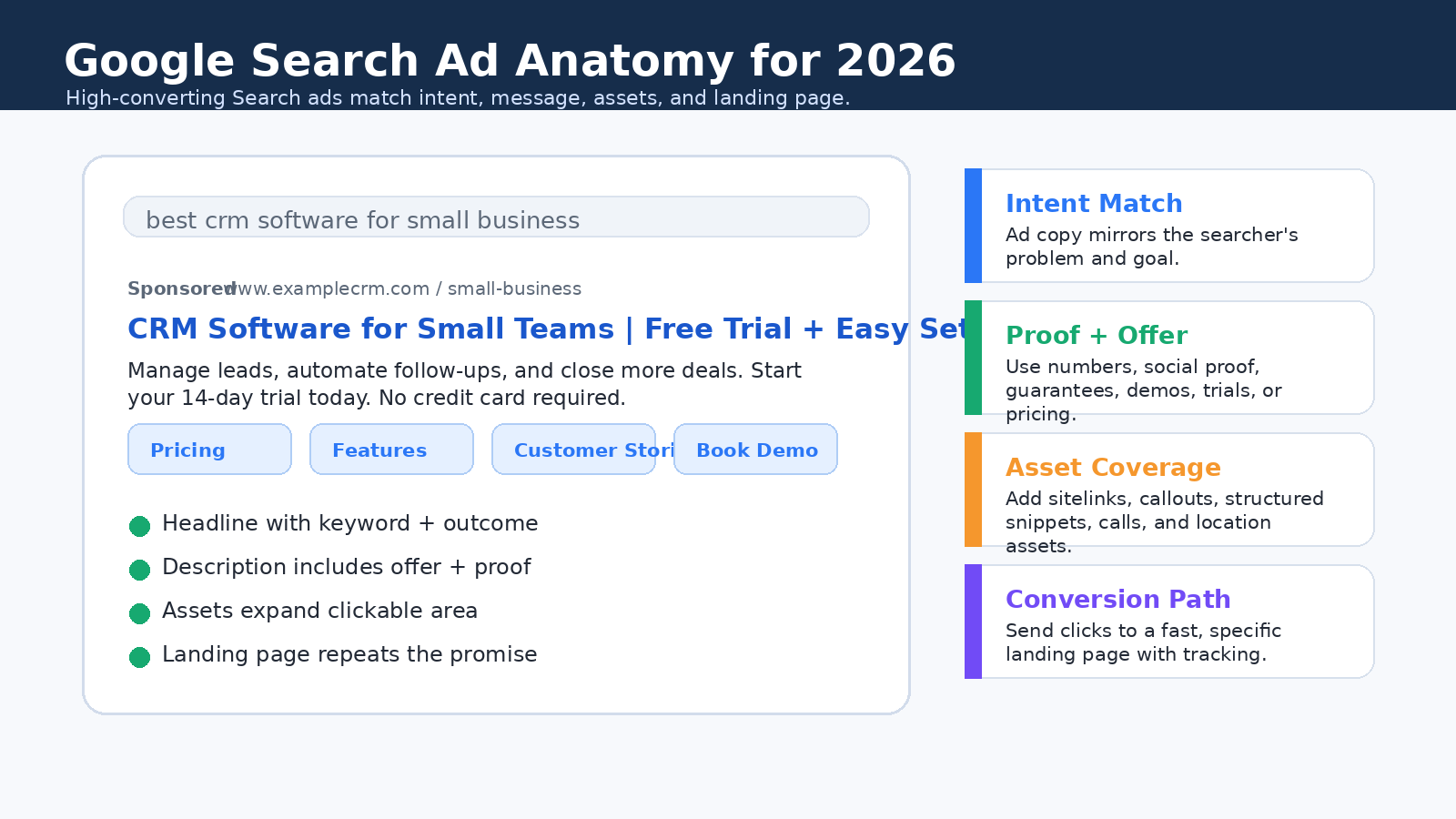
Introduction
Google Search ads work because they appear when people are actively searching for a solution. Unlike social ads, where you often interrupt someone browsing a feed, Search ads respond to existing intent. That is why the difference between an average Search ad and a high-converting Search ad usually comes down to message match: the right keyword, the right promise, the right landing page, and the right conversion action.
In 2026, high-performing Search campaigns are not built by writing one clever headline and hoping it works. Google Ads now relies heavily on responsive search ads, automated bidding, broad match signals, conversion data, assets, and AI-powered features such as AI Max for Search campaigns. To win, advertisers need to combine strong human strategy with clean campaign structure and reliable measurement.
This guide explains how to create Google Search ads that attract the right clicks, reduce wasted spend, and turn more visitors into leads or customers. It covers keyword intent, responsive ad copy, calls to action, ad assets, landing page alignment, Quality Score, conversion tracking, AI features, and weekly optimization.
Suggested internal CBOOMARANK links: Google Ads Beginner’s Guide for 2026 | PPC Advertising Ultimate Guide | Google Ads vs Facebook Ads | Best AI Marketing Tools in 2026 | CBOOMARANK Blog |
What Makes a Google Search Ad High-Converting?
A high-converting Search ad does not simply get clicks. It attracts qualified searchers who are likely to take the next business action: call, submit a form, book a demo, purchase, request a quote, sign up, or visit a store.
- It matches the searcher’s intent instead of chasing broad traffic.
- It makes the offer clear in the first headline or description.
- It uses proof, urgency, pricing, guarantees, or benefits to reduce doubt.
- It sends users to a landing page that repeats the same promise.
- It uses conversion tracking so Google can optimize toward real results.
- It is reviewed and improved based on search terms, assets, CTR, CPA, and conversion quality.
The High-Converting Search Ad Formula
| Formula Element | Question to Answer |
| Intent | What problem or goal is the searcher expressing? |
| Offer | What specific solution, product, service, trial, price, or benefit are you promising? |
| Proof | Why should the searcher trust you instead of a competitor? |
| Action | What should the searcher do next? |
| Page Match | Does the landing page confirm the same message immediately? |
| Measurement | Can you track the action that creates business value? |
Step 1: Start With Search Intent, Not Just Keywords
Many advertisers build Search campaigns by collecting keywords first. A better approach is to understand the intent behind those keywords. Someone searching “CRM pricing” is much closer to a purchase decision than someone searching “what is CRM.” Someone searching “emergency plumber near me” has a different urgency level from someone searching “how to fix a slow drain.”
Google Keyword Planner can help advertisers research keyword ideas and organize keyword lists for Search campaigns. Use it to discover keyword themes, but do not rely only on volume. High-converting ads usually come from keywords with clear commercial or action intent.
| Intent Type | Example Keyword | Best Ad Angle |
| Problem aware | why is my website traffic dropping | Offer diagnosis, audit, or expert guide |
| Solution aware | best PPC agency for ecommerce | Compare benefits, proof, case studies |
| Brand aware | CBOOMARANK SEO services | Protect brand demand and send to a relevant page |
| Local intent | Google Ads agency near me | Use location, call assets, reviews, and service area |
| Purchase intent | buy CRM software | Lead with pricing, demo, free trial, or guarantee |
Step 2: Build Tight Ad Groups Around One Theme
A common beginner mistake is putting too many unrelated keywords into one ad group. This makes it difficult to write specific ad copy and match users to the right landing page. For Search campaigns, one ad group should represent one intent theme, one promise, and one landing page direction.
- Keep ad groups focused around closely related search intent.
- Separate brand, competitor, service, local, and product-category keywords.
- Use negative keywords to block irrelevant searches.
- Avoid sending every searcher to the homepage unless the homepage is the best answer.
- Create landing pages for important services, offers, and locations.
Google Ads keyword matching options include broad, phrase, and exact match. Exact match gives advertisers the most steering over who views an ad but reaches fewer searches than phrase and broad match. The right choice depends on budget, conversion data, account maturity, and how controlled the campaign needs to be.
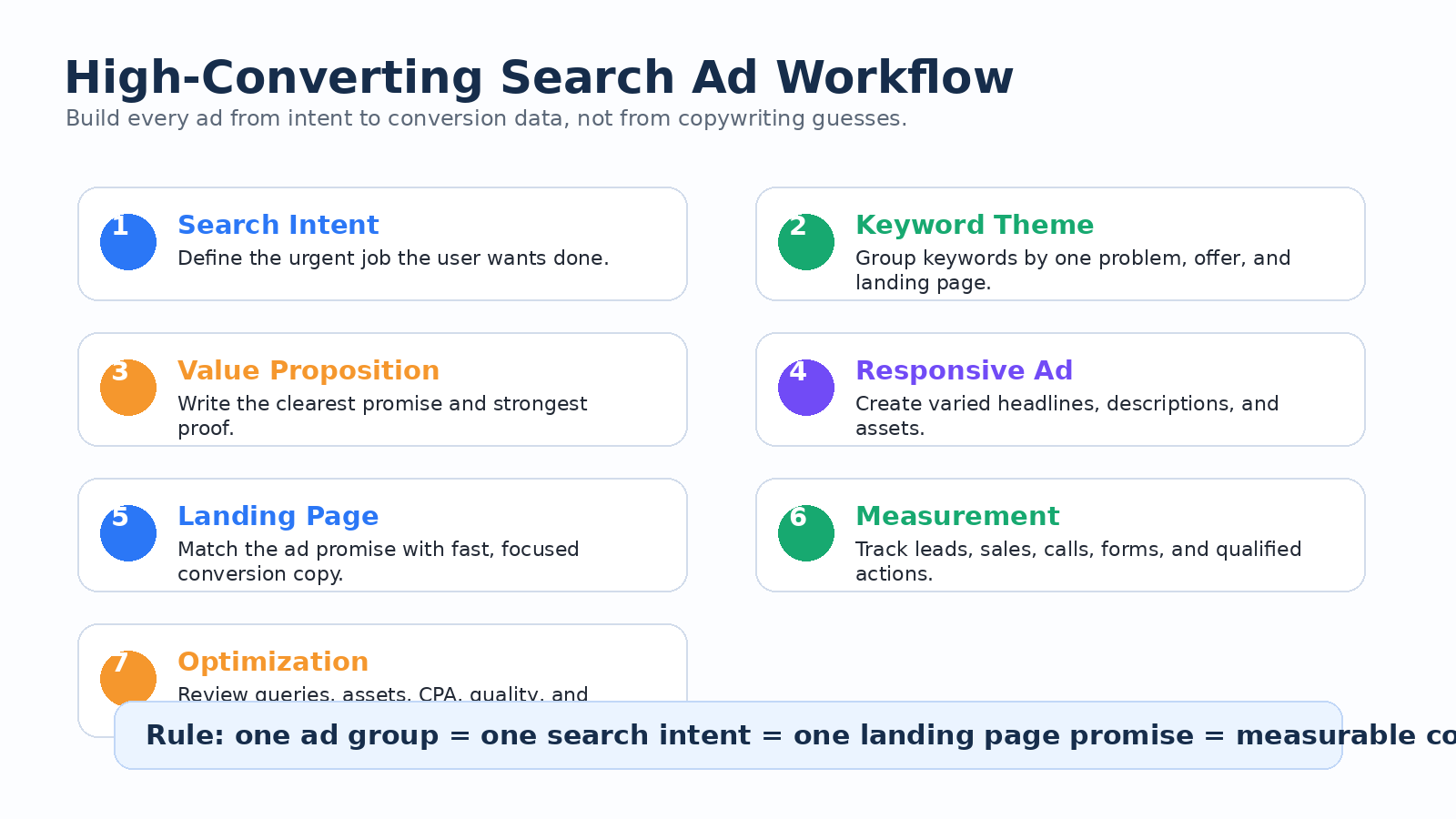
Image 2: A practical workflow for building Search ads around intent and measurement.
Step 3: Write Responsive Search Ads That Give Google Strong Options
Responsive search ads are the standard Search ad format in Google Ads. They allow advertisers to enter multiple headlines and descriptions. Google Ads then tests different combinations and learns which combinations perform best for different searches and users.
Google documentation says responsive search ads can use up to 15 headlines and 4 descriptions. The goal is not to fill every field with random variations. The goal is to give the system useful, distinct, non-repetitive assets that cover your keyword, benefit, proof, offer, and call to action.
Headline Framework for High-Converting Search Ads
| Headline Type | Example | Why It Works |
| Keyword headline | Google Ads Agency for Ecommerce | Confirms relevance to the search |
| Outcome headline | Get More Qualified Leads | Shows the business result |
| Offer headline | Free PPC Audit Available | Gives a reason to click now |
| Proof headline | Trusted by Growing Brands | Reduces risk and builds credibility |
| Speed headline | Launch Campaigns Faster | Appeals to urgency |
| Local headline | PPC Experts in Lagos | Supports local intent |
| CTA headline | Book a Strategy Call Today | Tells the user what to do |
Description Framework
Descriptions should explain the offer more clearly than the headline. They should also filter out bad clicks by naming the audience, service, price point, or outcome. A strong description often includes a benefit, proof point, and action.
- Weak: We offer Google Ads services for businesses.
- Stronger: Reduce wasted ad spend with expert Google Ads management, conversion tracking, and weekly campaign optimization. Book a free PPC audit.
- Weak: Buy our software today.
- Stronger: Manage leads, automate follow-ups, and track sales in one dashboard. Start a 14-day free trial with no credit card required.
Google Search Ad Copy Template
| Ad Element | Formula | Example |
| Headline 1 | [Main Keyword] + [Service/Product] | Google Ads Management for SaaS |
| Headline 2 | [Outcome or Benefit] | Lower CPA and Grow Qualified Leads |
| Headline 3 | [CTA or Offer] | Book a Free PPC Audit |
| Description 1 | [Problem] + [Solution] + [Proof] | Stop wasting budget on low-quality clicks. Get expert Search campaign setup, tracking, and weekly optimization. |
| Description 2 | [Audience] + [Offer] + [Action] | Built for startups, agencies, and ecommerce brands. Request a strategy call today. |
Step 4: Add Search Ad Assets
Ad assets expand your ad with additional information and clickable paths. Google describes assets as free to add and useful for giving ads more impact. For Search campaigns, sitelinks, callouts, structured snippets, call assets, location assets, promotion assets, and lead form assets can improve the usefulness of an ad.
| Asset Type | Purpose | Example |
| Sitelinks | Send users to important pages such as pricing, services, testimonials, or contact pages. | Pricing, Case Studies, Book Demo, Services |
| Callouts | Highlight short benefits that do not need separate landing pages. | Free Consultation, No Setup Fee, 24/7 Support |
| Structured snippets | Show categories, service types, brands, destinations, or features. | Services: PPC Audit, Search Ads, Remarketing |
| Call assets | Encourage phone calls from mobile searchers. | Best for urgent services and local businesses |
| Location assets | Show business location information. | Useful for local service companies and stores |
| Promotion assets | Highlight discounts or seasonal offers. | 20% Off Setup This Month |
Step 5: Match the Landing Page to the Ad
A Search ad can only convert if the landing page supports the same promise. If the ad says “Free PPC Audit,” the landing page should immediately mention the free PPC audit. If the ad targets “emergency roof repair,” the landing page should not be a generic roofing homepage.
- Repeat the keyword theme or offer in the page headline.
- Show the primary CTA above the fold.
- Keep page speed strong, especially on mobile.
- Include trust signals such as reviews, testimonials, case studies, guarantees, or certifications.
- Remove distracting navigation when the goal is lead generation.
- Make forms simple and ask only for information you need.
- Use phone numbers, WhatsApp, live chat, or booking tools when relevant.
Quality Score and Conversion Rate
Quality Score is a Google Ads diagnostic that helps advertisers understand the relevance and usefulness of ads and landing pages. Google lists expected click-through rate, ad relevance, and landing page experience as the main Quality Score components. Improving these areas can support better campaign efficiency, but the real goal should always be profitable conversions, not chasing a score for its own sake.
| Quality Signal | How to Improve It |
| Expected CTR | Write clearer headlines, use stronger offers, add assets, and filter irrelevant queries. |
| Ad relevance | Keep ad groups focused and include the main keyword theme naturally in copy. |
| Landing page experience | Improve speed, message match, mobile usability, content relevance, and trust signals. |
Step 6: Set Up Conversion Tracking Before Scaling
High-converting Search ads require accurate measurement. Without conversion tracking, you may optimize for clicks instead of leads, sales, calls, bookings, or qualified opportunities. Before increasing budget, track the actions that matter to your business.
- Lead form submissions
- Phone calls from ads and landing pages
- Online purchases
- Quote requests
- Demo bookings
- Newsletter signups when they are commercially meaningful
- Qualified pipeline actions imported from your CRM
For stronger optimization, connect Google Ads conversion tracking with GA4, Google Tag Manager, and CRM data when possible. This helps separate low-quality leads from actions that actually become revenue.
Step 7: Use AI Max and Automation Carefully
Google Ads has continued adding AI-powered optimization features. AI Max for Search campaigns is designed to help advertisers expand and optimize Search performance using AI-driven matching, assets, and reporting improvements. These features can be powerful, but they need clean conversion tracking, clear goals, and regular search-term review.
- Use automation after conversion tracking is working correctly.
- Feed the system strong landing pages and clear ad assets.
- Review search terms and add negative keywords regularly.
- Watch conversion quality, not only conversion volume.
- Avoid giving automation a vague goal such as “traffic” when you need leads or sales.
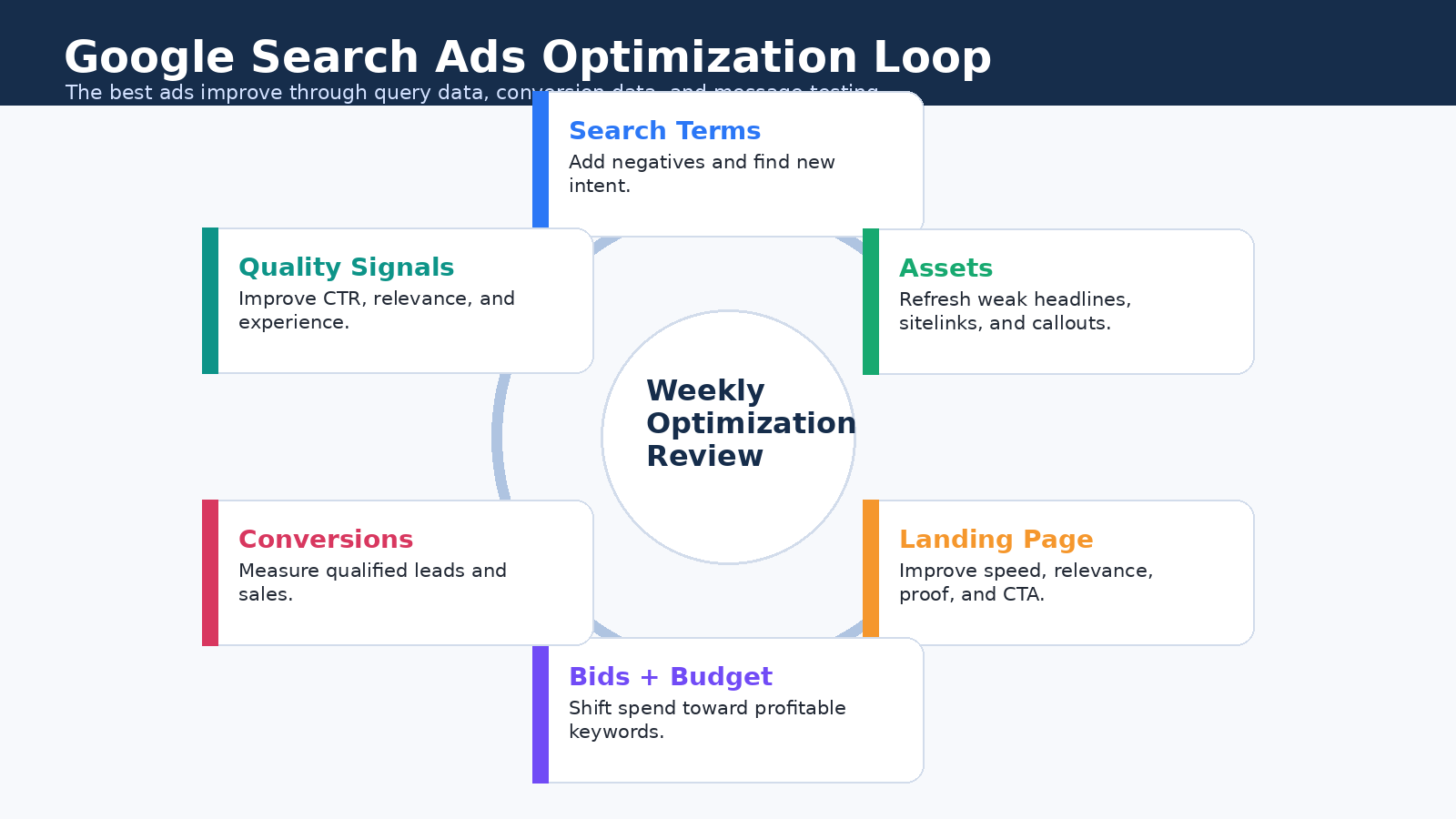
Image 3: Weekly Search Ads optimization loop for improving conversion rate and reducing wasted spend.
Step 8: Optimize Search Ads Weekly
Google Search ads improve through iteration. A campaign that looks average in week one can become profitable after search-term cleanup, ad copy improvement, landing page testing, bid adjustments, and better conversion tracking.
| Weekly Review Area | Action |
| Search terms | Add negative keywords and identify new keyword opportunities. |
| Ads and assets | Replace weak headlines, descriptions, sitelinks, and callouts. |
| Landing pages | Test headline, CTA, form length, proof, page speed, and offer clarity. |
| Bids and budget | Move budget toward campaigns with profitable conversions. |
| Conversions | Check lead quality, sales value, call quality, and duplicate conversions. |
| Competitors | Review auction insights and adjust positioning if CPCs rise. |
| Mobile performance | Check whether mobile visitors convert or bounce. |
Examples of High-Converting Google Search Ads
Example 1: Local Service Business
| Element | Example |
| Keyword theme | emergency plumber near me |
| Headline ideas | Emergency Plumber Near You | 24/7 Plumbing Repairs | Call Now for Fast Help |
| Description | Burst pipe or blocked drain? Get fast local plumbing help today. Licensed technicians, upfront pricing, and emergency response. |
| Landing page | Emergency plumbing service page with phone CTA and local trust signals |
Example 2: SaaS Free Trial
| Element | Example |
| Keyword theme | best project management software for agencies |
| Headline ideas | Agency Project Management Tool | Track Clients and Deadlines | Start Free Trial |
| Description | Plan campaigns, manage approvals, and track profitability in one dashboard. Try it free for 14 days. |
| Landing page | Agency-specific SaaS landing page with demo video and trial CTA |
Example 3: Ecommerce Category
| Element | Example |
| Keyword theme | buy ergonomic office chair |
| Headline ideas | Ergonomic Office Chairs | Free Delivery Available | Shop Adjustable Chairs |
| Description | Work comfortably with adjustable lumbar support, breathable mesh, and modern designs. Order online today. |
| Landing page | Filtered product category page with shipping, reviews, and returns information |
Common Mistakes That Lower Search Ad Conversions
- Sending every keyword to the homepage.
- Writing generic ads that could apply to any competitor.
- Using broad match without strong conversion data or negative keywords.
- Not setting up conversion tracking before launching.
- Measuring success only by clicks and CTR.
- Ignoring search terms after the campaign goes live.
- Using weak landing pages with slow speed, vague copy, or confusing forms.
- Over-pinning responsive search ad headlines so Google cannot test combinations.
- Not using sitelinks, callouts, structured snippets, or call assets.
- Failing to separate brand, competitor, local, and non-brand intent.
High-Converting Google Search Ads Checklist
- The campaign has a clear conversion goal.
- Conversion tracking is installed and tested.
- Keywords are grouped by intent, not dumped into one ad group.
- Each ad group has a relevant landing page.
- Responsive search ads include distinct headlines and descriptions.
- The main keyword, offer, proof, and CTA are represented in the ad assets.
- Sitelinks, callouts, structured snippets, and relevant assets are added.
- Negative keywords are reviewed weekly.
- Landing pages match the ad promise and load quickly on mobile.
- Reports focus on conversions, cost per conversion, revenue, and lead quality.
FAQ
What is a high-converting Google Search ad?
A high-converting Google Search ad attracts qualified searchers and turns them into leads, calls, sales, bookings, or other valuable actions. It is not only about getting a high click-through rate.
How many headlines should I add to a responsive search ad?
Google allows up to 15 headlines. Use enough distinct headlines to cover your keyword, offer, benefit, proof, and CTA. Avoid repeating the same idea in slightly different words.
Should I pin headlines in Google Search ads?
Pinning can be useful when legal, brand, or offer language must always appear. However, excessive pinning can reduce the number of combinations Google can test.
What is the best landing page for Google Search ads?
The best landing page is specific to the search intent. It should repeat the ad promise, load quickly, show trust signals, and make the next action obvious.
Do Search ads need negative keywords?
Yes. Negative keywords help prevent irrelevant searches from wasting budget, especially when using phrase or broad match keywords.
Is AI Max good for Search campaigns?
AI Max can help expand and optimize Search campaigns, but it works best when conversion tracking, landing pages, assets, and goals are already strong.
What metrics matter most for Search ads?
Focus on conversions, cost per conversion, conversion value, lead quality, return on ad spend, and revenue. CTR and Quality Score are useful diagnostics, but they are not the final business goal.
How often should I optimize Google Search ads?
Review active campaigns at least weekly. High-spend or fast-changing campaigns may need more frequent checks, especially for search terms, conversion quality, and budget allocation.
Suggested Internal Links for CBOOMARANK
- Google Ads Beginner’s Guide for 2026
- PPC Advertising Ultimate Guide
- Google Ads vs Facebook Ads: Which Is Better?
- Best AI Marketing Tools in 2026
- AI for Marketing: The Complete Beginner’s Guide
- SEO Pricing Guide
External Authoritative References
- Google Ads Help: Set up your ads for success
- Google Ads Help: About responsive search ads
- Google Ads Help: Best practices for responsive search ads
- Google Ads Help: Use Keyword Planner
- Google Ads Help: About Quality Score for Search campaigns
- Google Ads Help: About keyword matching options
- Google Ads Help: Add assets
- Google Ads Help: How AI Max for Search campaigns works
- Google Ads Help: Set up conversion tracking
Final Verdict
To create high-converting Google Search ads in 2026, start with intent, build focused ad groups, write distinct responsive search ad assets, add useful ad assets, match every ad to a relevant landing page, and track conversions before scaling. Automation can improve results, but only when the campaign has clean data and a strong strategy behind it.
The winning formula is simple: match the searcher’s intent, make a clear offer, prove why your business is credible, remove landing page friction, and optimize every week based on real conversion data.
