

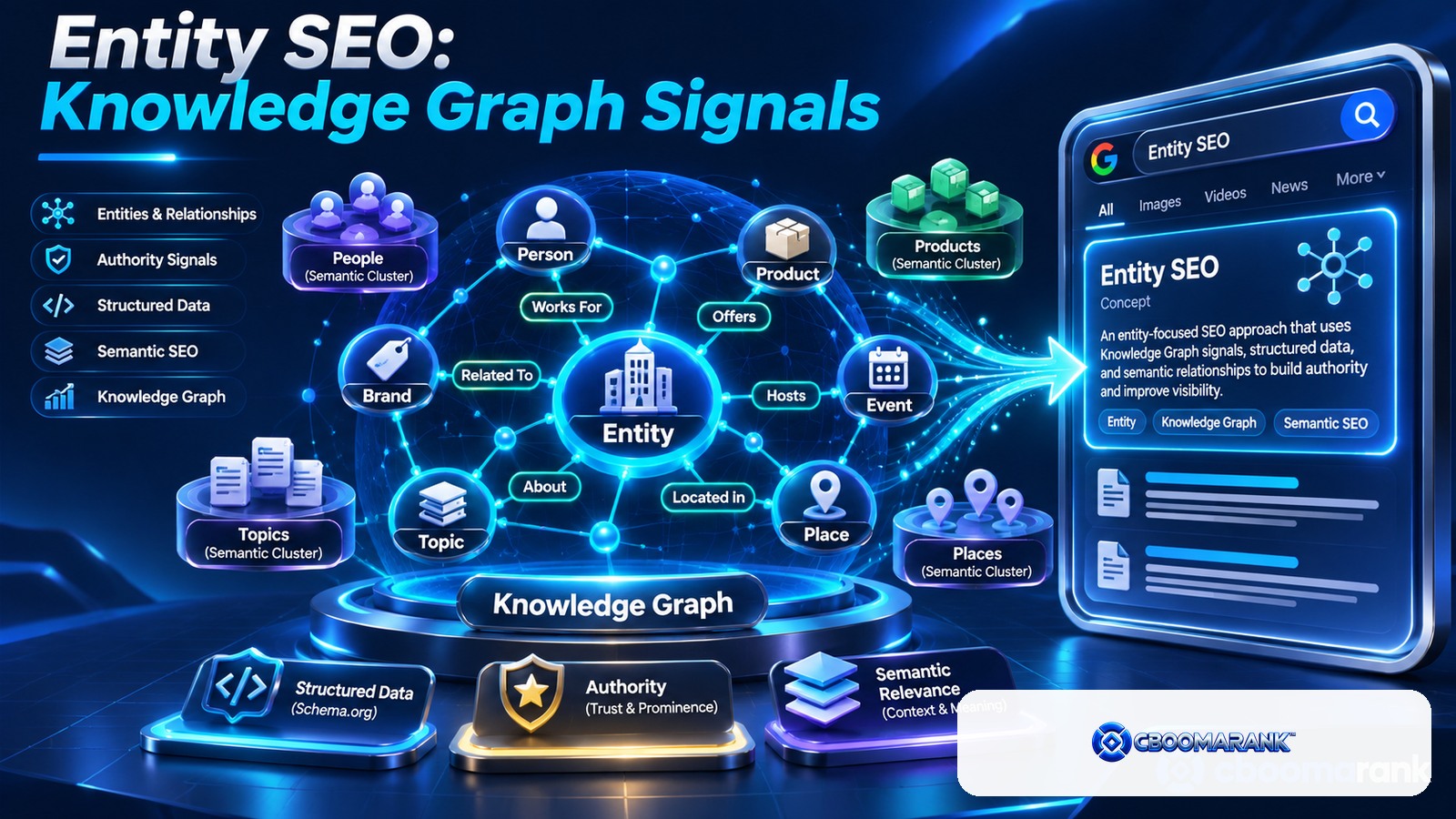
Entity SEO is the practice of making the people, organizations, products, topics and relationships behind a website easier for search systems to understand consistently. It is not a secret ranking factor, and it is not a replacement for normal SEO. The practical goal is to reduce ambiguity: make it clear who created the content, what the organization does, which topics it is qualified to cover, and how important pages relate to one another.
This matters in both traditional search and AI-assisted discovery because modern systems do more than match strings. They interpret context, relationships and source credibility. Clear entity signals will not guarantee rankings, knowledge panels, citations or AI recommendations, but they can make your website easier to interpret and verify.
Entity SEO: The Quick Answer
Start by defining the entities your website genuinely represents. For most businesses, that means the organization, its products or services, named authors, locations where relevant, and the core topics connected to the business. Then make those facts consistent across your About page, contact information, author pages, structured data, social profiles, internal links and editorial content.
| Entity area | What to clarify | Useful evidence |
|---|---|---|
| Organization | Official name, legal name where appropriate, website, logo, contact details | About page, Organization structured data, official profiles |
| Authors | Who writes or reviews the content | Author bios, expertise, editorial policy, profile links |
| Products/services | What the company actually offers | Product pages, documentation, pricing, category pages |
| Topics | Subjects the site repeatedly covers with depth | Topic clusters, internal links, original examples, supporting guides |
| Locations | Where the organization operates when geography matters | Contact pages, local pages, LocalBusiness data where appropriate |
Entity SEO Is About Consistency, Not Repetition
A common mistake is to treat entity SEO like keyword stuffing with a new label. Repeating a brand name dozens of times does not make the organization clearer. Consistency matters more: the same organization name, website, logo, product names, contact details and author identities should appear in sensible places without contradicting one another.
Google’s current Organization structured data documentation recommends putting organization information on the home page or a page that describes the organization, such as an About page. Google also recommends using properties that genuinely apply, including name, URL, logo and real-world contact information where relevant. The documentation does not promise rankings simply because markup exists.
Start With the Organization Entity
Your organization should have one clear public identity. Use the same primary brand name across the website, legal and policy pages, major profiles and structured data. If the legal name differs from the customer-facing brand, explain the relationship rather than forcing one name everywhere.
For CBOOMARANK, the organization entity should connect the platform, its website, product capabilities, editorial content and official brand profiles. The homepage already explains the platform as an SEO intelligence and publisher-marketplace product. The next step is making sure supporting pages reinforce that definition consistently instead of describing the company differently from page to page.
Create an organization evidence checklist
- Use one primary brand name and logo consistently.
- Maintain a substantial About page that explains what the organization does.
- Provide clear contact and ownership information.
- Keep privacy, terms and editorial policies accessible.
- Use Organization structured data only with accurate, visible information.
- Link to genuine official profiles where they help users verify the brand.
- Keep product names and descriptions consistent across marketing and documentation.
Make Author Entities Understandable

For editorial websites, anonymous or vague bylines weaken the reader’s ability to evaluate the source. An author entity should have a stable name, a useful biography, topic expertise and a way to see other work by the same person or editorial team. The biography should explain relevant experience rather than rely on generic claims such as “SEO expert.”
This is especially important when content covers technical SEO, cybersecurity, finance, health or other areas where readers need stronger context. Even when an editorial team shares responsibility, it helps to document how articles are researched, reviewed, corrected and updated.
CBOOMARANK can strengthen this further by connecting author pages with the SEO best practices guide, editorial standards and topic-specific articles. That creates a clearer relationship between the people or team, the site and the subjects they publish.
Build Topic Entities Through Clusters
A website becomes easier to understand when related pages form coherent topic groups instead of isolated articles. For example, CBOOMARANK already has substantial coverage around keyword research, search intent, keyword clustering, backlink analysis, technical SEO, GEO and AI visibility. Internal links should make those relationships explicit.
Use one strong hub for a broad subject and supporting pages for distinct questions or intents. Avoid publishing several near-duplicate pages merely to target slightly different phrases. The keyword research guide and the newer keyword-clustering content should reinforce one another rather than compete.
Use Structured Data as Supporting Evidence
Structured data can help search engines understand specific page entities, but it should describe content that already exists visibly. Do not create elaborate markup for executives, products, locations or reviews that are not actually represented on the page.
For an organization, use the most appropriate schema type and include properties that genuinely apply. For articles, accurate author, headline, image and date information can support clearer page interpretation. Structured data should be tested and maintained when site templates change.
Clarify Product and Service Relationships
Many websites blur the difference between the company, the product and the content publication. A cleaner model explains the relationship. The organization owns or operates the product. Product pages explain capabilities. Editorial pages educate the market. Documentation explains how features work. Pricing explains commercial access.
This separation makes internal linking more useful. An article about backlink analysis can link to the backlink feature when that is a logical next step, while the product page can link back to educational resources that help a buyer understand the problem.
Entity SEO for AI Search and Generative Answers
AI systems can mention a brand, cite a page or summarize information without behaving like a traditional ranked list. Clear entity information can help reduce ambiguity about who the brand is and what it provides, but it is only one layer of visibility.
CBOOMARANK’s AI visibility guide recommends measuring mentions, citations, recommendation presence and referral traffic separately. The GEO guide likewise emphasizes useful content, crawlability, evidence and authority rather than special entity tricks.
Use External Corroboration Carefully

Entity clarity is stronger when important facts can be corroborated outside the site, but this does not mean manufacturing mentions or profiles. Legitimate business directories, professional associations, publisher coverage, software listings, interviews and partner pages can help users verify that an organization exists and operates in the way its own website describes.
Evaluate external references for relevance and accuracy. A low-quality directory filled with copied descriptions adds little value. A credible industry publication, verified marketplace profile or partner page can provide more useful context. Keep names, URLs and product descriptions consistent when you control the listing.
Measure Entity SEO With Practical Signals
There is no single “entity SEO score” that proves success. Use observable outcomes: growth in branded queries, more consistent search-result presentation, increased discovery of author or organization pages, stronger visibility across topic clusters, legitimate citations and more accurate brand descriptions in search and AI systems.
Track errors as well as wins. If an AI system repeatedly confuses the product with another company or if Google surfaces the wrong logo, investigate the underlying identity signals, structured data, page content and external references. Measurement should focus on reducing ambiguity and improving useful discovery, not chasing a vanity score.
How to Audit Entity Consistency
- List the organization, product, author, location and core-topic entities that matter.
- Record the preferred public name and canonical page for each entity.
- Check the homepage, About page, contact page, author pages and product pages for inconsistent naming.
- Review Organization, Article and other structured data for accuracy.
- Compare official social and business profiles with the website.
- Map internal links between hub pages, supporting guides and product pages.
- Remove duplicate or contradictory descriptions.
- Recheck high-value pages after template or CMS changes.
Common Entity SEO Mistakes
- Treating entity SEO as a way to repeat the brand name more often.
- Adding structured data for information that is not visible or accurate.
- Creating multiple inconsistent author identities for the same person or team.
- Using different organization names across legal pages, social profiles and schema without explanation.
- Publishing hundreds of isolated articles without a clear topic architecture.
- Assuming a knowledge panel or AI citation can be guaranteed.
- Using fake third-party profiles or fabricated references to manufacture authority.
A Worked Entity SEO Example for a SaaS Brand
Consider a SaaS company that offers keyword research, competitor analysis and backlink intelligence. The website may mention the company name everywhere, but that alone does not create a clear entity. Search systems still need consistent evidence about what the organization is, what it offers, who publishes its content, which topics it is qualified to discuss and how those facts connect across the site.
Start with the homepage and About page. The organization name, logo, primary URL and short company description should agree. Next, review product and feature pages. They should use stable product names and explain how each capability relates to the organization instead of presenting every feature as an isolated brand. Author pages should identify real editorial responsibility and connect naturally to the articles those authors publish.
Then check external profiles and citations. A LinkedIn company page, YouTube profile, software directory listing or reputable industry mention should not introduce conflicting names, URLs or descriptions. Exact wording does not need to be duplicated everywhere, but the underlying facts should remain consistent. That is the practical difference between entity consistency and keyword repetition.
Build an entity evidence matrix
A simple spreadsheet can make inconsistencies visible before they become a technical project. Use one row for each important fact and one column for each source where that fact appears.
| Entity fact | Homepage | About | Schema | Author/profile | External profile |
|---|---|---|---|---|---|
| Organization name | Check | Check | Check | Reference | Check |
| Primary URL | Check | Check | Check | Reference | Check |
| Logo | Check | Check | Check | Optional | Check |
| Core products/services | Check | Check | Describe | Context | Describe |
| Primary topics | Context | Context | Support | Expertise | Context |
The purpose of this matrix is not to manufacture signals. It is to uncover contradictions. If one page calls the business a marketplace, another calls it an agency and a third describes it as analytics software, a search system has to reconcile those competing interpretations. If all three descriptions are genuinely true, explain the relationship clearly rather than forcing one label everywhere.
Entity SEO Prioritization: What to Fix First
Not every inconsistency deserves equal attention. Prioritize high-confidence facts that users and search systems repeatedly encounter: organization name, primary domain, logo, product names, author identities and major topic relationships. These are foundational signals. Secondary details such as social profile wording or optional schema properties can follow after the core identity is stable.
A useful prioritization method is to score each issue on three dimensions: visibility, contradiction risk and business importance. A wrong logo URL in Organization structured data has high contradiction risk. An outdated social bio may have lower technical impact but still matter if that profile ranks prominently for the brand. A missing author description may become important when the site publishes expert advice at scale.
Do not confuse structured data with entity creation
Structured data can clarify facts that already exist on a page, but it should not invent an identity the visible site does not support. Google’s Organization guidance recommends adding relevant properties that describe the real organization, including its name, URL and logo. Treat the markup as a machine-readable reinforcement of user-visible evidence, not as a shortcut around weak brand information.
Entity SEO Quality-Control Checklist Before Publishing
- Confirm the organization name and preferred logo are consistent across core pages.
- Verify that author names link to meaningful author information when appropriate.
- Make product and service names stable across navigation, copy and structured data.
- Use internal links to show the relationship between pillar topics and supporting topics.
- Check that external profiles point to the correct canonical website.
- Remove obsolete brand names, old URLs and contradictory business descriptions where they are no longer accurate.
- Validate structured data after content changes rather than assuming old markup still reflects the page.
Entity SEO works best as an information-quality discipline. When people, pages and machine-readable data all describe the same real-world organization coherently, search and AI systems have less ambiguity to resolve.
How CBOOMARANK Fits Into an Entity SEO Workflow
Entity work becomes more useful when it is connected to the rest of SEO. CBOOMARANK can support the surrounding research by helping teams audit websites, examine keywords and intent, analyze competitors, review backlinks and identify publisher opportunities. These signals do not create an entity automatically; they help reveal whether the site’s public identity and topical footprint are coherent.
For example, if a company wants to become associated with technical SEO, it should not rely on one landing page that says “technical SEO” repeatedly. It should publish genuinely useful technical resources, connect them with internal links, earn relevant external references and make the organization and authorship behind those resources clear.
Use CBOOMARANK to connect website analysis, keyword research, competitor intelligence and authority signals around the topics your brand wants to own.
Frequently Asked Questions
What is entity SEO?
Entity SEO is the practice of making the real people, organizations, products, places and topics behind a website easier for search systems to understand consistently.
Does entity SEO replace keyword research?
No. Keywords reveal how people express needs. Entities help clarify what people, organizations and concepts the content is about. Strong SEO uses both.
Does Organization schema guarantee a knowledge panel?
No. Structured data can help Google understand organization information, but Google does not guarantee a specific search feature or panel.
Should every page contain Organization schema?
Google recommends placing organization information on the home page or a page that describes the organization. You do not need to repeat the full organization markup on every page.
Can entity SEO improve AI visibility?
Clear entity information may reduce ambiguity, but AI visibility also depends on crawlability, useful content, source authority, citations, context and the platform’s own retrieval systems.
Final Checklist
Entity SEO works best as a consistency discipline. Define who and what the site represents, keep those facts accurate, support them with visible pages and appropriate structured data, and connect topics through useful internal architecture. The objective is not to manufacture an entity; it is to make the real one unmistakable.
