

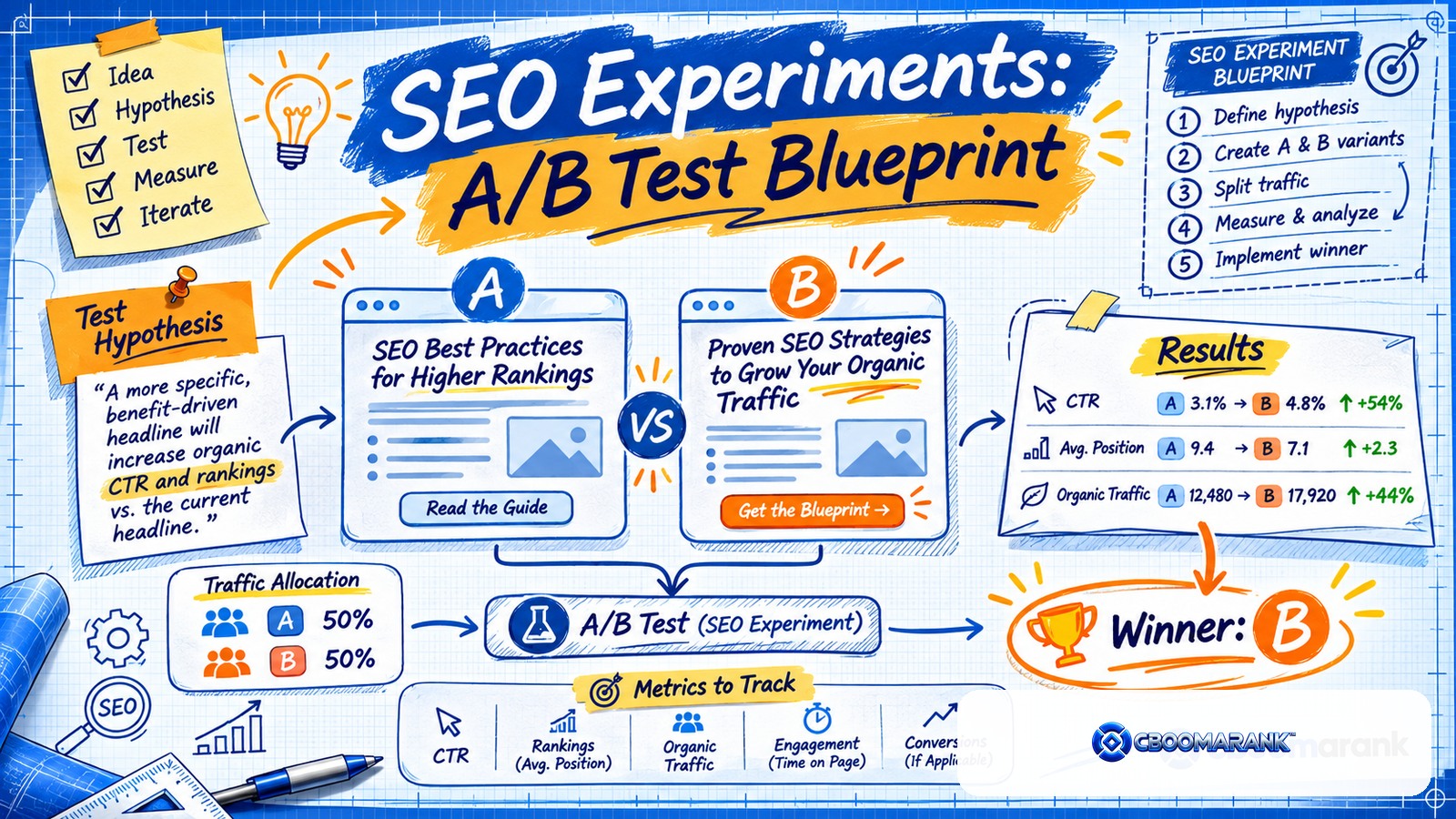
SEO experiments are controlled tests used to estimate whether a change actually improves organic performance. The hard part is not making the change; it is separating the effect of the change from seasonality, algorithm updates, demand shifts, competitor activity and normal ranking noise.
A strong experiment starts with a specific hypothesis, a clear success metric and a baseline. It also defines what would count as failure. Without those elements, an SEO team can easily credit a redesign for growth that was already happening or blame a content update for a decline caused by falling search demand.
SEO Experiments: The Quick Answer
Choose one change that can plausibly affect a measurable outcome. Record the pre-test baseline, define the pages or queries involved, keep unrelated changes to a minimum, and compare results against an appropriate control or historical expectation. Run the test long enough to collect meaningful data, then document whether the evidence supports the hypothesis.
| Experiment element | Weak version | Stronger version |
|---|---|---|
| Hypothesis | Improve SEO | Adding descriptive internal links to orphaned category pages will increase their organic impressions |
| Metric | Traffic | Clicks and impressions to the affected pages, with conversion quality monitored separately |
| Control | None | Comparable pages that do not receive the change, where feasible |
| Duration | Until results look good | Predefined observation window based on traffic and crawl frequency |
| Decision | Keep if rankings rise | Keep, roll back or retest based on predefined criteria |
Why SEO Experiments Are Harder Than CRO Tests
Conversion-rate experiments can often split users between variants at the same time. SEO tests are different because search engines crawl and reassess pages asynchronously, rankings depend on competitors and demand, and one page can influence another through internal links or site architecture.
Google’s website testing guidance explains how A/B and multivariate testing can be implemented without creating unnecessary Search problems. Google recommends avoiding cloaking, using canonicals for alternate test URLs, using temporary rather than permanent redirects for temporary tests, and removing test infrastructure when the experiment ends.
Start SEO Experiments With a Testable Hypothesis
A hypothesis should contain the change, the target and the expected direction. “We think adding comparison tables to commercial articles will increase clicks from non-branded commercial queries” is testable. “We think better content will help SEO” is not specific enough.
Good hypotheses come from diagnosis. Use Search Console, analytics, crawls, keyword research and competitor analysis to identify a plausible bottleneck before deciding what to change. If a page has high impressions but weak CTR, test the snippet. If pages are under-crawled, test internal-link changes. If queries show a different intent from the page, test the content format.
Build a Baseline Before You Change Anything

Export the relevant Search Console and analytics data before the test begins. Record clicks, impressions, CTR, average position, landing-page sessions and conversions where appropriate. The Search Console Performance report documentation notes that recent data can be preliminary, so avoid treating incomplete days as final.
For volatile or seasonal queries, compare year over year as well as period over period. A retail page may grow every November regardless of your change. A travel page may fall after peak season even if the test worked.
Choose the Right Experimental Unit for SEO Experiments
The unit can be one URL, a group of similar pages, a template or a site section. Large sites often benefit from split tests across comparable page groups because they provide more observations. Small sites may need slower before-and-after tests with stronger caution about causality.
Group pages by intent and template whenever possible. Testing product-category pages together is usually cleaner than mixing categories, blog posts and product pages. The more heterogeneous the group, the harder it is to interpret the result.
Use Control Pages in SEO Experiments When You Can
A control group helps answer whether the same movement would have happened without the change. Select pages that are similar in template, intent, traffic pattern and seasonality but that do not receive the treatment.
Controls are not perfect. Google may crawl one group more frequently, competitors may target one topic more aggressively, and internal linking can cause spillover. Still, a reasonable control is usually better than assuming every movement on the treatment pages came from the experiment.
SEO Experiment Ideas That Produce Useful Learning
- Title and snippet tests: improve clarity, intent alignment or differentiation on high-impression pages.
- Internal-link tests: add contextual links from strong pages to strategically important pages.
- Content-format tests: add tables, comparison criteria, examples or concise answer sections where the SERP suggests they are useful.
- Template tests: change headings, structured navigation or above-the-fold layout across a controlled page set.
- Indexation tests: consolidate low-value duplicates or improve canonical signals on a defined section.
- Freshness tests: materially refresh a group of declining pages and compare them with similar untouched pages.
What Not to Test Casually
Some changes are too risky to treat as casual experiments: domain migrations, widespread URL changes, robots.txt restrictions, canonical changes across thousands of pages and mass noindexing. These require migration planning and rollback procedures rather than a lightweight test.
If the change could make important pages inaccessible or deindexed, validate in staging and use a small controlled scope first. CBOOMARANK’s technical SEO checklist is useful for preflight validation.
How Long Should SEO Experiments Run?

There is no universal duration. The right window depends on crawl frequency, traffic volume, query volatility, seasonality and the size of the expected effect. High-traffic templates may produce a signal in weeks. Low-volume pages may need much longer and may never support strong statistical confidence.
Do not stop because the chart briefly moves in the desired direction. Define the observation window in advance and document major external events during the test, including known algorithm updates, sitewide launches, tracking changes and unusual promotions.
Measure More Than Average Position
Average position can hide useful changes. A page may gain visibility across many new queries while its average position looks flat. Track clicks, impressions, query count, CTR, landing-page traffic and conversions. For informational tests, engagement may matter; for commercial pages, qualified leads or revenue may matter more.
The content decay guide explains why historical context matters when evaluating page changes. A page recovering from a prior decline should be judged against its own baseline and the market around it.
Avoid the Most Common Biases in SEO Experiments
- Regression to the mean: unusually bad or good periods often move back toward normal even without intervention.
- Selection bias: choosing only pages that already look likely to improve.
- Survivorship bias: reporting successful tests but forgetting failed ones.
- Multiple changes: changing content, template, internal links and URLs together and then claiming one caused the result.
- Confirmation bias: extending or shortening the test until the preferred answer appears.
Account for Algorithm and Market Events
SEO experiments do not happen in a laboratory. Core updates, competitor launches, news events and demand shifts can move treatment and control pages at the same time. Keep an event log beside the experiment so you can explain unusual changes instead of attributing everything to the test.
When a major external event overlaps the test, the correct decision may be to extend, pause or repeat the experiment. Do not discard the event because it makes the result inconvenient. The objective is a defensible conclusion, not a green dashboard.
Use Guardrail Metrics
A test can improve one metric while harming another. A title change may increase CTR but attract less-qualified traffic. An aggressive content expansion may increase impressions while reducing conversion rate or page speed. Define guardrails before the test starts.
Typical guardrails include conversion rate, revenue per visitor, crawl errors, Core Web Vitals, indexation and user engagement. If the primary SEO metric improves but a critical business or technical metric deteriorates, the result should not be labeled an uncomplicated success.
Document Every SEO Experiment
Maintain a simple experiment log with the hypothesis, affected URLs, start date, end date, control group, metrics, screenshots or exports, implementation notes and final decision. This prevents the team from repeating failed ideas and makes successful patterns easier to scale.
| Field | Example |
|---|---|
| Hypothesis | Adding relevant comparison criteria will improve commercial-query CTR and clicks |
| Treatment | 20 software-comparison pages |
| Control | 20 similar comparison pages |
| Primary metric | Organic clicks |
| Guardrail | Conversion rate must not materially decline |
| Decision | Scale, revert or retest |
Worked SEO Experiments Example: Testing a More Specific Title Pattern
Suppose a site has 40 evergreen guides with stable rankings but weaker click-through rates than expected. The hypothesis is that titles which state a specific benefit and audience will earn more qualified clicks than generic titles. A weak experiment would rewrite all 40 pages at once and celebrate if traffic rises. A stronger SEO experiment keeps enough comparable pages unchanged so normal demand shifts can be separated from the treatment.
Before changing anything, record at least the baseline period you intend to compare against. Capture clicks, impressions, CTR, average position, conversions and any major technical changes. Divide similar pages into a treatment group and a control group using a rule that avoids cherry-picking only the strongest or weakest URLs. Apply the new title pattern only to the treatment group.
Define the decision before seeing the result
Write the rule for success before the experiment begins. For example: treatment pages should improve CTR relative to the control group without a material decline in impressions, average position or conversion quality. This prevents the team from changing the definition of success after seeing a noisy outcome.
| Metric | Why it matters | Possible guardrail |
|---|---|---|
| Clicks | Measures additional organic visits | Compare against control trend |
| CTR | Shows whether the snippet earns more clicks | Review position mix |
| Impressions | Checks whether visibility changed | Avoid declaring a win from CTR alone |
| Conversions | Tests traffic quality | Watch for lower-intent clicks |
| Indexing/canonical | Protects technical stability | No unexpected URL changes |
Google’s testing guidance is particularly important when an experiment creates alternate URLs. Temporary test URLs should not accidentally replace the preferred URL in search. Use canonical signals appropriately, use temporary redirects when redirects are part of the test, and end experiments when enough evidence has been collected.
Use an SEO Experiment Log, Not Memory
SEO teams often remember that “we changed titles in March” but forget the exact pages, dates, baseline, confounding events or rollback decision. A lightweight experiment log solves this problem. Record the hypothesis, target URLs, control URLs, implementation date, observation window, metrics, known external events and final decision.
The log becomes more valuable over time because it turns isolated tests into organizational knowledge. You may discover that title changes work well for comparison pages but not for definitions, or that internal-link experiments produce stronger gains on pages already ranking on page two. Those patterns can guide future prioritization.
Interpret inconclusive results correctly
An inconclusive result is not a failed experiment. It may mean the effect is too small for the available traffic, the test window is too short, the control group was poorly matched or an external event overwhelmed the signal. The correct response is to document the uncertainty, not to force a winner.
SEO Experiments Decision Framework
- Roll out: the treatment produces a consistent improvement and guardrail metrics remain healthy.
- Keep current: the treatment creates no meaningful improvement or introduces downside risk.
- Iterate: the direction is promising but the implementation needs refinement.
- Retest: the test was contaminated by a migration, algorithm event, tracking failure or other major confounder.
- Stop testing: the expected business value is too small to justify more measurement effort.
The discipline matters more than the number of experiments. A small library of well-documented tests can teach more than dozens of uncontrolled before-and-after changes.
How CBOOMARANK Can Support SEO Experiments
CBOOMARANK can support the research around experiments by connecting website analysis, keyword opportunities, competitor evidence, backlink context and page-level SEO findings. The platform should not pretend to prove causality automatically; the value is in helping teams identify hypotheses, choose affected pages and monitor the signals around the test.
For example, if a competitor gap reveals that ranking pages consistently include a comparison section your page lacks, that observation can become a testable hypothesis rather than an instruction to copy competitors.
Use CBOOMARANK to turn SEO findings into prioritized hypotheses and measurable actions.
SEO Experiment Workflow
- Identify a specific problem or opportunity from data.
- Write a falsifiable hypothesis.
- Choose the treatment pages and a control where possible.
- Export the pre-test baseline.
- Define primary metrics and guardrails.
- Implement one meaningful change while minimizing unrelated edits.
- Record crawl and indexation status.
- Run the test through the predefined observation window.
- Compare treatment, control and historical expectations.
- Document the result and decide whether to scale, revert or retest.
Frequently Asked Questions
What is an SEO experiment?
An SEO experiment is a structured test designed to estimate whether a specific change affects organic search performance.
Can I A/B test SEO pages?
Yes, but Search behavior requires special care. Google recommends avoiding cloaking, using canonicals for alternate test URLs and using temporary redirects for temporary experiments.
How long should an SEO test run?
It depends on traffic, crawl frequency, seasonality and expected effect size. Define the observation window before the result is known.
Do I need statistical significance?
Large controlled tests benefit from statistical methods. Small sites may not have enough data for strong significance, so conclusions should be more cautious and supported by multiple signals.
Should I test multiple SEO changes at once?
Usually not if you want to understand causality. Bundled changes can be useful for a redesign, but they make it harder to know which component caused the result.
Final Verdict
SEO experiments are most valuable when they make your decision process more disciplined. Start with diagnosis, isolate a plausible change, measure against a baseline and document what happened. The goal is not to prove that every idea worked; it is to learn which changes reliably improve search performance without confusing correlation with causation.
