

Brand messaging defines how a business explains who it serves, what problem it solves, why its solution matters and why customers should choose it instead of competing alternatives. For SEO, effective brand messaging also connects those ideas with the language, questions and search intent used by potential customers.
Additionally, A company can rank for valuable keywords and still struggle to convert visitors if its message is vague. Likewise, a strong brand message may fail to attract enough qualified traffic when the website does not align its positioning with the topics people actually search for.
Moreover, The strongest approach combines audience research, keyword research, competitive positioning and conversion copy. That creates a consistent message across search results, landing pages, product pages, sales content and AI-driven discovery.
In addition, This guide explains how to build brand messaging that supports SEO, search intent, positioning and conversion while remaining clear enough to use consistently across your website and marketing channels.
Build messaging from real search demand.
Furthermore, Use CBOOMARANK keyword and competitor research to discover how your audience searches, which topics competitors emphasize and where your brand can differentiate.
Brand Messaging: Quick Answer
Also, Brand messaging is the structured language a company uses to communicate its value, positioning, audience relevance and differentiation.
A practical messaging system normally answers several questions:
- Who is the ideal customer?
- Which problem does the customer want to solve?
- What outcome does the customer want?
- Which solution does the company offer?
- Why is that offer different?
- What evidence supports the claim?
- What should the visitor do next?
In practice, For SEO, these questions should also connect to search intent. The words used by a company internally are not always the same words customers type into Google, Bing or AI search experiences.
What Is Brand Messaging?
Equally important, Brand messaging is the verbal system a business uses to explain its identity and value to an audience.
At the same time, It includes more than a slogan or tagline. A complete messaging system can guide homepage copy, service pages, product descriptions, advertising, sales presentations, social content, email campaigns and search-optimized articles.
Brand Messaging: Core Brand Message
Additionally, The core brand message communicates the central idea customers should understand about the business.
Moreover, It should identify the audience, the problem or opportunity and the main value the business provides.
Brand Messaging: Supporting Messages
In addition, Supporting messages explain why the primary promise is credible. They may focus on features, benefits, proof, expertise, speed, affordability, reliability, specialization or measurable outcomes.
Brand Messaging Proof Points
Furthermore, Claims become more persuasive when supported by evidence. Proof may include customer outcomes, case studies, certifications, product capabilities, data, reviews, guarantees or documented experience.
Brand Messaging Calls to Action
Also, Messaging should lead naturally toward a next step. Depending on the business, that action might be requesting a consultation, starting a trial, analyzing a website, comparing plans or purchasing a service.
Brand Messaging vs Brand Positioning
In practice, Brand positioning defines the strategic place a company wants to occupy in the customer’s mind relative to alternatives. Brand messaging translates that positioning into language.
For example, positioning may define a product as an accessible SEO platform for businesses that need practical insights without an overly complex enterprise workflow.
Equally important, The messaging then expresses that position through headlines, benefits, feature descriptions, comparisons and calls to action.
At the same time, In other words, positioning determines the strategic idea. Messaging communicates that idea.
Brand Messaging vs Brand Voice
Additionally, Brand voice describes how the company communicates. Brand messaging describes what the company communicates.
Moreover, A brand voice might be professional, technical, conversational, direct or educational. However, the underlying message could still focus on saving time, increasing visibility or improving business performance.
In addition, Both matter, but they solve different problems. Consistent voice supports recognition, while consistent messaging supports understanding.
Brand Messaging vs Tagline
A tagline is one short expression of a brand. It is not the entire messaging strategy.
Furthermore, Strong messaging should remain useful even when the tagline changes. It should provide enough structure for writers, marketers, sales teams and product teams to create consistent communication across different formats.
Why Brand Messaging Matters for SEO
Also, SEO brings people to a page, but messaging influences whether those visitors understand the offer and continue toward a meaningful action.
Messaging Clarifies Search Relevance
In practice, A landing page should make it immediately clear that it matches the visitor’s search intent. If someone searches for website SEO analysis, the page should not force that person to decode broad corporate language before understanding the service.
Messaging Helps Differentiate Similar Offers
Equally important, Competitive search results often contain many businesses targeting similar keywords. Clear messaging helps explain why one solution may be more relevant to a specific customer segment.
Messaging Supports Better Page Architecture
At the same time, A structured messaging framework makes it easier to decide which pages should target which problems, audiences and search intents.
Messaging Can Improve Conversion Quality
Additionally, More traffic is not always better traffic. A precise message can discourage poorly matched visitors while helping better-qualified prospects recognize that the offer fits their needs.
The Brand Messaging Framework
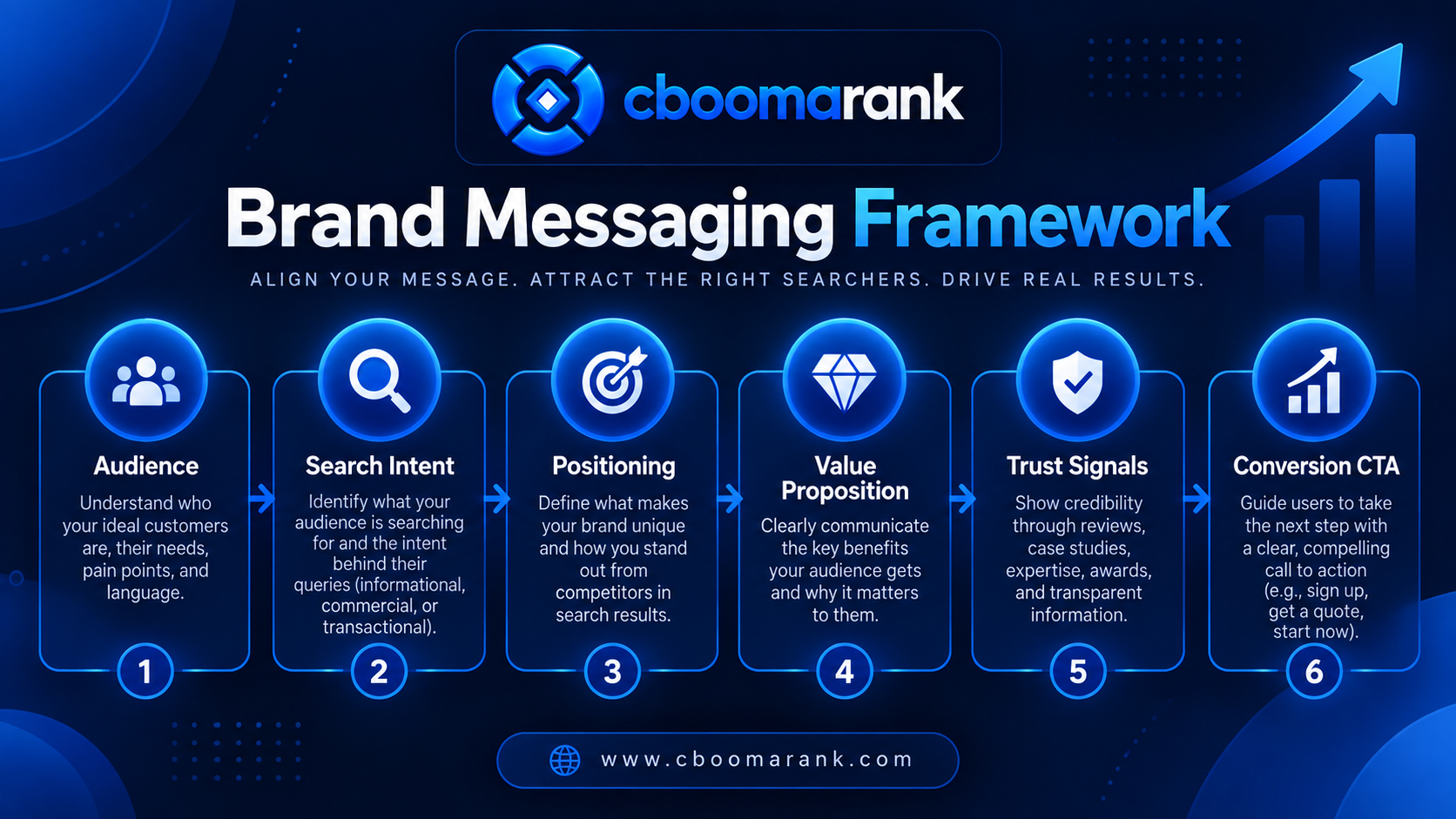
A practical brand messaging framework can be built from seven connected components.
1. Target Audience
Moreover, Define who the message is for. Avoid descriptions so broad that nearly anyone could qualify.
In addition, Depending on the product, useful audience distinctions may include company size, role, industry, technical maturity, budget, business model or primary goal.
2. Customer Problem
Furthermore, Describe the problem from the customer’s point of view rather than from the company’s internal terminology.
For example, a customer may not think, “I need a technical visibility optimization platform.” The real concern might be, “My competitors rank above me and I don’t know why.”
3. Desired Outcome
Customers usually care about outcomes more than product categories.
Also, Possible outcomes include generating qualified leads, increasing search traffic, understanding competitors, improving conversions, reducing wasted advertising spend or identifying technical website problems.
4. Value Proposition
In practice, The value proposition explains the primary benefit a customer should expect from choosing the solution.
Equally important, It should be specific enough to be meaningful but credible enough to support with evidence.
5. Differentiation
Explain why customers should consider this option instead of alternatives.
At the same time, Differentiation may come from specialization, workflow, pricing model, usability, integration, data coverage, service quality or a combination of factors.
6. Proof
Additionally, Support important claims with evidence. Strong proof reduces the distance between a marketing promise and a customer’s willingness to believe it.
7. Call to Action
Moreover, Define the most useful next action. The CTA should fit the visitor’s stage in the decision process rather than forcing every visitor into the same conversion path.
Start Brand Messaging With Audience Research
In addition, Messaging becomes stronger when it is based on real audience behavior instead of assumptions made inside the company.
Brand Messaging Research: Review Customer Questions
Sales calls, support tickets, product reviews, contact forms and customer interviews can reveal recurring questions and objections.
Brand Messaging Research: Study Search Queries
Keyword research can reveal the language people use before they know your brand.
Search terms can also expose different stages of awareness. A person searching “what is SEO software” has different needs from someone searching “Semrush alternatives pricing.”
Brand Messaging Research: Analyze Competitors
Competitor research helps identify claims and themes that appear repeatedly in the market.
The goal is not to copy those messages. Instead, use the research to determine which ideas are already crowded and where a clearer or more distinctive position may be available.
Discover the language your market already uses.
Use CBOOMARANK keyword research and competitor research to connect brand messaging with real search behavior.
Brand Messaging and Search Intent
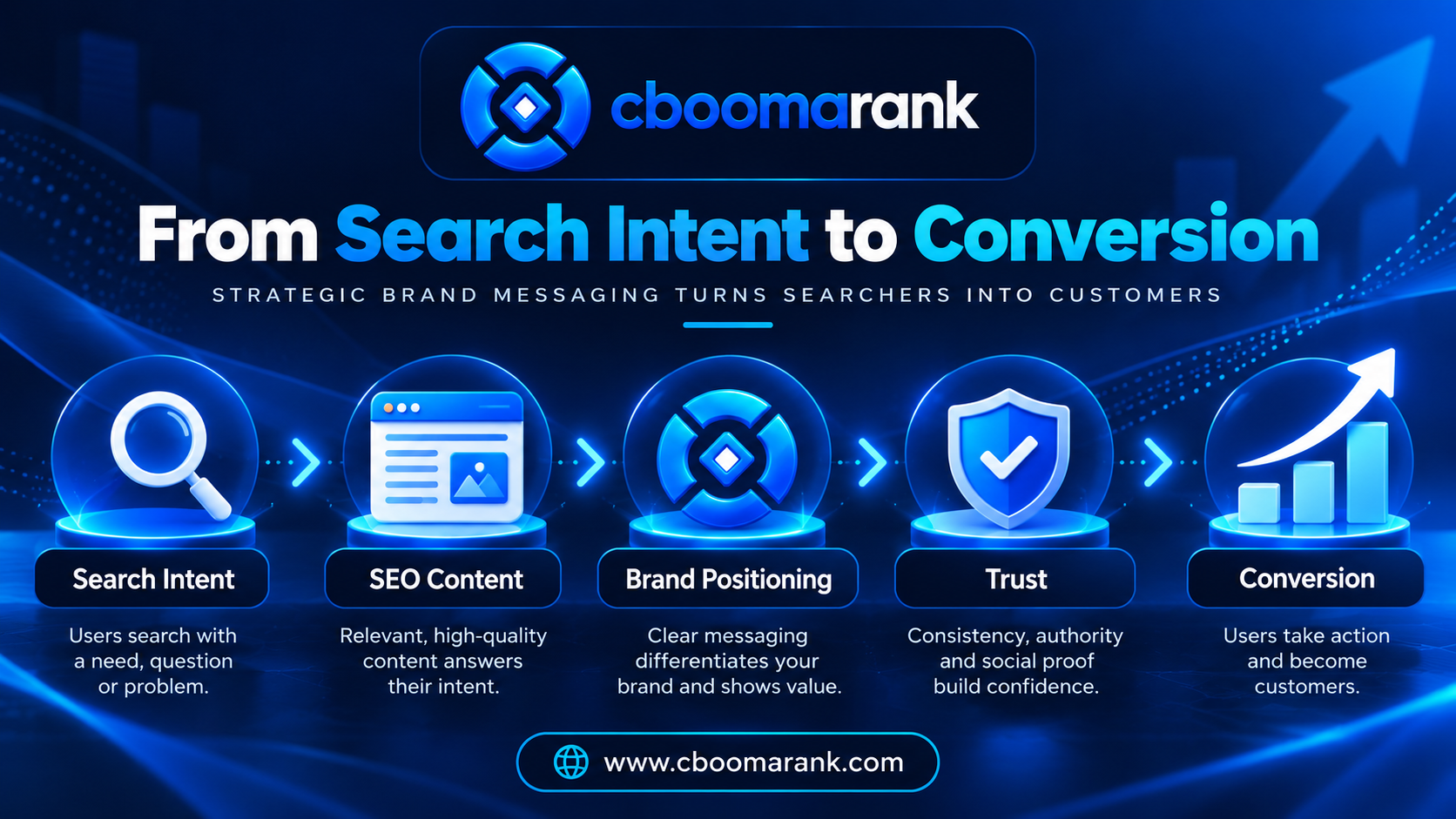
Search intent describes what a person is trying to accomplish when entering a query.
Effective brand messaging should adapt to that purpose instead of repeating the exact same sales message on every page.
Brand Messaging for Informational Intent
Informational visitors are primarily trying to learn. Educational content should answer the question clearly before pushing a commercial offer.
Brand Messaging for Commercial Investigation
Commercial visitors are comparing approaches, products or providers. Messaging should emphasize differentiation, use cases, capabilities, evidence and tradeoffs.
Brand Messaging for Transactional Intent
Transactional visitors are closer to taking action. They need clear pricing signals, next steps, trust information and minimal friction.
Brand Messaging for Navigational Intent
Navigational searches usually involve a known brand, product or destination. Messaging should confirm quickly that the visitor reached the correct page.
How to Align Brand Messaging With Keywords
Keyword alignment does not mean forcing the same exact phrase into every sentence. The goal is to connect customer language with a clear business message.
Brand Messaging: Map One Primary Intent to Each Important Page
Each major landing page should have a clear purpose. Avoid making one page compete for too many unrelated search intents.
Brand Messaging: Use the Primary Topic Naturally
The main topic should appear in strategic locations such as the page title, introduction and relevant headings when it accurately describes the page.
Brand Messaging: Use Supporting Terms to Add Context
Related concepts help explain the topic completely. For a brand messaging page, those terms may include positioning, value proposition, search intent, brand voice, conversion copy and message hierarchy.
Brand Messaging: Match the Message to the Search Stage
A high-intent commercial page should usually communicate the offer faster than a long educational guide.
Building a Brand Message Hierarchy
A message hierarchy determines which ideas visitors should understand first, second and third.
Brand Messaging: Primary Message
The primary message should answer the most important question: why should the target customer care?
Supporting Brand Messages
Secondary messages explain major benefits or differentiators supporting the primary promise.
Evidence in Brand Messaging
Proof points demonstrate that the primary and secondary messages are credible.
Action Layer for Brand Messaging
The final layer tells the visitor what to do next.
This hierarchy keeps pages focused and prevents important selling points from being buried beneath less relevant details.
Brand Messaging for a Homepage
A homepage often serves multiple audiences, so its messaging must establish the company’s broad value quickly without becoming vague.
Homepage Hero Message
The hero section should communicate what the company offers, who benefits and why the visitor should continue.
Avoid headlines that sound impressive but provide little information about the actual business.
Supporting Value Messages
After the primary message, explain the most important capabilities or outcomes.
Trust and Proof
Add relevant evidence such as product capabilities, customer results, reviews, integrations or measurable outcomes where available.
Clear Next Action
The homepage should provide an obvious path to the next stage, whether that means exploring features, analyzing a website, viewing pricing or creating an account.
Brand Messaging for Service Pages
Service-page messaging should be more specific than homepage messaging because the visitor has already narrowed the topic.
A strong service page should communicate:
- The problem the service addresses
- The target customer
- The service scope
- The expected business value
- The process
- Relevant proof
- Frequently asked questions
- The next action
SEO service pages should also align closely with the commercial search intent associated with the service.
Brand Messaging for Product and SaaS Pages
Software messaging should connect features to outcomes. Listing features without explaining their value forces visitors to interpret why each capability matters.
For example, “competitor keyword database” describes a capability. “Find keywords competitors rank for that your website is missing” communicates an outcome more directly.
The strongest product pages often combine both: the feature for clarity and the resulting benefit for relevance.
Connect messaging with keyword opportunities.
CBOOMARANK can help identify search topics, competitor gaps and website opportunities that inform stronger landing-page messaging.
How Brand Positioning Shapes Brand Messaging
Positioning should come before detailed copywriting. Without a clear strategic position, different pages may communicate conflicting ideas about what the company stands for.
Define the Competitive Frame
Identify the category or group of alternatives customers use when evaluating the solution. This helps clarify which comparisons matter and which claims need stronger evidence.
Select a Relevant Point of Difference
A meaningful differentiator should matter to the target customer. Being different is not enough if the difference has little influence on the purchase decision.
Connect Differentiation to an Outcome
Translate the differentiator into customer value. For example, simpler reporting matters because it may help teams act faster. Broader keyword coverage matters because it may reveal more search opportunities.
How to Write a Strong Value Proposition
A value proposition should explain the principal reason a target customer should consider the product or service.
Start With the Customer
Begin with the customer’s problem, desired result or decision rather than the company’s history.
State the Primary Benefit
Make the benefit concrete enough to understand quickly. Generic phrases such as “transform your business” usually require supporting context before they become meaningful.
Explain Why the Offer Is Credible
Connect the promise to relevant capabilities, evidence or expertise.
Avoid Unsupported Superlatives
Claims such as “best,” “number one” or “most powerful” should not be used merely because they sound persuasive. Strong messaging is more credible when it explains specific advantages rather than relying on unsupported rankings.
Brand Differentiation and SEO
SEO often places competitors beside one another on the same search results page. That makes differentiation especially important.
Differentiate the Offer, Not Just the Wording
Replacing competitor language with synonyms does not create meaningful differentiation. The underlying value, workflow or audience focus should be genuinely distinct.
Use Comparison Research Carefully
Competitor pages can reveal common promises, features and objections. Use those observations to identify gaps instead of reproducing competitor messages.
Build Topic Ownership
A company can strengthen its position by publishing useful content around the problems it wants to be associated with. Over time, this creates a clearer connection between the brand and specific areas of expertise.
Brand Messaging for Conversion
Conversion messaging turns strategic positioning into language that helps visitors make a decision.
Lead With Relevance
The first screen of a landing page should make the visitor feel that the page was created for the problem they are trying to solve.
Translate Features Into Benefits
Features describe what the product contains. Benefits explain why those capabilities matter.
For example:
- Feature: competitor keyword research
- Benefit: identify search topics competitors rank for that your site may be missing
Address Objections
Visitors may hesitate because of price, complexity, implementation time, credibility or uncertainty about results. Messaging should answer the most important objections before they become reasons to leave.
Use Specific Calls to Action
Calls to action work better when visitors know what will happen next. “Analyze your website” is more descriptive than a generic “Continue.”
Brand Messaging Across the Customer Journey
The same brand promise can be expressed differently depending on where the customer is in the decision process.
Awareness Stage
At the awareness stage, messaging should help customers understand the problem and possible solutions.
Consideration Stage
During consideration, emphasize capabilities, differentiation, comparisons, evidence and practical use cases.
Decision Stage
At the decision stage, reduce friction with clear pricing, onboarding information, support expectations and strong next-step guidance.
Retention Stage
Existing customers need messaging that reinforces value, teaches better product use and introduces relevant capabilities without sounding disconnected from the original promise.
Brand Messaging for SEO Content
Editorial content should support the broader brand position without turning every article into an advertisement.
Answer the Search Question First
Readers arriving through informational search should receive a useful answer before encountering a commercial pitch.
Connect the Topic to the Brand Naturally
When the product or service genuinely helps with the problem discussed in the article, explain that connection contextually.
Use Internal Links Strategically
Internal links can move readers from educational content to relevant product, pricing or service pages while also strengthening the site’s information architecture.
Keep Claims Consistent
Blog posts, landing pages, product pages and advertisements should not make contradictory promises about the same offer.
Brand Messaging and AI Search Discovery
Search behavior is expanding beyond traditional blue-link results. Users increasingly encounter summaries, assistants and AI-driven discovery experiences that synthesize information from multiple sources.
This makes clear, consistent and well-supported brand messaging increasingly important.
Use Explicit Language
Clearly state what the business does, who it serves and which problems it addresses. Ambiguous slogans alone provide little contextual information.
Strengthen Entity Consistency
Company names, product names, descriptions and core positioning should remain reasonably consistent across important owned pages and profiles.
Support Claims With Evidence
Specific, verifiable information is more useful than vague promotional claims. Product documentation, case studies, structured information and transparent feature descriptions can strengthen context.
Build Topical Depth
A broad collection of useful content around a coherent set of topics can help users and discovery systems understand what areas the brand focuses on.
Connect keywords, competitors and AI visibility.
Use CBOOMARANK to research search demand, inspect competitors and identify content opportunities that reinforce your brand’s positioning.
Brand Messaging Examples by Business Type
The following examples illustrate message structure rather than recommended claims for any particular company.
Local Service Business
Weak: We provide exceptional solutions for all your needs.
Clearer: Local bookkeeping support for small businesses that need accurate monthly accounts without hiring a full internal finance team.
The second version identifies an audience, service and practical business situation.
SaaS Platform
Weak: The future of digital growth.
Clearer: Analyze SEO performance, keyword opportunities and competitors from one connected workspace.
The clearer version explains what the platform enables users to do.
Marketing Agency
Weak: We help brands win online.
Clearer: Performance marketing for ecommerce companies that need measurable growth across paid search, SEO and conversion optimization.
Cybersecurity Provider
Weak: Advanced protection for the modern world.
Clearer: Managed cybersecurity monitoring and incident support for growing businesses without a dedicated internal security team.
Brand Messaging Examples for SEO Pages
Keyword Research Page
A keyword research page should communicate what users can discover, such as search demand, ranking difficulty, related topics or competitor opportunities.
Competitor Research Page
The message should focus on what users can learn about competing websites and how those insights can inform their own strategy.
Website Analysis Page
The message should explain which website issues can be identified and what users can do with those findings.
Pricing Page
Pricing messaging should help buyers understand the difference between plans, who each option is designed for and which capabilities are included.
Common Brand Messaging Mistakes
Trying to Speak to Everyone
Messaging often becomes vague when a company refuses to prioritize any particular audience.
Leading With Internal Terminology
Customers may use different language from product teams. Research real search queries and customer questions before finalizing key messages.
Using Too Many Claims at Once
If every feature is presented as equally important, the visitor may not understand which benefit matters most.
Copying Competitor Language
Competitor research should improve differentiation, not create a collection of similar claims.
Ignoring Search Intent
A page may contain the right keyword but still disappoint visitors if its message does not match what they intended to find.
Using Empty Marketing Language
Terms such as innovative, world-class, revolutionary and next-generation provide little value when they are not supported by specific evidence.
Changing the Message on Every Channel
Creative variation is useful, but the fundamental positioning should remain recognizable across search, social media, email, advertising and sales materials.
How to Audit Existing Brand Messaging
Review Your Homepage
Ask whether a new visitor can understand the company, audience and primary value within a few seconds.
Audit Important Landing Pages
Check whether each page has a distinct search intent and whether its message matches that intent.
Evaluate Calls to Action
Confirm that CTAs describe meaningful next steps rather than relying only on generic button labels.
Check Supporting Proof
Identify major claims that lack supporting evidence.
Check Keyword Alignment
Compare page language with the terms potential customers actually use when searching for the problem or solution.
Compare Competitor Messaging
Place your key messages beside competitor messages. If they could be swapped between companies without anyone noticing, differentiation needs improvement.
How to Test Brand Messaging
Messaging should be treated as something that can be measured and improved rather than a permanent creative decision.
Search Performance
Track impressions, clicks and landing-page performance for strategically important topics.
Conversion Performance
Measure actions such as trials, registrations, inquiries, purchases or other business-relevant conversions.
User Feedback
Ask customers what they thought the company offered before purchasing. Their answers can reveal whether the message is being understood as intended.
Sales Feedback
Sales conversations can expose recurring confusion, objections or expectations created by website messaging.
Controlled Testing
Where traffic volume supports meaningful analysis, test important messaging elements such as headlines, supporting copy or calls to action.
Brand Messaging Template
A simple working template can help teams create a first messaging draft:
For [target audience] who need [problem or desired outcome], [brand/product] provides [category or solution] that helps them [primary benefit]. Unlike [main alternative or market pattern], it [meaningful differentiator], supported by [proof].
This is a planning framework, not necessarily final website copy. Rewrite it into natural language before publishing.
Brand Messaging Checklist
- Target audience is clearly defined
- Customer problem is specific
- Desired outcome is clear
- Primary value proposition is understandable
- Differentiation is meaningful
- Important claims have evidence
- Search intent is mapped to key pages
- Keywords reflect customer language
- Homepage message is clear
- Service and product pages are more specific
- Calls to action describe useful next steps
- Blog content supports the broader positioning
- Messaging remains consistent across channels
- Results are measured and reviewed
Turn your message into measurable search opportunities.
Use CBOOMARANK keyword research, competitor research and AI-assisted workflows to discover how your market searches and where stronger messaging can create differentiation.
A Practical CBOOMARANK Brand Messaging Workflow
Brand messaging becomes more useful when it is connected to measurable audience demand instead of being developed only from internal opinions.
A practical workflow can combine keyword research, competitor research, website analysis and ongoing performance measurement.
Step 1: Define the Business Goal
Start by identifying what the messaging is expected to support. The goal may be more qualified leads, stronger product adoption, higher trial registrations, better ecommerce conversions or increased visibility for a specific service.
A clear business goal prevents the messaging exercise from becoming only a creative writing project.
Step 2: Identify the Priority Audience
Document the people most likely to benefit from the offer. Include useful characteristics such as business type, role, company size, problem, level of awareness and purchase constraints.
Step 3: Research Search Demand
Use keyword research to identify how the audience describes its problems, solutions and desired outcomes.
Group keywords by intent rather than treating every phrase as an isolated opportunity. This creates a clearer connection between audience needs and website architecture.
For additional context, see our guide on the importance of keyword research for website visibility.
Step 4: Analyze Competitors
Review competitor positioning, page titles, value propositions, product descriptions and high-ranking content.
Look for patterns such as:
- Repeated promises across the market
- Common customer problems
- Frequently emphasized features
- Pricing positioning
- Audience segments
- Missing or weak proof
- Topics competitors overlook
The objective is to understand the market well enough to create clearer differentiation.
Step 5: Build the Message Hierarchy
Define the primary message first. Then add secondary benefits, proof points and calls to action.
A practical order is:
- Audience
- Problem
- Outcome
- Solution
- Differentiation
- Evidence
- Action
Step 6: Map Messages to Website Pages
Do not place every message on every page. The homepage, feature pages, service pages, pricing page and educational content should each emphasize what is most relevant to that page’s search intent.
Step 7: Measure Search and Conversion Results
Track whether the pages carrying the new message attract relevant traffic and generate useful actions.
Important changes should be reviewed over enough time to distinguish a meaningful trend from normal day-to-day variation.
Turn brand messaging into a research-driven workflow.
Use CBOOMARANK keyword research, competitor research, website analysis and AI-assisted workflows to identify audience language, search opportunities and content gaps.
How to Measure Brand Messaging Performance
Brand messaging should be evaluated through a combination of search, engagement and conversion metrics.
Organic Impressions
Impressions can indicate whether relevant pages are appearing for a broader set of searches associated with the company’s target topics.
Organic Clicks
Clicks show whether search visibility is turning into visits. However, clicks should be evaluated together with query relevance rather than treated as an isolated success metric.
Click-Through Rate
Search-result messaging can influence whether users choose one result over another. Titles and descriptions should accurately communicate the page topic and value without using misleading claims.
Qualified Conversions
Track business outcomes such as registrations, inquiries, trials, purchases, demos or subscriptions.
If traffic rises while qualified conversions decline, the new message may be attracting the wrong audience or creating expectations that the offer does not fulfill.
Engagement With Priority Pages
Review whether users continue from informational pages to product, service or pricing pages. Internal navigation patterns can reveal whether the message creates a logical next step.
Branded Search Demand
Changes in searches containing the brand or product name can provide additional context about awareness, although many factors besides messaging can influence branded demand.
Brand Messaging and Brand Visibility
Messaging and visibility solve different parts of the same growth problem.
Visibility determines whether audiences encounter the brand. Messaging determines what those audiences understand when they do.
A business can have high visibility but weak messaging. In that situation, people may repeatedly encounter the company without understanding its value or differentiation.
Conversely, a company can have excellent messaging but limited visibility. The message may resonate strongly with visitors while reaching too few potential customers.
The strongest strategy works on both dimensions.
See our complete guide to brand visibility measurement for practical methods to track search, social and AI discovery.
Brand Messaging and Company Branding
Messaging should remain consistent with broader brand identity.
Visual design, tone, positioning and website copy should reinforce rather than contradict one another.
For example, a brand positioned around simplicity should avoid unnecessarily complicated product descriptions. A brand positioned around transparency should make important information such as pricing, limitations or processes reasonably easy to understand.
For broader branding context, read our guide to company branding and SEO.
Brand Messaging for AI-Assisted Search and Discovery
AI-assisted discovery increases the importance of explicit, useful and consistent information about a brand, its products and the topics it covers.
State What the Company Does Clearly
Important pages should explain the product or service in plain language instead of depending only on slogans.
Maintain Consistent Product and Company Names
Use stable naming across important owned pages so that users can recognize the same products and services throughout the site.
Publish Useful Supporting Information
Documentation, comparisons, educational articles, FAQs and use cases can provide additional context about what the company offers and where it is relevant.
Keep Information Current
Outdated product descriptions, pricing, screenshots and feature information can create confusion for both users and systems that discover the content.
Avoid Creating Content Only for Search Systems
Search-focused content should still provide real value to the intended audience. Pages created only to repeat keywords without helping users weaken the quality of the overall content strategy.
How to Create a Brand Messaging Document
A shared messaging document helps marketers, writers, sales teams and product teams communicate consistently.
A practical document can contain the following sections:
Audience Definition
Describe the primary audience and any important secondary segments.
Problem Statement
Explain the main problem the business helps solve using language customers understand.
Desired Outcome
Define the result the customer wants to achieve.
Primary Value Proposition
State the central value the product or service provides.
Key Differentiators
Document the most important reasons the offer differs from competing alternatives.
Brand Messaging Proof Points
List approved evidence supporting the most important claims.
Primary Messages
Write the main ideas every customer-facing team should understand.
Brand Messaging: Supporting Messages
Add secondary claims that are useful in specific contexts.
Brand Voice
Define tone and language principles separately from the strategic message itself.
Approved Calls to Action
Document appropriate next steps for different stages of the customer journey.
Words or Claims to Avoid
Record terminology that is inaccurate, legally sensitive, too vague or inconsistent with the product.
Brand Messaging Review Questions
Before approving a messaging framework, ask:
- Can a new visitor understand what we offer?
- Is the target audience identifiable?
- Does the message describe a real customer problem?
- Is the primary value proposition specific?
- Can we support our important claims?
- Is our differentiation meaningful?
- Does the language match how customers search?
- Does each important page have a clear intent?
- Are calls to action specific?
- Is the message consistent across marketing and sales?
- Does the message work without relying on buzzwords?
- Can customers repeat our value proposition in their own words?
Brand Messaging Frequently Asked Questions
What Is Brand Messaging?
Brand messaging is the structured language a business uses to communicate its audience, value proposition, positioning, differentiation, proof and calls to action.
Why Is Brand Messaging Important?
Clear messaging helps potential customers understand what a business offers, why it is relevant and how it differs from alternatives.
How Does Brand Messaging Help SEO?
Brand messaging can improve the alignment between landing pages, customer language and search intent. It also helps teams organize pages around clearer topics and customer needs.
What Is the Difference Between Brand Messaging and Brand Positioning?
Positioning defines the strategic place a brand wants to occupy relative to alternatives. Messaging is the language used to communicate that position.
What Is the Difference Between Brand Messaging and Brand Voice?
Messaging defines what the company communicates. Brand voice defines how that information sounds.
How Do You Create Brand Messaging?
Start with audience research, customer problems, desired outcomes, competitor analysis and keyword research. Then define the value proposition, differentiation, proof and calls to action.
Should Brand Messaging Include Keywords?
Important website messaging should use language that accurately reflects how customers describe the topic. However, keywords should fit naturally rather than being inserted simply to increase repetition.
How Often Should Brand Messaging Be Updated?
Review messaging when the product, audience, competitive market or positioning changes. Periodic reviews are also useful when search behavior or customer objections reveal new information.
Can Brand Messaging Improve Conversion Rates?
Clearer messaging can help visitors understand relevance, benefits, differentiation and next steps. Conversion results should still be measured rather than assumed.
How Can CBOOMARANK Support Brand Messaging?
CBOOMARANK can support keyword research, competitor analysis, website analysis and related workflows that help teams understand search demand and identify opportunities for clearer, more differentiated messaging.
Final Brand Messaging Checklist
- Define the target audience
- Identify the primary customer problem
- Document the desired outcome
- Write a clear value proposition
- Define meaningful differentiation
- Collect proof points
- Research relevant keywords
- Map search intent to website pages
- Create a message hierarchy
- Align homepage and landing-page messaging
- Connect features to customer benefits
- Use clear calls to action
- Maintain consistency across channels
- Review competitor messaging
- Measure search and conversion performance
- Update messaging as the market changes
Brand Messaging: Final Takeaway
Effective brand messaging connects what a company wants to communicate with what customers actually care about.
For SEO, that means understanding search intent and customer language rather than merely inserting keywords into marketing copy.
From a positioning perspective, it means clearly explaining why the offer deserves consideration alongside competing alternatives.
From a conversion perspective, it means helping visitors understand the problem, value, evidence and next step without unnecessary confusion.
The strongest messaging systems bring these goals together. They use audience research, keyword data, competitor analysis and business strategy to create a message that is useful in search results, landing pages, sales conversations, content marketing and AI-assisted discovery.
Build your message around real search opportunities.
Use CBOOMARANK keyword research, competitor insights and AI-assisted workflows to identify the topics, audience language and opportunities that should shape your messaging strategy.
Sources and Further Reading
- Google Search Central — SEO Starter Guide
- Google Search Central — Creating Helpful, Reliable, People-First Content
- Google Search Central — AI Features and Your Website
- Google Search Central — Search Appearance Documentation
Search behavior, competitive markets, AI discovery systems and customer expectations change over time. Review current performance data and official platform guidance when updating your brand messaging strategy.
