


A search volume checker helps you estimate how frequently people look for a particular term in a specified market. The challenge is making the estimate reproducible and useful. This practical workflow compares Google Keyword Planner with supporting research and your own Search Console data, labels modeled estimates clearly, and converts search demand into a content decision.
Practical scope: Operational source comparison and validation, not another general demand-definition page. The instructions below distinguish actual first-party metrics, observed search results, and third-party estimates. Their meaning changes with location, date, device, and source, so a useful decision begins by documenting those inputs.
Explore CBOOMARANK, review the CBOOMARANK pricing options, or use the Ranks 66–74 research workbook to record your research and next actions.
What Is Search Volume Checker? Quick Explanation
A search volume checker helps you estimate how frequently people look for a particular term in a specified market. The challenge is making the estimate reproducible and useful. This practical workflow compares Google Keyword Planner with supporting research and your own Search Console data, labels modeled estimates clearly, and converts search demand into a content decision.
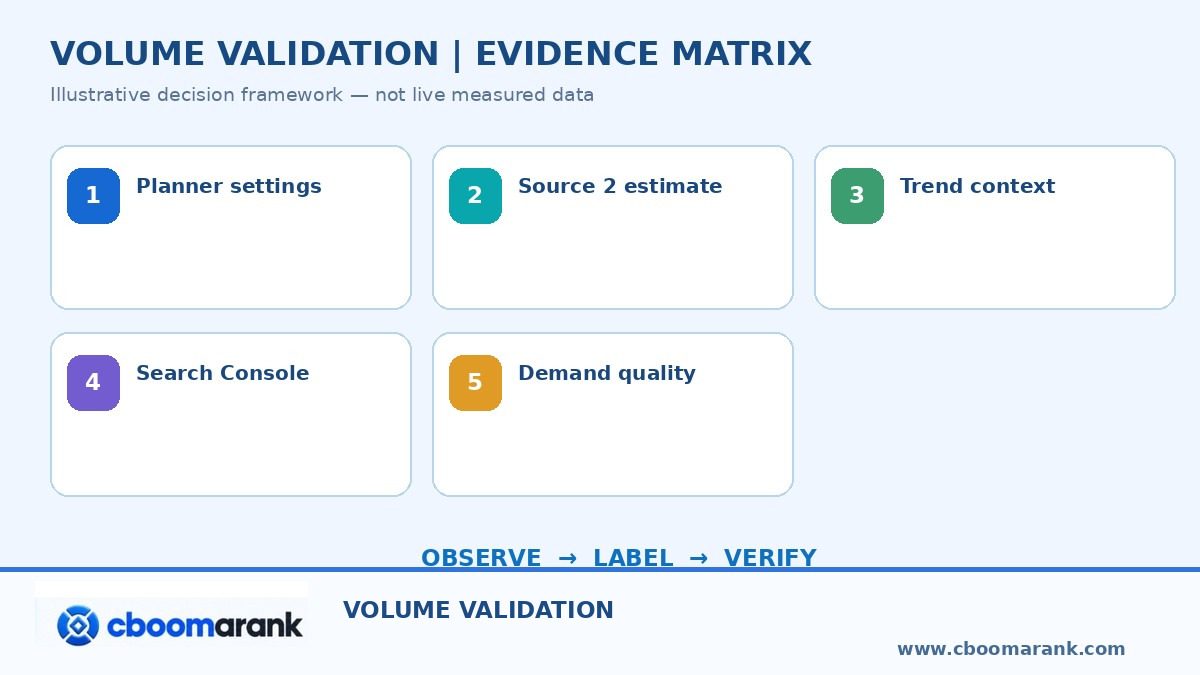
At a Glance: Evidence You Need Before Making a Decision
| Stage | What to do | Why it matters |
|---|---|---|
| 1 | Create a clean keyword and country list | Enter one row per query, market and language. |
| 2 | Check Google Keyword Planner settings | Open Keyword Planner in an eligible Google Ads account and inspect historical metrics. |
| 3 | Repeat a small sample with a second tool | Use another research source to compare order-of-magnitude estimates and related variations. |
| 4 | Verify current interest and seasonal patterns | Use a trend view to detect rising, falling or seasonal demand. |
| 5 | Cross-check your existing website | In Search Console, review related queries generating impressions and clicks for relevant pages. |
| 6 | Use a demand-quality scorecard | Score relevance, intent, achievable ranking opportunity, topical expertise and conversion path. |
| 7 | Publish, measure and refine | Build the content that satisfies the chosen intent. |

How to Use Search Volume Checker: A Seven-Step Method
Step 1: Create a clean keyword and country list
Enter one row per query, market and language. Remove accidental duplicates but preserve phrases whose intent differs. Assign an intended landing-page type before exporting hundreds of ideas. A search volume checker is only as useful as the seed list, and a noisy list can exaggerate the available content opportunity.
For this stage, make your evidence traceable: record the scope of “create a clean keyword and country list,” the source you consulted, what remains uncertain, and the next action you would take. If the available data is incomplete, mark it as an assumption rather than filling the gap with an unsupported ranking, conversion rate or advertising cost. This extra discipline makes search volume checker work easier to audit when another analyst repeats the exercise next month.
Step 2: Check Google Keyword Planner settings — Search Volume Checker
Open Keyword Planner in an eligible Google Ads account and inspect historical metrics. Confirm the selected country, language, Search Network and date range. Record average monthly searches, competition, and top-of-page bid ranges where available. Competition in Google Ads is advertiser competition, not an organic keyword difficulty score.
For this stage, make your evidence traceable: record the scope of “check google keyword planner settings,” the source you consulted, what remains uncertain, and the next action you would take. If the available data is incomplete, mark it as an assumption rather than filling the gap with an unsupported ranking, conversion rate or advertising cost. This extra discipline makes search volume checker work easier to audit when another analyst repeats the exercise next month.
Step 3: Repeat a small sample with a second tool
Use another research source to compare order-of-magnitude estimates and related variations. Differences should prompt inspection of country settings and close-variant handling, not a claim that the larger figure is true. Save both source labels and collection dates; choose a conservative planning range where uncertainty remains.
For this stage, make your evidence traceable: record the scope of “repeat a small sample with a second tool,” the source you consulted, what remains uncertain, and the next action you would take. If the available data is incomplete, mark it as an assumption rather than filling the gap with an unsupported ranking, conversion rate or advertising cost. This extra discipline makes search volume checker work easier to audit when another analyst repeats the exercise next month.
Quality check for step 3
Confirm that the observation is relevant to the user’s real task and that a different location, date, device, page, or audience would not change its meaning. Document any exception in the research workbook so it does not become an unexplained outlier in a later presentation.
Step 4: Verify current interest and seasonal patterns
Use a trend view to detect rising, falling or seasonal demand. A 12-month average may conceal sudden product launches or annual peaks. Never translate a normalized trend score into an absolute search count without a suitable supporting source.
For this stage, make your evidence traceable: record the scope of “verify current interest and seasonal patterns,” the source you consulted, what remains uncertain, and the next action you would take. If the available data is incomplete, mark it as an assumption rather than filling the gap with an unsupported ranking, conversion rate or advertising cost. This extra discipline makes search volume checker work easier to audit when another analyst repeats the exercise next month.
Step 5: Cross-check your existing website — Search Volume Checker
In Search Console, review related queries generating impressions and clicks for relevant pages. Search Console reflects your own search exposure, not the total number of searches in the market. A query absent from your performance report can still have demand if your site has not appeared for it.
For this stage, make your evidence traceable: record the scope of “cross-check your existing website,” the source you consulted, what remains uncertain, and the next action you would take. If the available data is incomplete, mark it as an assumption rather than filling the gap with an unsupported ranking, conversion rate or advertising cost. This extra discipline makes search volume checker work easier to audit when another analyst repeats the exercise next month.
Step 6: Use a demand-quality scorecard
Score relevance, intent, achievable ranking opportunity, topical expertise and conversion path. Rank terms by actionable value rather than volume alone. Use a single parent page for closely related questions unless the SERP proves distinct intent. An editorial brief should state the exact customer problem it will solve.
For this stage, make your evidence traceable: record the scope of “use a demand-quality scorecard,” the source you consulted, what remains uncertain, and the next action you would take. If the available data is incomplete, mark it as an assumption rather than filling the gap with an unsupported ranking, conversion rate or advertising cost. This extra discipline makes search volume checker work easier to audit when another analyst repeats the exercise next month.
Quality check for step 6
Confirm that the observation is relevant to the user’s real task and that a different location, date, device, page, or audience would not change its meaning. Document any exception in the research workbook so it does not become an unexplained outlier in a later presentation.
Step 7: Publish, measure and refine
Build the content that satisfies the chosen intent. Add clear examples, internal links and an appropriate next step, then review impressions and qualified conversions over a reasonable period. Return to the source estimate only as a planning reference; actual first-party outcomes should control future investment.
For this stage, make your evidence traceable: record the scope of “publish, measure and refine,” the source you consulted, what remains uncertain, and the next action you would take. If the available data is incomplete, mark it as an assumption rather than filling the gap with an unsupported ranking, conversion rate or advertising cost. This extra discipline makes search volume checker work easier to audit when another analyst repeats the exercise next month.
Search Volume Checker in Practice: Worked Example
A local IT company collects 25 service-related phrases in London and Toronto. It compares Planner settings by country, notes that some keyword volumes are grouped or rounded, and separates “emergency network support” from a generic networking tutorial. One landing-page cluster is selected because it matches a real service. A follow-up report tracks impressions, qualified calls and form submissions rather than boasting that estimated volume became customers.
Evidence rule: Any example figures in this article are hypothetical teaching inputs, not CBOOMARANK customer results, a current Google Ads auction, or a measurement of a named competitor. Use your own collected records before drawing a commercial conclusion.
Common Search Volume Checker Mistakes and How to Avoid Them
1. Never treat Google Ads competition as organic difficulty.
Never treat Google Ads competition as organic difficulty. A more reliable approach is to label the exact source, period, market and limitations beside the observation, then state what the user should do next. This matters because stakeholder decisions can become expensive when a narrow sampled signal is promoted into an unsupported universal claim. Keep the correction tied to the reader’s goal and check whether the evidence changes after the next consistent measurement.
2. Record country, network and date range with each value.
Record country, network and date range with each value. A more reliable approach is to label the exact source, period, market and limitations beside the observation, then state what the user should do next. This matters because stakeholder decisions can become expensive when a narrow sampled signal is promoted into an unsupported universal claim. Keep the correction tied to the reader’s goal and check whether the evidence changes after the next consistent measurement.
3. Cross-check but do not average incompatible datasets blindly.
Cross-check but do not average incompatible datasets blindly. A more reliable approach is to label the exact source, period, market and limitations beside the observation, then state what the user should do next. This matters because stakeholder decisions can become expensive when a narrow sampled signal is promoted into an unsupported universal claim. Keep the correction tied to the reader’s goal and check whether the evidence changes after the next consistent measurement.
4. Missing estimates are not proof of zero demand.
Missing estimates are not proof of zero demand. A more reliable approach is to label the exact source, period, market and limitations beside the observation, then state what the user should do next. This matters because stakeholder decisions can become expensive when a narrow sampled signal is promoted into an unsupported universal claim. Keep the correction tied to the reader’s goal and check whether the evidence changes after the next consistent measurement.
5. Do not report modeled visits as measured traffic.
Do not report modeled visits as measured traffic. A more reliable approach is to label the exact source, period, market and limitations beside the observation, then state what the user should do next. This matters because stakeholder decisions can become expensive when a narrow sampled signal is promoted into an unsupported universal claim. Keep the correction tied to the reader’s goal and check whether the evidence changes after the next consistent measurement.
6. Match one topic cluster to one primary intent.
Match one topic cluster to one primary intent. A more reliable approach is to label the exact source, period, market and limitations beside the observation, then state what the user should do next. This matters because stakeholder decisions can become expensive when a narrow sampled signal is promoted into an unsupported universal claim. Keep the correction tied to the reader’s goal and check whether the evidence changes after the next consistent measurement.
Turn Search Volume Checker Findings into a 30-Day Action Plan
Week 1 — Collect a reproducible baseline
Agree which keywords, audience, countries, languages, URLs, and conversion goals belong to the project. Verify analytics and search reporting access. Save a dated baseline and label unknown values rather than pretending the available dataset is complete. If source settings differ, create separate rows rather than averaging incompatible results.
Week 2 — Prioritize the evidence
Group queries by shared intent and mark where an existing page already answers the need. Rate opportunities by relevance, feasibility, customer value, confidence and effort. Discuss apparent contradictions before moving budget or restructuring content. Choose one hypothesis that the team can test within its technical and editorial constraints.
Week 3 — Implement one controlled improvement
Improve the most relevant landing page, clarify its answer, fix a tracking problem or test an appropriate paid campaign if authorized. Record what was changed, when, and how success will be measured. Preserve backups and avoid simultaneous changes that make the outcome hard to interpret.
Week 4 — Measure qualified outcomes
Compare equivalent observation windows, review search impressions and clicks, and measure meaningful leads or registrations where tracking is configured. Distinguish correlation from causation. Keep changes that benefit customers, discard weak assumptions and set the next review cadence based on the business value of the finding.
Frequently Asked Questions About Search Volume Checker
Is there a completely accurate search volume checker?
No estimator is a full census of all relevant searches. Use documented source settings and ranges.
Is Google Keyword Planner free?
It is available through Google Ads subject to current account setup and feature access requirements.
Why does a tool show zero searches for an important term?
Sparse data, grouping, limited samples or market selection can explain zero or missing estimates.
Can Search Console give total keyword volume?
No. It measures your site’s recorded search visibility and interaction.
How often should I recheck volume?
Revisit when targeting, seasonality or market conditions materially change rather than refreshing every day for cosmetic updates.
Official References and Further Reading
- Google Ads Keyword Planner: historical metrics and forecasts. Check the provider’s current definitions and limitations.
- Google Search Console: performance reports. Check the provider’s current definitions and limitations.
- Google Search Central: creating helpful content. Check the provider’s current definitions and limitations.
Continue researching with this related CBOOMARANK SEO guide and another practical CBOOMARANK resource. Related articles support this narrower task rather than replacing it.
Final Verdict: Make Search Volume Checker Measurable
The point of search volume checker is not to collect impressive-looking metrics without context. Use a clear measurement specification, original evidence where available, defensible assumptions, and an action tied to a real customer need. A smaller, well-understood result can be more valuable than a broad ranking, search-volume or CPC estimate that cannot be reproduced.
Explore www.cboomarank.com for SEO and competitor research, compare CBOOMARANK plans, and download the nine-topic workbook to document the decision and supporting evidence.
Editorial review: October 2026. Tools, search layouts, plan limits and advertising costs can change. Examples are explicitly illustrative. This CBOOMARANK article is commercial editorial content; verify current third-party facts and product access before making a purchase.
