

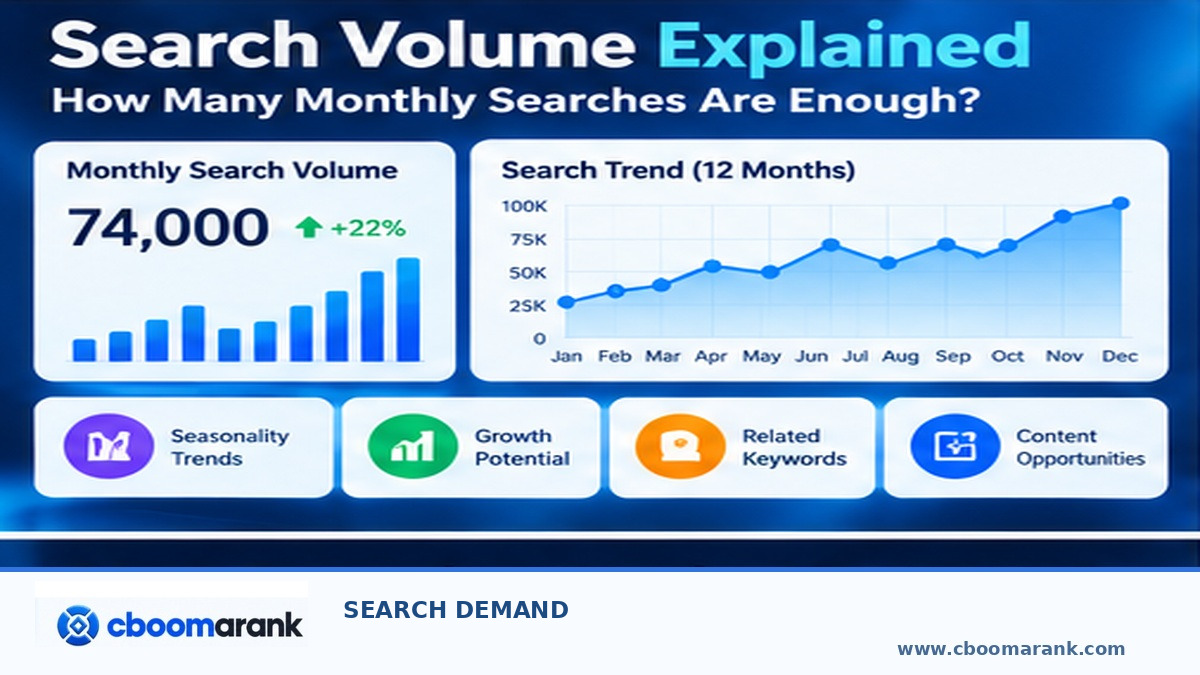
Keyword search volume describes estimated search demand, usually expressed as searches per month for a query or group of close variants. “Enough” depends on your audience, ranking opportunity, click share, purchase intent and the value of a customer. One hundred niche searches can be commercially useful, while a hundred thousand unrelated searches may produce almost no qualified revenue.
Practical scope: Use volume ranges, demand distribution and conversion capacity to decide what is enough. The instructions below distinguish actual first-party metrics, observed search results, and third-party estimates. Their meaning changes with location, date, device, and source, so a useful decision begins by documenting those inputs.
Explore CBOOMARANK, review the CBOOMARANK pricing options, or use the Ranks 66–74 research workbook to record your research and next actions.
What Is Keyword Search Volume? Quick Explanation
Keyword search volume describes estimated search demand, usually expressed as searches per month for a query or group of close variants. “Enough” depends on your audience, ranking opportunity, click share, purchase intent and the value of a customer. One hundred niche searches can be commercially useful, while a hundred thousand unrelated searches may produce almost no qualified revenue.
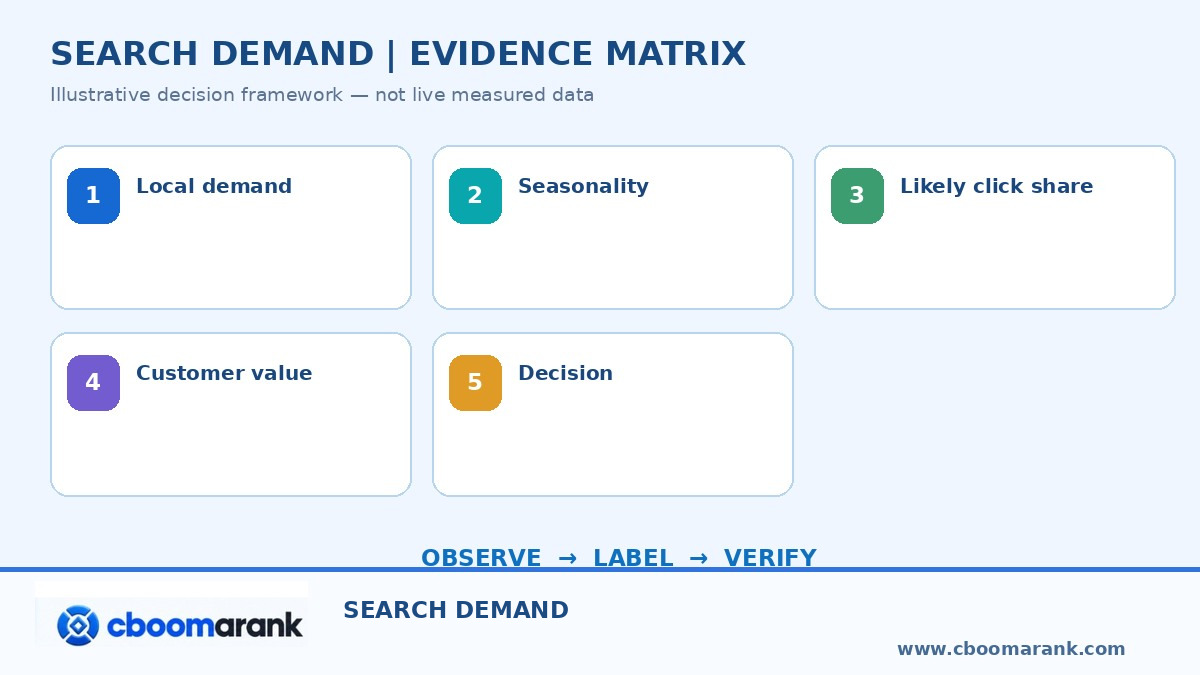
At a Glance: Evidence You Need Before Making a Decision
| Stage | What to do | Why it matters |
|---|---|---|
| 1 | Understand where volume comes from | Many tools model demand using Google Ads data, clickstream sources or other sampled datasets. |
| 2 | Separate global volume from local opportunity | Start with the countries and languages you serve. |
| 3 | Examine seasonality and trend direction | Compare month-by-month estimates where available and use Google Trends carefully for relative direction rather than absolute search counts. |
| 4 | Estimate realistic accessible clicks | Start with estimated search demand, but discount for ranking probability, actual click share, SERP layouts, competitor strength and query ambigui. |
| 5 | Connect the keyword to profit | A commercial phrase with forty qualified searches may be more useful than a large generic informational phrase. |
| 6 | Choose clusters instead of individual phrases | Group closely related queries when one page can satisfy the same underlying intent. |
| 7 | Set a decision threshold and test | Specify the minimum credible demand, strategic value and effort you require. |

How to Use Keyword Search Volume: A Seven-Step Method
Step 1: Understand where volume comes from
Many tools model demand using Google Ads data, clickstream sources or other sampled datasets. Google Keyword Planner reports average monthly searches for a configured location and network, often grouped with close variants. A displayed monthly estimate is not a promise of that many distinct users or clicks to your page.
For this stage, make your evidence traceable: record the scope of “understand where volume comes from,” the source you consulted, what remains uncertain, and the next action you would take. If the available data is incomplete, mark it as an assumption rather than filling the gap with an unsupported ranking, conversion rate or advertising cost. This extra discipline makes keyword search volume work easier to audit when another analyst repeats the exercise next month.
Step 2: Separate global volume from local opportunity — Keyword Search Volume
Start with the countries and languages you serve. A global total can conceal that most demand is in markets you cannot fulfill. Record whether the research tool reports a single country, multiple countries or global estimates. A local service provider may need city-level query research instead of a national aggregate.
For this stage, make your evidence traceable: record the scope of “separate global volume from local opportunity,” the source you consulted, what remains uncertain, and the next action you would take. If the available data is incomplete, mark it as an assumption rather than filling the gap with an unsupported ranking, conversion rate or advertising cost. This extra discipline makes keyword search volume work easier to audit when another analyst repeats the exercise next month.
Step 3: Examine seasonality and trend direction
Compare month-by-month estimates where available and use Google Trends carefully for relative direction rather than absolute search counts. Peak-season demand can dominate a yearly average. Products affected by tax periods, school terms, software launches or holiday shopping need a seasonal content and campaign calendar.
For this stage, make your evidence traceable: record the scope of “examine seasonality and trend direction,” the source you consulted, what remains uncertain, and the next action you would take. If the available data is incomplete, mark it as an assumption rather than filling the gap with an unsupported ranking, conversion rate or advertising cost. This extra discipline makes keyword search volume work easier to audit when another analyst repeats the exercise next month.
Quality check for step 3
Confirm that the observation is relevant to the user’s real task and that a different location, date, device, page, or audience would not change its meaning. Document any exception in the research workbook so it does not become an unexplained outlier in a later presentation.
Step 4: Estimate realistic accessible clicks
Start with estimated search demand, but discount for ranking probability, actual click share, SERP layouts, competitor strength and query ambiguity. Avoid turning a search estimate directly into a traffic forecast. When available, use existing Search Console CTR by page and query type as a more relevant starting point.
For this stage, make your evidence traceable: record the scope of “estimate realistic accessible clicks,” the source you consulted, what remains uncertain, and the next action you would take. If the available data is incomplete, mark it as an assumption rather than filling the gap with an unsupported ranking, conversion rate or advertising cost. This extra discipline makes keyword search volume work easier to audit when another analyst repeats the exercise next month.
Step 5: Connect the keyword to profit — Keyword Search Volume
A commercial phrase with forty qualified searches may be more useful than a large generic informational phrase. Evaluate customer value, conversion path, repeat purchases and lead qualification. Advertiser bid estimates can hint at competition but do not establish your own conversion economics.
For this stage, make your evidence traceable: record the scope of “connect the keyword to profit,” the source you consulted, what remains uncertain, and the next action you would take. If the available data is incomplete, mark it as an assumption rather than filling the gap with an unsupported ranking, conversion rate or advertising cost. This extra discipline makes keyword search volume work easier to audit when another analyst repeats the exercise next month.
Step 6: Choose clusters instead of individual phrases
Group closely related queries when one page can satisfy the same underlying intent. Estimate opportunities for the cluster without blindly summing near-duplicate keyword volumes, which can double-count searches. Create distinct pages only when user tasks and SERP results genuinely differ.
For this stage, make your evidence traceable: record the scope of “choose clusters instead of individual phrases,” the source you consulted, what remains uncertain, and the next action you would take. If the available data is incomplete, mark it as an assumption rather than filling the gap with an unsupported ranking, conversion rate or advertising cost. This extra discipline makes keyword search volume work easier to audit when another analyst repeats the exercise next month.
Quality check for step 6
Confirm that the observation is relevant to the user’s real task and that a different location, date, device, page, or audience would not change its meaning. Document any exception in the research workbook so it does not become an unexplained outlier in a later presentation.
Step 7: Set a decision threshold and test
Specify the minimum credible demand, strategic value and effort you require. If you already have impressions on a related page, improving that page may be faster than starting a new article. Measure changes in clicks and qualified leads after updates, then revise your assumptions rather than declaring a forecast proven.
For this stage, make your evidence traceable: record the scope of “set a decision threshold and test,” the source you consulted, what remains uncertain, and the next action you would take. If the available data is incomplete, mark it as an assumption rather than filling the gap with an unsupported ranking, conversion rate or advertising cost. This extra discipline makes keyword search volume work easier to audit when another analyst repeats the exercise next month.
Keyword Search Volume in Practice: Worked Example
A hypothetical consultancy evaluates an enterprise analytics query with 90 monthly searches and a general definition query with 9,000. The first may produce fewer visitors but better demo enquiries; the second may build awareness and internal-link authority. The team tests a commercial landing page and a helpful explainer separately, records their Search Console impressions, and measures actual form quality. Neither term is automatically a winner based on volume alone.
Evidence rule: Any example figures in this article are hypothetical teaching inputs, not CBOOMARANK customer results, a current Google Ads auction, or a measurement of a named competitor. Use your own collected records before drawing a commercial conclusion.
Common Keyword Search Volume Mistakes and How to Avoid Them
1. Document the geography behind each volume number.
Document the geography behind each volume number. A more reliable approach is to label the exact source, period, market and limitations beside the observation, then state what the user should do next. This matters because stakeholder decisions can become expensive when a narrow sampled signal is promoted into an unsupported universal claim. Keep the correction tied to the reader’s goal and check whether the evidence changes after the next consistent measurement.
2. Volume is searches, not guaranteed website visits.
Volume is searches, not guaranteed website visits. A more reliable approach is to label the exact source, period, market and limitations beside the observation, then state what the user should do next. This matters because stakeholder decisions can become expensive when a narrow sampled signal is promoted into an unsupported universal claim. Keep the correction tied to the reader’s goal and check whether the evidence changes after the next consistent measurement.
3. Be careful with close-variant aggregation.
Be careful with close-variant aggregation. A more reliable approach is to label the exact source, period, market and limitations beside the observation, then state what the user should do next. This matters because stakeholder decisions can become expensive when a narrow sampled signal is promoted into an unsupported universal claim. Keep the correction tied to the reader’s goal and check whether the evidence changes after the next consistent measurement.
4. Trend indices are not absolute counts.
Trend indices are not absolute counts. A more reliable approach is to label the exact source, period, market and limitations beside the observation, then state what the user should do next. This matters because stakeholder decisions can become expensive when a narrow sampled signal is promoted into an unsupported universal claim. Keep the correction tied to the reader’s goal and check whether the evidence changes after the next consistent measurement.
5. Measure leads, not just projected click totals.
Measure leads, not just projected click totals. A more reliable approach is to label the exact source, period, market and limitations beside the observation, then state what the user should do next. This matters because stakeholder decisions can become expensive when a narrow sampled signal is promoted into an unsupported universal claim. Keep the correction tied to the reader’s goal and check whether the evidence changes after the next consistent measurement.
6. Cluster shared intent to prevent duplicate content.
Cluster shared intent to prevent duplicate content. A more reliable approach is to label the exact source, period, market and limitations beside the observation, then state what the user should do next. This matters because stakeholder decisions can become expensive when a narrow sampled signal is promoted into an unsupported universal claim. Keep the correction tied to the reader’s goal and check whether the evidence changes after the next consistent measurement.
Turn Keyword Search Volume Findings into a 30-Day Action Plan
Week 1 — Collect a reproducible baseline
Agree which keywords, audience, countries, languages, URLs, and conversion goals belong to the project. Verify analytics and search reporting access. Save a dated baseline and label unknown values rather than pretending the available dataset is complete. If source settings differ, create separate rows rather than averaging incompatible results.
Week 2 — Prioritize the evidence
Group queries by shared intent and mark where an existing page already answers the need. Rate opportunities by relevance, feasibility, customer value, confidence and effort. Discuss apparent contradictions before moving budget or restructuring content. Choose one hypothesis that the team can test within its technical and editorial constraints.
Week 3 — Implement one controlled improvement
Improve the most relevant landing page, clarify its answer, fix a tracking problem or test an appropriate paid campaign if authorized. Record what was changed, when, and how success will be measured. Preserve backups and avoid simultaneous changes that make the outcome hard to interpret.
Week 4 — Measure qualified outcomes
Compare equivalent observation windows, review search impressions and clicks, and measure meaningful leads or registrations where tracking is configured. Distinguish correlation from causation. Keep changes that benefit customers, discard weak assumptions and set the next review cadence based on the business value of the finding.
Frequently Asked Questions About Keyword Search Volume
Is 100 searches a month worth targeting?
It can be if relevance and customer value are high; context matters more than a universal minimum.
Does monthly search volume equal unique searchers?
No. Some people search repeatedly, and tools may group closely related phrases.
Why do research tools disagree?
They can use different datasets, geographies, time ranges and estimation methods.
What does Google Trends 100 mean?
It is a normalized relative interest index for the selected context, not 100 monthly searches.
Should I add search volumes for every keyword variant?
Avoid blindly summing close variants or near-synonymous phrases because estimates may overlap.
Official References and Further Reading
- Google Ads Keyword Planner: historical metrics and forecasts. Check the provider’s current definitions and limitations.
- Google Search Console: performance reports. Check the provider’s current definitions and limitations.
- Google Search Central: creating helpful content. Check the provider’s current definitions and limitations.
Continue researching with this related CBOOMARANK SEO guide and another practical CBOOMARANK resource. Related articles support this narrower task rather than replacing it.
Final Verdict: Make Keyword Search Volume Measurable
The point of keyword search volume is not to collect impressive-looking metrics without context. Use a clear measurement specification, original evidence where available, defensible assumptions, and an action tied to a real customer need. A smaller, well-understood result can be more valuable than a broad ranking, search-volume or CPC estimate that cannot be reproduced.
Explore www.cboomarank.com for SEO and competitor research, compare CBOOMARANK plans, and download the nine-topic workbook to document the decision and supporting evidence.
Editorial review: October 2026. Tools, search layouts, plan limits and advertising costs can change. Examples are explicitly illustrative. This CBOOMARANK article is commercial editorial content; verify current third-party facts and product access before making a purchase.
