

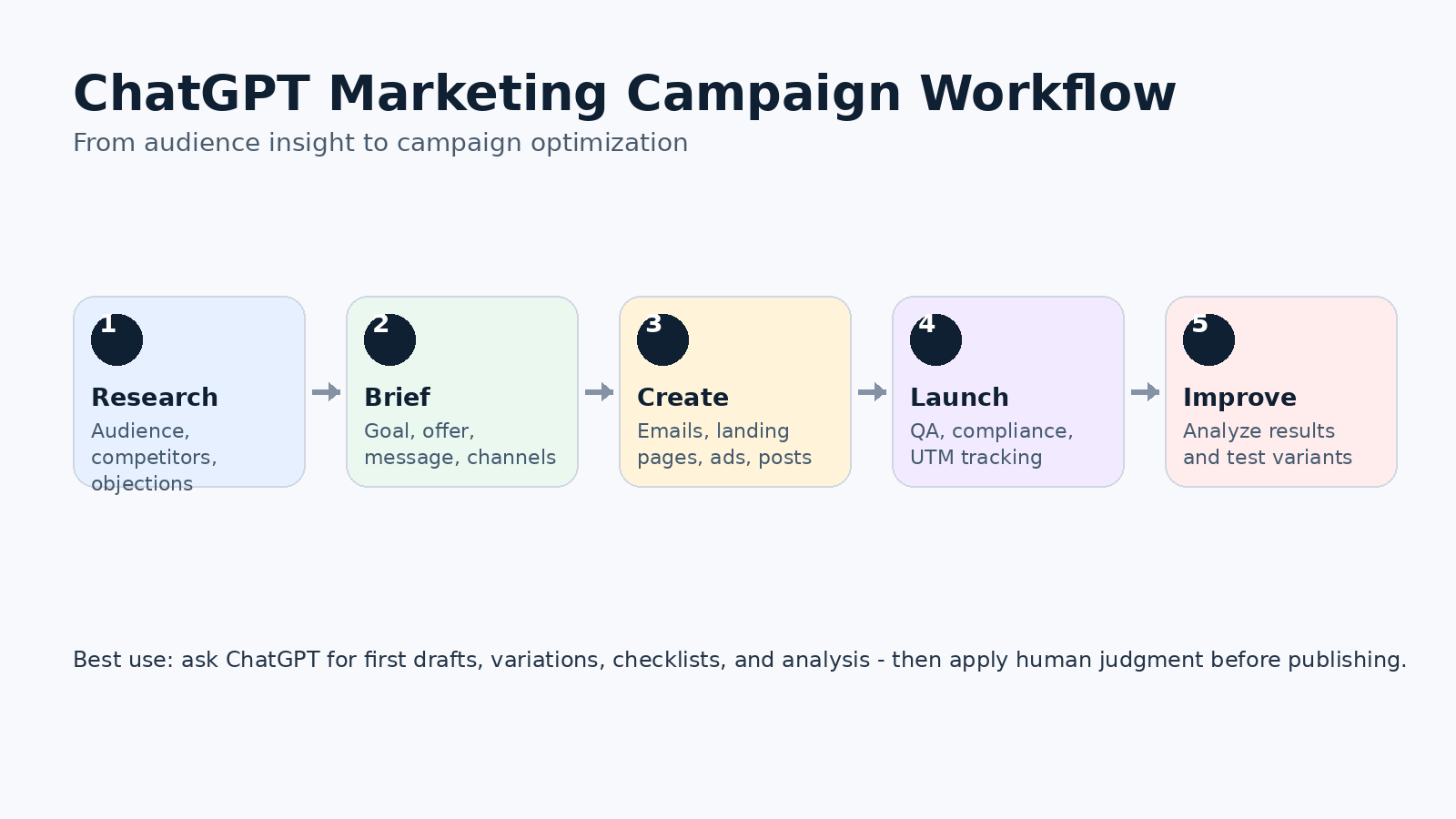
Introduction: Why Marketers Are Using ChatGPT
ChatGPT has become one of the most practical AI tools for marketing teams because it can reduce the blank-page problem, organize scattered campaign inputs, and speed up first drafts. Used correctly, it can help marketers turn product notes, audience research, customer objections, brand guidelines, and performance data into campaign briefs, content ideas, email sequences, social posts, paid ad variations, landing page copy, and reporting insights. OpenAI describes ChatGPT for marketing teams as a way to move from idea to brief to assets to launch and then back to performance review, while helping teams generate variations for testing and summarize results into next steps.
However, ChatGPT is not a replacement for marketing strategy. It should not be used to publish unchecked claims, invent customer results, bypass legal review, or replace audience research. The best results come when marketers use ChatGPT as a campaign assistant: fast at drafting, organizing, summarizing, and varying ideas, but guided by human judgment, data, brand standards, and compliance rules.
What ChatGPT Can Do in a Marketing Campaign
A marketing campaign usually requires many moving parts: audience analysis, offer positioning, messaging, content production, creative testing, launch coordination, reporting, and optimization. ChatGPT can support each step by converting raw information into structured outputs. For example, it can turn a messy product description into a campaign brief, transform a customer persona into channel-specific messages, create ten subject-line variations, summarize a Google Analytics export, or explain why one landing page angle may outperform another.
OpenAI’s marketing solution page describes ChatGPT Work as helping marketing teams use customer insights, campaign context, and brand standards to create briefs, creative assets, and performance reports. That makes it useful across the full campaign lifecycle, not just content writing.
Important Rule: Use ChatGPT as an Assistant, Not an Autopilot
The biggest mistake beginners make is asking ChatGPT to write a campaign and then publishing the output without review. That is risky. AI can make confident mistakes, miss legal context, overstate benefits, use a generic tone, or create content that sounds polished but does not match your actual customers.
The safer workflow is simple: give ChatGPT clear inputs, ask for structured outputs, review the result, add human experience, verify claims, adapt the tone, and test performance. In other words, ChatGPT should accelerate the marketing process, but your team still owns the strategy, truthfulness, brand voice, and final approval.
| Campaign Stage | How ChatGPT Helps | Example Output |
| Research | Summarizes customer pain points, competitor messages, and audience objections. | Persona notes, objection list, competitor positioning summary |
| Strategy | Turns goals and inputs into a campaign brief. | Campaign objective, audience, offer, message, channels, timeline |
| Creative | Generates multiple message angles and copy variations. | Email copy, ad copy, landing page sections, social posts |
| Launch | Creates QA checklists and channel-specific publishing plans. | Launch checklist, UTM naming plan, content calendar |
| Optimization | Summarizes results and suggests test ideas. | Performance recap, winning angles, next experiments |
Step 1: Define the Campaign Goal
Start by giving ChatGPT a clear business goal. A weak prompt like “write a marketing campaign” will produce generic results. A stronger prompt includes the product, audience, offer, deadline, channel, budget range, success metric, and constraints.
Use this prompt:
You are a senior marketing strategist. Create a campaign brief for
targeting [audience]. The main goal is [lead generation/sales/trial signups/brand awareness]. The offer is [offer]. The campaign will run on [channels] for [time period]. Include campaign objective, audience pain points, positioning, core message, content assets, CTA, tracking metrics, and risks.
Step 2: Build a Useful Customer Persona
ChatGPT can help turn basic audience notes into a practical persona. The goal is not to invent fake customers but to organize what you already know. Include real customer feedback, sales-call notes, reviews, survey responses, and support questions when available.
Prompt:
Based on these customer notes, create a practical marketing persona. Include goals, pain points, objections, buying triggers, preferred channels, questions they ask before buying, and messages that are likely to resonate. Do not invent statistics or claims.
Step 3: Create Campaign Angles
Once you have a clear persona and offer, ask ChatGPT to produce multiple angles. This is where ChatGPT is especially useful because it can generate variations quickly. For example, one angle might focus on saving time, another on reducing cost, another on risk reduction, and another on social proof.
Prompt:
Generate 10 campaign angles for [offer] targeting [persona]. For each angle, include the emotional hook, logical proof point, headline idea, CTA, and best channel. Make the ideas specific, avoid exaggerated claims, and prioritize angles that can be tested.
Step 4: Write a Landing Page Draft
A landing page needs structure, not just copy. Ask ChatGPT to create a page outline before writing the full draft. This helps you review the story flow before investing time in polishing.
Prompt:
Create a landing page outline for this campaign. Include hero headline, subheadline, problem section, solution section, benefits, proof points, FAQ, CTA sections, trust elements, and conversion notes. Then write a first draft in a clear, persuasive, non-hype tone.
Step 5: Generate Email Campaigns
ChatGPT can quickly build email sequences for launches, webinar registrations, lead nurturing, product education, abandoned carts, and reactivation. The strongest email prompts include the audience, offer, send schedule, tone, objection, and CTA.
Prompt:
Write a 5-email campaign for [audience] promoting [offer]. Include subject line, preview text, email body, CTA, and purpose of each email. Email 1 should introduce the problem, Email 2 should explain the solution, Email 3 should address objections, Email 4 should show proof, and Email 5 should create urgency without using false scarcity.
Step 6: Create Social Media Content
For social media, ChatGPT can create post variations for LinkedIn, X, Facebook, Instagram captions, TikTok scripts, and YouTube Shorts ideas. The key is to specify the platform because a strong LinkedIn post usually differs from a TikTok script or Instagram caption.
Prompt:
Create a 14-day social media content calendar for this campaign. Include platform, post type, hook, caption, visual idea, CTA, and hashtag direction. Keep the tone educational and practical.
Step 7: Draft Paid Ad Variations
ChatGPT can help produce ad variations for Google Ads, Meta Ads, LinkedIn Ads, and Microsoft Ads. However, ad copy must be reviewed for policy compliance and truthful claims. Google Ads notes that Performance Max uses Google AI to optimize bids and placements for conversion goals, but advertisers still provide inputs such as audience signals and high-quality text, images, and video.
Prompt:
Create 15 paid ad variations for [offer]. Group them by angle: pain-point, benefit, proof, comparison, and urgency. Include headline, description, CTA, and landing page message match. Avoid unsupported claims and prohibited wording.
Step 8: Build a Measurement Plan
Campaigns should be measurable before they launch. ChatGPT can help create a tracking plan with UTMs, KPIs, conversion events, and reporting questions.
Prompt:
Create a campaign measurement plan for [campaign]. Include primary KPI, secondary KPIs, UTM naming convention, conversion events, weekly reporting questions, and how to decide whether to pause, improve, or scale the campaign.
Step 9: Analyze Results and Improve
After launch, ChatGPT can help summarize campaign results and identify patterns. You can paste non-sensitive performance data, such as channel-level metrics, and ask for insights. Always check the math and context before making decisions.
Prompt:
Analyze this campaign performance summary. Identify the strongest channel, weakest channel, likely reasons for performance, what to test next, and three recommendations for the next campaign. Do not assume causes that are not supported by the data.
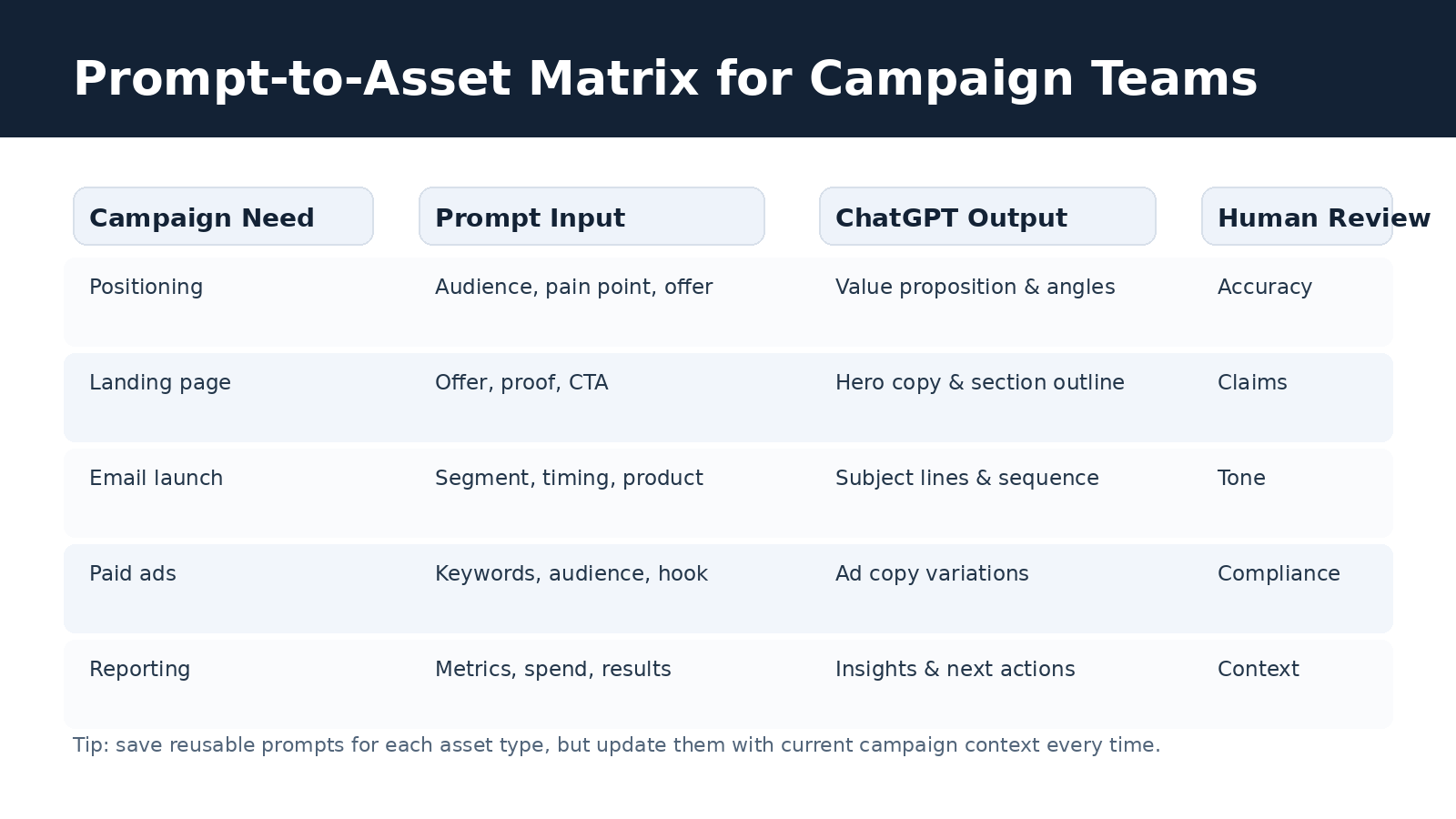
How to Use ChatGPT for SEO Content Campaigns
For SEO campaigns, ChatGPT can help create topic clusters, content briefs, title options, meta descriptions, FAQ ideas, internal linking maps, and content refresh plans. It should not be used to mass-produce low-value content. Google Search Central’s guidance on AI-generated content focuses on rewarding original, high-quality, people-first content rather than content produced mainly to manipulate rankings.
A safe SEO workflow is to use ChatGPT to draft outlines and improve clarity, then add first-hand expertise, examples, screenshots, product testing, original data, and editorial review. For CBOOMARANK, useful internal links can include the Best Free SEO Tools for Beginners guide, SEO Pricing Guide, Semrush vs Ahrefs comparison, and Ubersuggest vs Semrush comparison.
How to Use ChatGPT for PPC Campaigns
For PPC, ChatGPT can help brainstorm ad angles, write headline variations, structure landing page messages, create keyword theme groups, and review ad-to-landing-page message match. It can also help summarize campaign results and propose tests.
Do not let ChatGPT invent performance claims such as guaranteed conversions, exact ROAS, or competitor comparisons unless you have verified evidence. Use it to generate ideas, then check all ad platform policies and performance data.
How to Use ChatGPT for Email Marketing
For email marketing, ChatGPT can create lifecycle sequences, promotional campaigns, welcome emails, abandoned-cart emails, reactivation campaigns, subject line tests, and segmentation ideas. Strong prompts should include the subscriber type, offer, stage of awareness, brand tone, and the action you want the reader to take.
A good email workflow is: ask ChatGPT for sequence strategy, generate first drafts, improve subject lines, shorten copy, personalize by segment, and then manually review for brand accuracy and deliverability.
How to Use ChatGPT for Social Media Campaigns
ChatGPT can help turn one campaign idea into multiple platform-specific content pieces. For example, a blog post can become a LinkedIn post, a Twitter/X thread, an Instagram carousel outline, a Facebook caption, a YouTube Shorts script, and a newsletter intro.
The most important rule is to adapt the format. Do not simply copy the same text across every platform. Ask ChatGPT to rewrite for each platform’s style, audience, and length.
How to Use ChatGPT for Campaign Reporting
Reporting is one of the most underrated uses of ChatGPT. Marketers often spend too much time explaining data manually. ChatGPT can turn performance tables into summaries, insights, and recommendations.
For example, provide channel-level results such as spend, impressions, clicks, leads, cost per lead, conversion rate, and revenue. Then ask ChatGPT to identify patterns, possible explanations, risks, and next actions. Never accept the output without checking the numbers and business context.
| Marketing Task | Reusable ChatGPT Prompt |
| Campaign brief | Create a campaign brief for [offer] targeting [audience], including goals, key message, channels, KPIs, assets, and timeline. |
| Persona | Turn these customer notes into a persona with pain points, objections, triggers, and messaging recommendations. |
| Landing page | Create a conversion-focused landing page outline and first draft for [offer]. Include headline, sections, FAQ, and CTA. |
| Email sequence | Write a 5-email sequence for [audience] that introduces the problem, explains the solution, addresses objections, shows proof, and asks for action. |
| Ad copy | Generate ad copy variations by angle, including pain point, benefit, proof, comparison, and urgency. |
| Social calendar | Create a 14-day content calendar with post hooks, captions, visual ideas, and CTAs. |
| Performance report | Summarize campaign data into insights, risks, lessons, and next tests. |
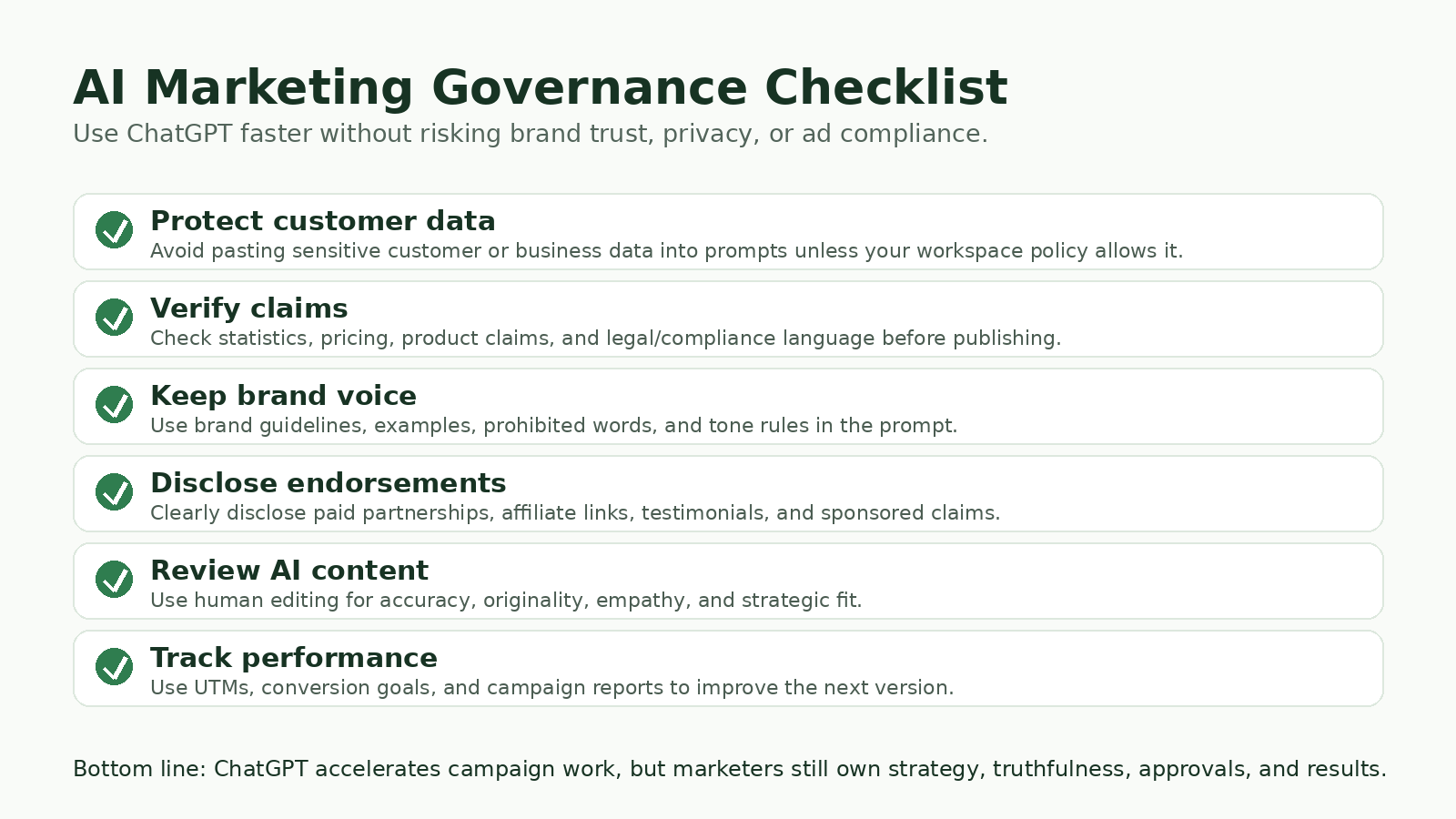
.
Best Practices for Using ChatGPT in Marketing
The best marketers use ChatGPT with clear inputs, not vague requests. Before prompting, collect your audience data, offer details, brand voice, proof points, objections, channel requirements, and success metrics. Then ask for structured outputs such as tables, checklists, briefs, or drafts.
Use ChatGPT to create options, not one final answer. Ask for three positioning angles, ten subject lines, five ad hooks, or two landing page structures. Then choose the strongest ideas and improve them with human experience.
Marketing Compliance and Brand Safety
Marketing teams should treat AI output as a draft that needs review. Be careful with claims about health, finance, income, rankings, savings, legal outcomes, or guaranteed results. If a campaign includes endorsements, influencer content, testimonials, or affiliate promotion, review FTC guidance on endorsements and disclosures.
Privacy also matters. OpenAI’s ChatGPT Business documentation states that OpenAI does not train on workspace data by default, and business data is encrypted in transit and at rest. Even with stronger business privacy settings, teams should still follow their own internal data policy and avoid unnecessary sharing of sensitive customer information.
What Not to Do With ChatGPT in Campaigns
Do not publish AI-generated content without review. Do not paste sensitive customer data into prompts without approval. Do not ask ChatGPT to fabricate testimonials, statistics, case studies, product claims, or competitor facts. Do not generate large volumes of thin SEO content only to target keywords. Do not ignore ad platform rules or legal disclosures.
ChatGPT is powerful, but marketing trust is fragile. A campaign that is fast but inaccurate can damage your brand faster than a slower campaign that is carefully reviewed.
Best Internal Links for This CBOOMARANK Article
Use internal links to connect this article with related CBOOMARANK content. Recommended links include Best AI Marketing Tools in 2026, AI for Marketing: The Complete Beginner’s Guide, Best Free SEO Tools for Beginners, Semrush vs Ahrefs, Ubersuggest vs Semrush, SEO Pricing Guide, and Submit URL to Search Engines. These links help readers continue learning and help search engines understand topic relationships across the site.
Final Verdict
ChatGPT can help marketers plan campaigns faster, create better first drafts, generate content variations, organize launch tasks, and analyze results. The best approach is not to replace marketers but to give them a faster campaign assistant.
Use ChatGPT for research summaries, campaign briefs, personas, landing pages, email sequences, social posts, ad copy variations, SEO outlines, content calendars, and reporting insights. Then add human strategy, customer knowledge, brand voice, fact-checking, compliance review, and performance testing.
In 2026, the winning marketing teams will not be the ones that blindly automate everything. They will be the teams that combine AI speed with human judgment, strong positioning, accurate data, and consistent optimization.
FAQ: Using ChatGPT for Marketing Campaigns
Can ChatGPT create a full marketing campaign?
Yes, ChatGPT can help create a full campaign framework, including brief, audience persona, messaging, assets, calendar, and reporting plan. However, marketers should review and customize all outputs before launch.
Is ChatGPT good for marketing beginners?
Yes. Beginners can use ChatGPT to understand campaign structure, generate ideas, draft content, and create checklists. It is especially useful when paired with real customer research and analytics data.
Can I use ChatGPT for SEO content?
Yes, but use it responsibly. Google guidance focuses on helpful, original, people-first content. Add human expertise, examples, verification, and editorial review before publishing.
Can ChatGPT write paid ad copy?
Yes. ChatGPT can create ad copy variations, but you must check claims, policies, character limits, landing-page consistency, and platform rules before publishing.
Can ChatGPT analyze campaign data?
Yes. It can summarize performance data and suggest next actions, but you should verify calculations and interpret results using business context.
What information should I give ChatGPT before asking for campaign content?
Provide the product, target audience, goal, offer, value proposition, objections, brand voice, channel, campaign timeline, CTA, and proof points.
What should marketers avoid when using ChatGPT?
Avoid publishing unchecked content, inventing claims, using sensitive data without approval, ignoring disclosures, and relying on AI output without strategy or review.
Recommended Internal Links for CBOOMARANK
- AI for Marketing: The Complete Beginner’s Guide: https://www.cboomarank.com/blog/ai-for-marketing-the-complete-beginners-guide/
- Best AI Marketing Tools in 2026: https://www.cboomarank.com/blog/best-ai-marketing-tools-2026/
- Best Free SEO Tools for Beginners: https://www.cboomarank.com/blog/best-free-seo-tools-for-beginners/
- Semrush vs Ahrefs: https://www.cboomarank.com/blog/semrush-vs-ahrefs/
- Ubersuggest vs Semrush: https://www.cboomarank.com/blog/ubersuggest-vs-semrush/
- Submit URL to Search Engines: https://www.cboomarank.com/blog/submit-url-to-search-engines/
- SEO Pricing Guide: https://www.cboomarank.com/blog/seo-pricing-guide/
External Authoritative References
- OpenAI Academy – ChatGPT for marketing teams: https://openai.com/academy/marketing/
- OpenAI – ChatGPT Work for marketing teams: https://openai.com/business/solutions/marketing/
- OpenAI Help – Managing data, sharing, and privacy in ChatGPT Business: https://help.openai.com/en/articles/8798634
- Google Search Central – Guidance on generative AI content: https://developers.google.com/search/docs/fundamentals/using-gen-ai-content
- Google Ads Help – About Performance Max campaigns: https://support.google.com/google-ads/answer/10724817
- FTC – Advertisement endorsements: https://www.ftc.gov/news-events/topics/truth-advertising/advertisement-endorsements
