

Table of Contents
- What Makes a Backlink High Quality in 2026?
- Why High-Quality Backlinks Still Matter
- The 2026 Backlink Quality Framework
- Step 1: Build Linkable Assets
- Step 2: Find Relevant Link Prospects
- Step 3: Use Outreach That Helps the Reader
- Step 4: Guest Post the Right Way
- Step 5: Use Broken Link Building
- Step 6: Earn Links Through Digital PR
- Step 7: Track, Clean Up, and Improve
- Backlink Strategies by Business Type
- Link-Building Mistakes to Avoid
- Backlink Quality Checklist
- Suggested Internal and External Links
- FAQ
How to Build High-Quality Backlinks in 2026
Backlinks are still one of the strongest trust signals in SEO, but the way businesses should build them has changed. In 2026, successful link building is less about collecting as many links as possible and more about earning relevant, editorial mentions from websites that serve real audiences.
A high-quality backlink is a link from another website that makes sense for the reader, appears naturally inside useful content, comes from a relevant or trusted source, and supports the topic of the linked page. A weak backlink is usually unrelated, automated, paid without proper disclosure, over-optimized, or placed only to manipulate rankings.
This guide explains how to build backlinks safely in 2026 without spammy shortcuts. It is written for business owners, bloggers, affiliate marketers, ecommerce teams, SaaS companies, and agencies that want long-term organic growth.
What Makes a Backlink High Quality in 2026?
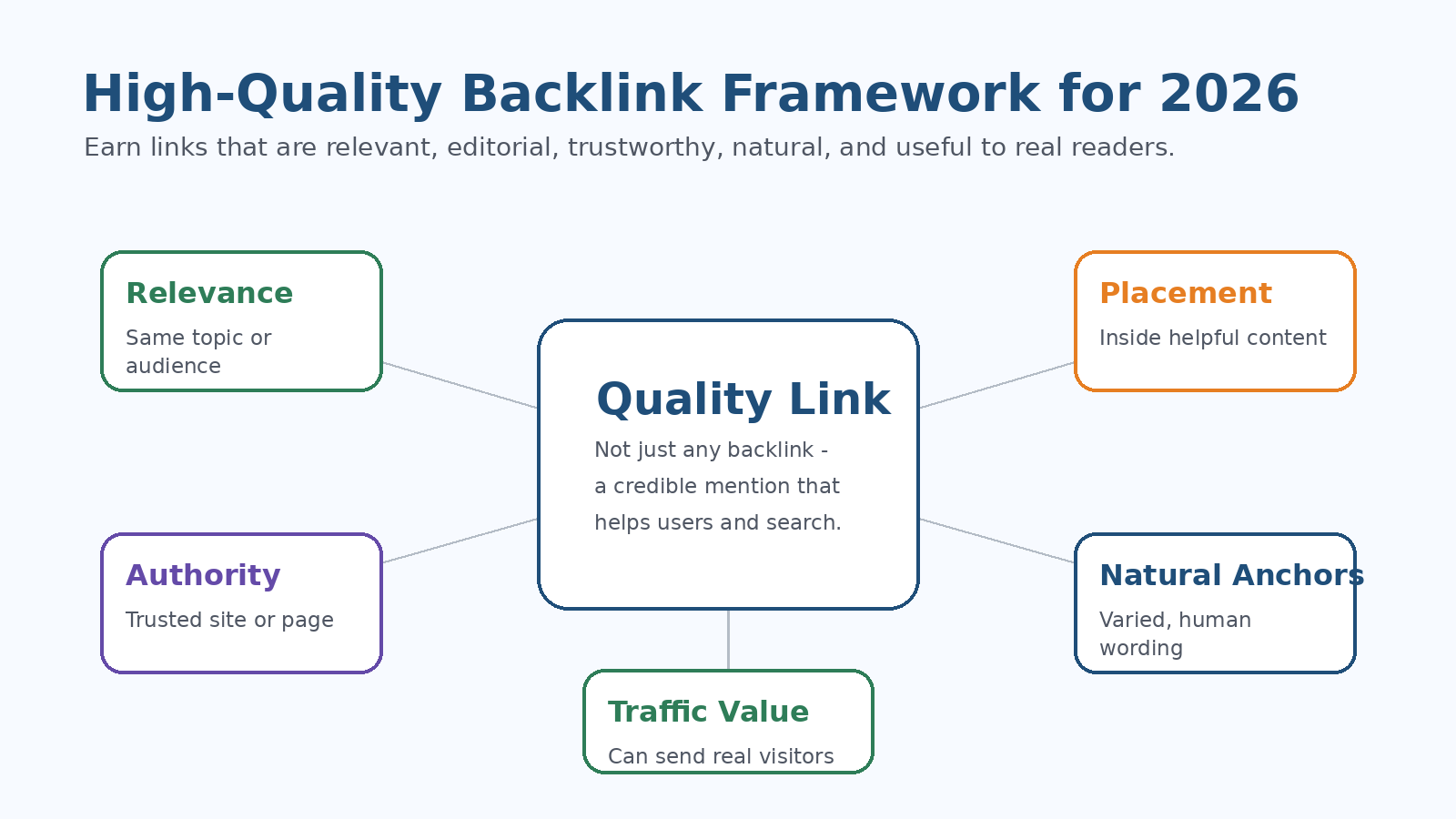
A strong backlink is not defined by one metric alone. Domain authority, Domain Rating, traffic estimates, and spam scores can help you evaluate an opportunity, but they should not replace common sense. The best links usually have five qualities: relevance, authority, editorial placement, natural anchor text, and real traffic potential.
| Quality Signal | What It Means | Why It Matters |
| Relevance | The linking site or page is related to your topic, niche, audience, or problem. | Relevant links help search engines and readers understand your topical authority. |
| Authority | The page or website has credibility, quality content, and a real audience. | Trusted sites can strengthen perceived authority and brand credibility. |
| Editorial placement | The link appears naturally inside the main body of useful content. | Editorial links are usually more valuable than random footer, sidebar, or directory links. |
| Natural anchor text | The clickable text looks human and varied, not forced or repetitive. | Natural anchors reduce risk and help maintain a healthy backlink profile. |
| Traffic potential | The link can be clicked by real readers. | Referral traffic makes the link valuable beyond ranking influence. |
Google recommends qualifying paid, sponsored, affiliate, and user-generated outbound links with appropriate attributes where needed. That means safe link building should respect disclosure and avoid tactics designed only to manipulate search rankings.
Ahrefs also identifies relevance, authority, anchor text, and placement as major concepts used by SEOs when judging backlink quality. Backlinko similarly emphasizes that in 2026, brand credibility, topical associations, AI visibility, and editorial trust all matter more than raw link volume.
Why High-Quality Backlinks Still Matter
Backlinks matter because they help search engines discover pages, understand relationships between websites, and evaluate whether other publishers trust your content. They also create referral traffic, brand mentions, partnership opportunities, and industry credibility.
For a new website, backlinks can help search engines find important pages faster. For a growing business, backlinks can improve authority around commercial topics. For an affiliate website, backlinks can support comparison pages, buying guides, tutorials, and review content. For ecommerce brands, backlinks can strengthen category pages, product guides, and resource hubs.
However, backlinks only work well when the rest of your SEO foundation is healthy. You still need helpful content, technical SEO, fast pages, clean internal linking, strong search intent alignment, and reliable tracking. Link building should amplify quality content, not hide weak content.
The 2026 Backlink Quality Framework
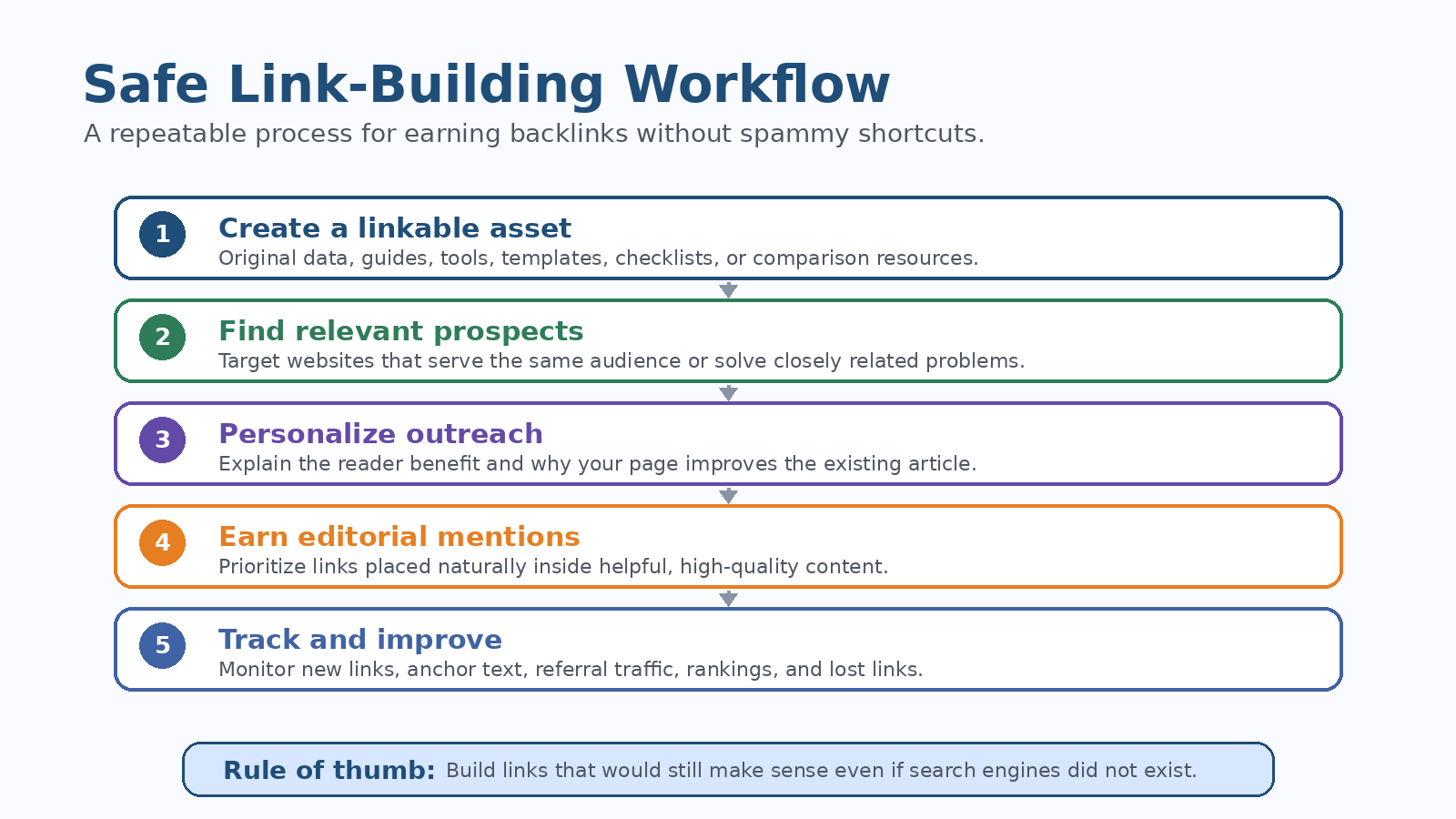
Before you start outreach, use a simple filter: would this link make sense if Google did not exist? If the answer is yes, the backlink is more likely to be safe, useful, and valuable. If the link only exists to pass ranking signals, it may be risky.
- Create a page worth linking to. Useful assets attract links more naturally than ordinary sales pages.
- Find websites that share your audience. Relevance should come before raw authority metrics.
- Pitch the value to readers. Explain why the link improves the page, not why you want a backlink.
- Earn editorial placement. Aim for links inside helpful content, not hidden placements.
- Track results. Monitor referring domains, anchor text, traffic, conversions, and lost links.
Step 1: Build Linkable Assets
The easiest way to earn strong backlinks is to create something people actually want to reference. A linkable asset is a page, resource, or piece of content that provides unique value to other writers, bloggers, journalists, educators, and business owners.
Most websites struggle with link building because they try to build links to pages that are not link-worthy. A generic service page, thin blog post, or copied listicle is difficult to pitch. A useful guide, original study, calculator, checklist, template, comparison, or data-driven report is much easier to promote.
Examples of Linkable Assets
- Original research, surveys, or industry statistics.
- Free calculators, audit tools, templates, or worksheets.
- Long-form guides that solve a specific problem better than existing results.
- Comparison tables that help buyers choose between products or services.
- Checklists for SEO audits, website launches, backlink outreach, or content optimization.
- Visual explainers, infographics, and downloadable frameworks.
- Case studies with real steps, screenshots, and measurable results.
For CBOOMARANK, strong linkable assets could include a free SEO checklist, a backlink quality checklist, a keyword research template, a web hosting comparison scorecard, and a downloadable SEO pricing calculator.
Step 2: Find Relevant Link Prospects
A link prospect is a website, page, journalist, blogger, partner, or publication that could reasonably link to your asset. The best prospects already cover topics related to your niche and have content where your page would improve the reader experience.
Do not start with random mass outreach. Start with relevance. Search for pages that already mention your topic but do not yet include your resource. Look for list posts, resource pages, competitor links, broken links, old guides, and articles that need updated examples.
Ways to Find Link Prospects
- Search Google for resource pages using terms like “SEO resources”, “marketing tools”, or “link building checklist”.
- Use competitor backlink analysis to see who links to similar content.
- Find outdated articles that need newer 2026 examples or statistics.
- Look for broken external links on relevant websites.
- Identify podcasts, newsletters, and blogs that feature expert sources.
- Review partner, vendor, client, and association websites for legitimate mention opportunities.
Step 3: Use Outreach That Helps the Reader
Good outreach is not begging for links. Good outreach explains how your resource helps the writer improve their article and serve their readers. The message should be short, personalized, and specific.
A strong outreach email includes the page you are referencing, the exact reason your content fits, the benefit to the reader, and a polite closing. Avoid fake flattery, generic templates, and long explanations about your SEO goals.
Simple Outreach Template
Subject: Useful resource for your [topic] article
Hi [Name],
I was reading your article on [page topic] and noticed you included resources on [specific section]. We recently published a practical guide on [your resource] that includes [unique value: checklist, data, examples, template, or step-by-step process].
It may be a helpful addition for readers who want to [reader benefit]. Here is the resource: [URL]
Either way, thanks for creating a useful article.
Best,
[Your Name]
The goal is to make the editor’s decision easy. If your resource is genuinely helpful and the page is relevant, some outreach will convert. If the resource is weak, outreach volume will not fix the problem.
Step 4: Guest Post the Right Way
Guest posting still works when it is done as real publishing, not as spam. A good guest post gives the host website an original article that helps their audience. The link back to your website should be natural, relevant, and useful.
Avoid low-quality guest post farms, recycled content, and websites that publish anything for payment. If the site has no editorial standards, no audience, and unrelated categories, it is probably not worth your time.
Good Guest Posting Criteria
- The website is relevant to your industry or audience.
- The site publishes original content and has visible editorial quality.
- The link is placed only where it helps the reader.
- The article is not copied, spun, or AI-generated without review.
- The author bio and any sponsored relationship are transparent.
- The post can send referral traffic or build brand credibility.
Step 5: Use Broken Link Building
Broken link building is a white-hat strategy where you find dead links on relevant websites and suggest your content as a replacement. This works because you are helping the website owner fix a bad user experience.
To use this tactic, find a relevant page in your niche, check whether any external links are broken, create or identify a resource that replaces the dead page, and contact the site owner with a short helpful message.
Broken Link Building Process
- Find a relevant resource page or article.
- Check for broken external links.
- Confirm your page is a strong replacement.
- Send a short message explaining the broken link and replacement resource.
- Track responses and update your prospect list.
Step 6: Earn Links Through Digital PR
Digital PR is one of the strongest ways to build high-quality backlinks because it focuses on stories, data, expert commentary, and newsworthy content. Instead of asking for links directly, you create something worth covering.
Examples include industry reports, survey findings, trend analysis, expert predictions, interactive tools, or local data studies. Journalists and bloggers need credible sources. If your brand provides useful data or expert insight, you can earn mentions and links from relevant publications.
Digital PR Ideas for SEO and Marketing Brands
- Publish a yearly SEO pricing report.
- Analyze website speed benchmarks across popular CMS platforms.
- Survey small businesses about SEO budgets and tool usage.
- Create a study comparing backlink profiles of top-ranking websites.
- Release a free template or calculator journalists can reference.
Step 7: Track, Clean Up, and Improve
Link building is not finished when a backlink goes live. You should track which links are earned, which pages attract links, which anchors are used, which links are lost, and whether referral traffic or rankings improve over time.
Start with Google Search Console for basic link data. Then use SEO tools such as Ahrefs, Semrush, SE Ranking, Moz, or Ubersuggest when you need deeper backlink analysis, competitor gaps, anchor text reports, and link monitoring.
Be careful with disavow files. Most sites do not need to disavow every strange-looking link. Focus on building better links and only consider disavow actions when there is a clear history of manipulative link building or a manual action risk.
Backlink Strategies by Business Type
| Business Type | Best Link Assets | Recommended Tactics |
| Local business | Local guides, community resources, service checklists | Local citations, partnerships, chamber directories, local PR, sponsorships with proper disclosure |
| Blog or affiliate site | Comparison guides, tutorials, templates, statistics | Guest posting, resource page outreach, broken link building, expert roundups |
| Ecommerce store | Buying guides, product comparison tools, trend reports | Digital PR, blogger reviews with disclosure, product guides, niche resource outreach |
| SaaS company | Free tools, benchmark reports, templates, integrations pages | Digital PR, software directories, partner pages, data studies, expert commentary |
| SEO agency | Case studies, calculators, audits, industry reports | Guest posts, webinars, podcast features, statistics pages, thought leadership |
Link-Building Mistakes to Avoid
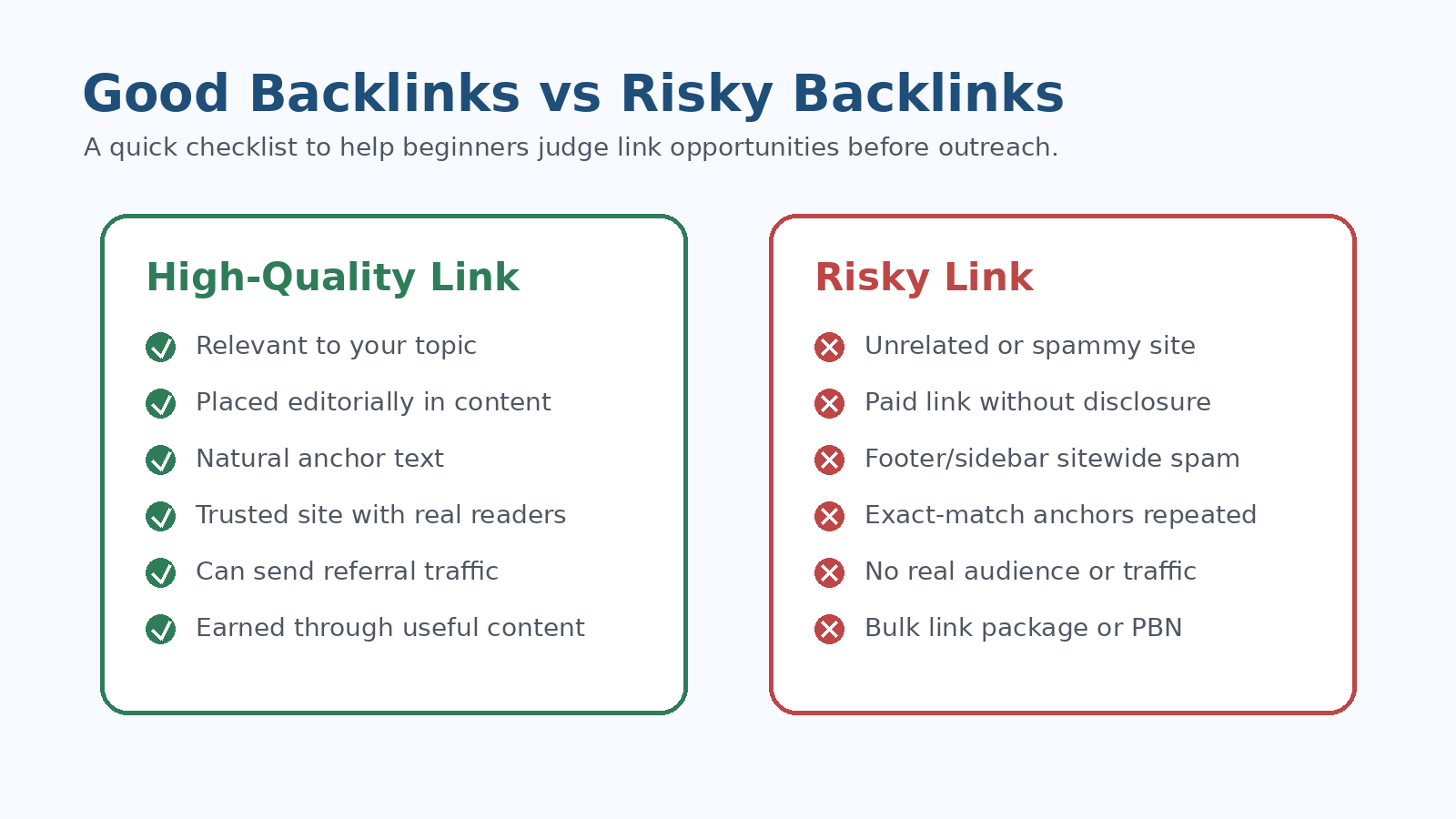
Most backlink problems come from chasing shortcuts. Cheap link packages, private blog networks, unrelated guest posts, automated comments, spam directories, and exact-match anchor manipulation may appear attractive, but they can damage trust and waste budget.
- Do not buy bulk backlink packages from unrelated websites.
- Do not use private blog networks as your main link strategy.
- Do not force every anchor text to match your target keyword.
- Do not publish guest posts on websites with no editorial quality.
- Do not ignore sponsored, affiliate, or user-generated link attributes when they are required.
- Do not build links to weak pages before improving the content.
- Do not judge every opportunity only by DA or DR. Relevance and quality matter more.
Backlink Quality Checklist
| Question | Good Sign | Warning Sign |
| Is the site relevant? | It covers your topic or serves your audience. | It is completely unrelated to your niche. |
| Is the content useful? | The page provides real information and value. | The page exists only to sell links. |
| Is the link editorial? | The link fits naturally inside the article. | The link is hidden in a footer, widget, or random list. |
| Is the anchor natural? | Anchor text varies and sounds human. | All anchors use exact-match money keywords. |
| Can it send traffic? | The website appears to have real readers. | No audience, no rankings, and thin content. |
| Is payment involved? | Sponsored relationships are disclosed and qualified. | Paid links are disguised as organic editorial links. |
Suggested Internal Links for CBOOMARANK
Add these internal links naturally inside the WordPress article to strengthen topical relevance and help readers continue learning:
- Best Free SEO Tools for Beginners
- SEO Pricing Guide: What Businesses Should Expect
- Semrush vs Ahrefs
- Ubersuggest vs Semrush
- Submit URL to Search Engines
Suggested External Authoritative Links
Use these external references to support link quality, spam-safe practices, outbound link qualification, and backlink evaluation:
- Google Search Central – Spam Policies
- Google Search Central – Qualify Outbound Links
- Ahrefs – What Makes a High-Quality Backlink?
- Backlinko – High-Quality Backlinks Guide
- Google Search Central – SEO Starter Guide
Final Verdict
The best way to build high-quality backlinks in 2026 is to create genuinely useful content, identify relevant websites, personalize outreach, earn editorial placements, and monitor results over time. Link building should support users first and search engines second.
For most businesses, the best backlink strategy is a mix of linkable assets, guest posting on relevant sites, broken link building, digital PR, partner mentions, and consistent content improvement. Avoid cheap shortcuts, protect your brand reputation, and focus on links that would still be valuable even if rankings were not involved.
FAQ
What is a high-quality backlink?
A high-quality backlink is a relevant, editorial link from a trusted website or page that uses natural anchor text and can provide value to real readers.
How do beginners build backlinks?
Beginners should start by creating helpful content, reaching out to relevant websites, guest posting on quality blogs, using broken link building, and building local or industry relationships.
Are backlinks still important in 2026?
Yes. Backlinks still matter, but quality, relevance, editorial context, brand credibility, and user value matter more than raw backlink volume.
Is guest posting still good for SEO?
Guest posting can be valuable when it is relevant, original, editorial, and useful to the host website audience. Low-quality guest post networks should be avoided.
Should I buy backlinks?
Buying links for ranking manipulation is risky. If a link is sponsored, paid, affiliate-related, or user-generated, it should be properly qualified according to search engine guidance.
How many backlinks do I need?
There is no fixed number. The answer depends on competition, keyword difficulty, content quality, site authority, and the backlink profiles of pages already ranking.
What is the safest link-building strategy?
The safest strategy is to create link-worthy resources and earn mentions from relevant websites through outreach, PR, partnerships, guest content, and useful assets.
How do I check backlink quality?
Check relevance, trust, placement, anchor text, traffic potential, page quality, and whether the link exists for users rather than only for SEO.
