

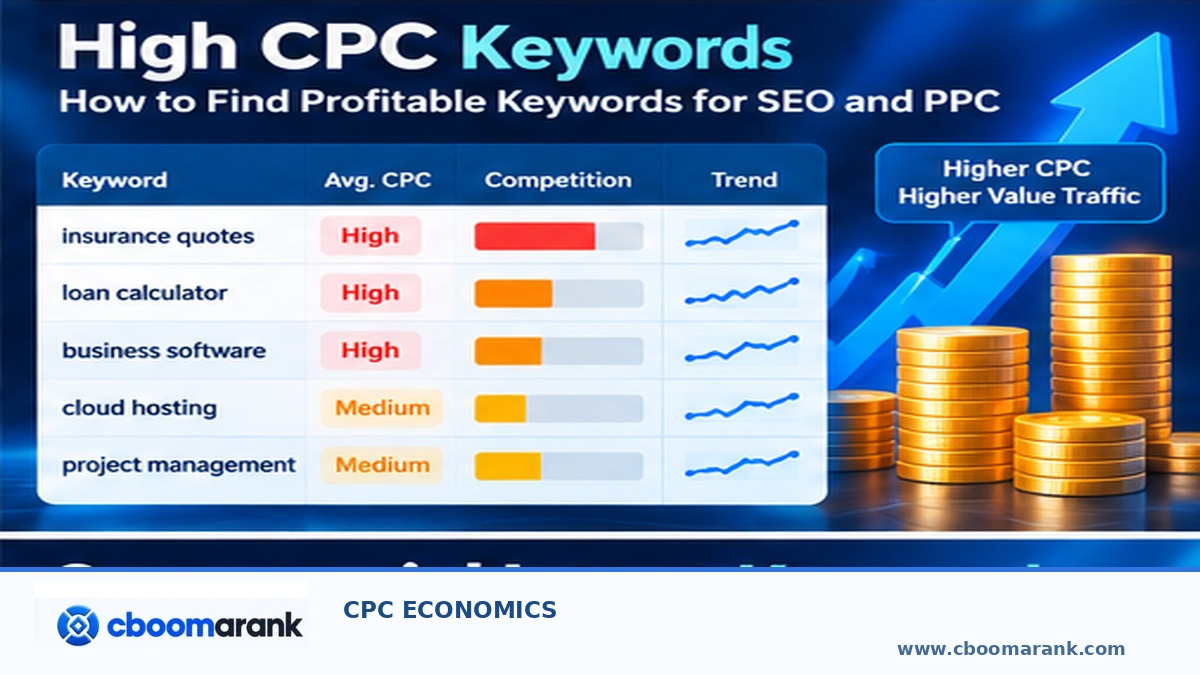
High CPC keywords can indicate intense bidding, valuable customers or limited ad inventory. They do not automatically guarantee profitable traffic. A keyword may be expensive because advertisers compete aggressively even when your business cannot convert those visitors. This guide connects cost-per-click estimates with customer value, lead quality and a practical SEO-versus-PPC decision.
Practical scope: Evaluate economics behind costly paid clicks and organic opportunity. The instructions below distinguish actual first-party metrics, observed search results, and third-party estimates. Their meaning changes with location, date, device, and source, so a useful decision begins by documenting those inputs.
What Is High Cpc Keywords? Quick Explanation
High CPC keywords can indicate intense bidding, valuable customers or limited ad inventory. They do not automatically guarantee profitable traffic. A keyword may be expensive because advertisers compete aggressively even when your business cannot convert those visitors. This guide connects cost-per-click estimates with customer value, lead quality and a practical SEO-versus-PPC decision.
High CPC Keywords: Evidence to Evaluate Before Investing
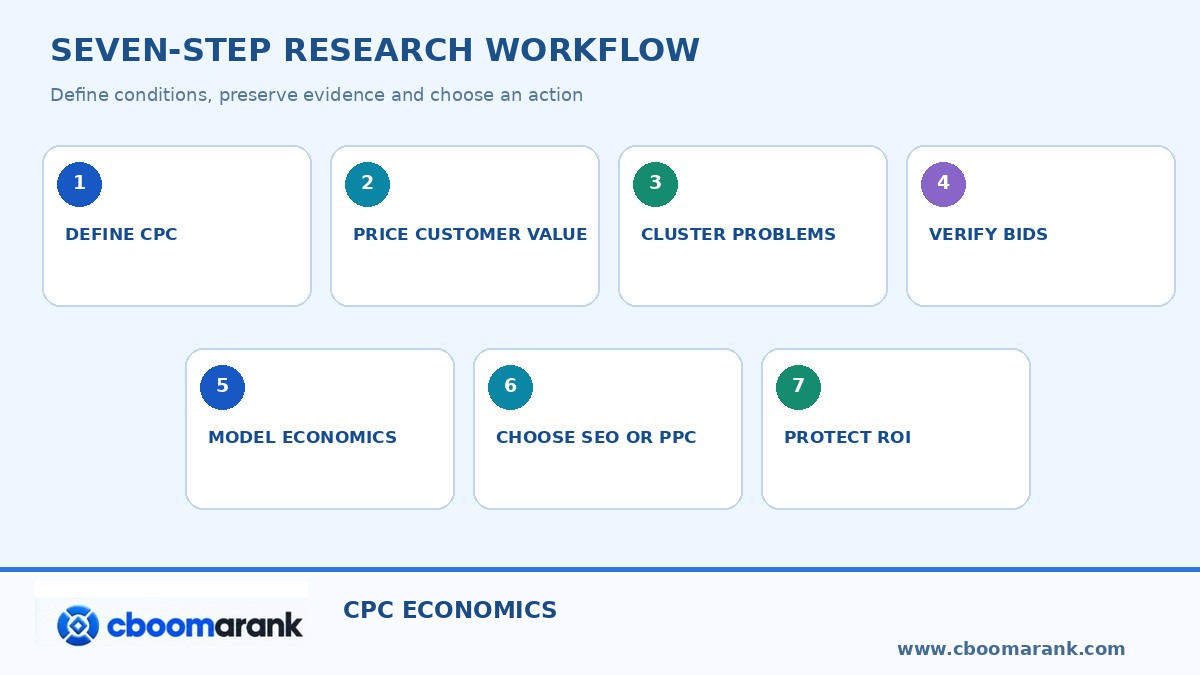
| Stage | What to do | Why it matters |
|---|---|---|
| 1 | Understand the CPC metric before using it | Cost per click is the amount paid for an advertising click. |
| 2 | Start from products with measurable value | List the offers with known gross margin, lead-to-customer rate and realistic customer lifetime value. |
| 3 | Build clusters around commercial problems | Research pricing, quote, demo, solution, agency, insurance, hosting or enterprise-related queries only where relevant to your business. |
| 4 | Verify paid bidding evidence | Use Keyword Planner bid ranges and your own Google Ads search-term and auction reports where permitted. |
| 5 | Model the conversion economics | For a hypothetical $12 CPC and 3% qualified lead rate, cost per qualified lead would be $400, before sales conversion. |
| 6 | Choose paid or organic investment intentionally | Paid search can test a high-intent term quickly but requires budget and accurate conversion tracking. |
| 7 | Protect ROI after launch | Review actual search terms for irrelevant intent, test ad-to-landing-page relevance, and monitor lead quality and cost per acquisition. |
How to Use High Cpc Keywords: A Seven-Step Method
Step 1: Understand the CPC metric before using it
Cost per click is the amount paid for an advertising click. Average CPC is an observed cost divided by clicks within the reporting scope; Planner top-of-page bid ranges are historical auction indicators, not fixed future prices. Specify market, device, date and currency. Do not label third-party estimates as verified advertiser spend.
For this stage, make your evidence traceable: record the scope of “understand the cpc metric before using it,” the source you consulted, what remains uncertain, and the next action you would take. If the available data is incomplete, mark it as an assumption rather than filling the gap with an unsupported ranking, conversion rate or advertising cost. This extra discipline makes high CPC keywords work easier to audit when another analyst repeats the exercise next month.
Step 2: Start from products with measurable value — High Cpc Keywords
List the offers with known gross margin, lead-to-customer rate and realistic customer lifetime value. A keyword costing more than alternatives might still be sensible when it produces well-qualified enterprise leads. Conversely, an expensive broad phrase can waste budget if the landing page has no conversion path.
For this stage, make your evidence traceable: record the scope of “start from products with measurable value,” the source you consulted, what remains uncertain, and the next action you would take. If the available data is incomplete, mark it as an assumption rather than filling the gap with an unsupported ranking, conversion rate or advertising cost. This extra discipline makes high CPC keywords work easier to audit when another analyst repeats the exercise next month.
Step 3: Group High CPC Keywords by Commercial Intent
Research pricing, quote, demo, solution, agency, insurance, hosting or enterprise-related queries only where relevant to your business. Separate definitions from problem-aware and buy-ready phrases. A high-CPC list is most useful when each term maps to an offer the business actually delivers.
For this stage, make your evidence traceable: record the scope of “build clusters around commercial problems,” the source you consulted, what remains uncertain, and the next action you would take. If the available data is incomplete, mark it as an assumption rather than filling the gap with an unsupported ranking, conversion rate or advertising cost. This extra discipline makes high CPC keywords work easier to audit when another analyst repeats the exercise next month.
Quality check for step 3
Confirm that the observation is relevant to the user’s real task and that a different location, date, device, page, or audience would not change its meaning. Document any exception in the research workbook so it does not become an unexplained outlier in a later presentation.
Step 4: Verify paid bidding evidence
Use Keyword Planner bid ranges and your own Google Ads search-term and auction reports where permitted. Keep estimates and realized average CPC in separate fields. Check search network, location and matching settings: two advertisers can pay different prices for ostensibly similar searches.
For this stage, make your evidence traceable: record the scope of “verify paid bidding evidence,” the source you consulted, what remains uncertain, and the next action you would take. If the available data is incomplete, mark it as an assumption rather than filling the gap with an unsupported ranking, conversion rate or advertising cost. This extra discipline makes high CPC keywords work easier to audit when another analyst repeats the exercise next month.
Step 5: Model the conversion economics — High Cpc Keywords
For a hypothetical $12 CPC and 3% qualified lead rate, cost per qualified lead would be $400, before sales conversion. This simple illustration shows why bid cost cannot be judged in isolation. Replace examples with actual tracked outcomes; account for gross margin, refunds, qualification and sales cycle before declaring a keyword profitable.
For this stage, make your evidence traceable: record the scope of “model the conversion economics,” the source you consulted, what remains uncertain, and the next action you would take. If the available data is incomplete, mark it as an assumption rather than filling the gap with an unsupported ranking, conversion rate or advertising cost. This extra discipline makes high CPC keywords work easier to audit when another analyst repeats the exercise next month.
Step 6: Choose paid or organic investment intentionally
Paid search can test a high-intent term quickly but requires budget and accurate conversion tracking. Organic content can support sustained visibility over time but also requires effort, authority and ongoing maintenance. Many valuable keywords warrant both a targeted landing page and paid tests, with separate metrics for each channel.
For this stage, make your evidence traceable: record the scope of “choose paid or organic investment intentionally,” the source you consulted, what remains uncertain, and the next action you would take. If the available data is incomplete, mark it as an assumption rather than filling the gap with an unsupported ranking, conversion rate or advertising cost. This extra discipline makes high CPC keywords work easier to audit when another analyst repeats the exercise next month.
Quality check for step 6
Confirm that the observation is relevant to the user’s real task and that a different location, date, device, page, or audience would not change its meaning. Document any exception in the research workbook so it does not become an unexplained outlier in a later presentation.
Step 7: Protect ROI after launch
Review actual search terms for irrelevant intent, test ad-to-landing-page relevance, and monitor lead quality and cost per acquisition. For SEO, compare content effort with real qualified traffic and conversions. Do not optimize toward CPC alone if your most useful leads come from a less competitive phrase.
For this stage, make your evidence traceable: record the scope of “protect roi after launch,” the source you consulted, what remains uncertain, and the next action you would take. If the available data is incomplete, mark it as an assumption rather than filling the gap with an unsupported ranking, conversion rate or advertising cost. This extra discipline makes high CPC keywords work easier to audit when another analyst repeats the exercise next month.
High Cpc Keywords in Practice: Worked Example
Imagine an agency comparing two illustrative keywords: “enterprise SEO audit software pricing” with high expected click costs and “how to check backlinks” with lower paid intensity. The first may deserve a demo landing page and a tightly controlled paid test, while the second could warrant an educational guide. The team models qualified conversions at several plausible rates rather than assuming the more expensive phrase wins. No figures here represent live auction bids.
Evidence rule: Any example figures in this article are hypothetical teaching inputs, not CBOOMARANK customer results, a current Google Ads auction, or a measurement of a named competitor. Use your own collected records before drawing a commercial conclusion.
Common High Cpc Keywords Mistakes and How to Avoid Them
1. Bid estimates are not guaranteed click prices.
Bid estimates are not guaranteed click prices. A more reliable approach is to label the exact source, period, market and limitations beside the observation, then state what the user should do next. This matters because stakeholder decisions can become expensive when a narrow sampled signal is promoted into an unsupported universal claim. Keep the correction tied to the reader’s goal and check whether the evidence changes after the next consistent measurement.
2. Do not copy “top keywords” lists without checking relevance.
Do not copy “top keywords” lists without checking relevance. A more reliable approach is to label the exact source, period, market and limitations beside the observation, then state what the user should do next. This matters because stakeholder decisions can become expensive when a narrow sampled signal is promoted into an unsupported universal claim. Keep the correction tied to the reader’s goal and check whether the evidence changes after the next consistent measurement.
3. Use actual conversion evidence where available.
Use actual conversion evidence where available. A more reliable approach is to label the exact source, period, market and limitations beside the observation, then state what the user should do next. This matters because stakeholder decisions can become expensive when a narrow sampled signal is promoted into an unsupported universal claim. Keep the correction tied to the reader’s goal and check whether the evidence changes after the next consistent measurement.
4. Segment by geography and currency.
Segment by geography and currency. A more reliable approach is to label the exact source, period, market and limitations beside the observation, then state what the user should do next. This matters because stakeholder decisions can become expensive when a narrow sampled signal is promoted into an unsupported universal claim. Keep the correction tied to the reader’s goal and check whether the evidence changes after the next consistent measurement.
5. Never claim private competitor ROAS from public bid data.
Never claim private competitor ROAS from public bid data. A more reliable approach is to label the exact source, period, market and limitations beside the observation, then state what the user should do next. This matters because stakeholder decisions can become expensive when a narrow sampled signal is promoted into an unsupported universal claim. Keep the correction tied to the reader’s goal and check whether the evidence changes after the next consistent measurement.
6. Compare net value after qualification and acquisition costs.
Compare net value after qualification and acquisition costs. A more reliable approach is to label the exact source, period, market and limitations beside the observation, then state what the user should do next. This matters because stakeholder decisions can become expensive when a narrow sampled signal is promoted into an unsupported universal claim. Keep the correction tied to the reader’s goal and check whether the evidence changes after the next consistent measurement.
Turn High Cpc Keywords Findings into a 30-Day Action Plan
Week 1 — Collect a reproducible baseline
Agree which keywords, audience, countries, languages, URLs, and conversion goals belong to the project. Verify analytics and search reporting access. Save a dated baseline and label unknown values rather than pretending the available dataset is complete. If source settings differ, create separate rows rather than averaging incompatible results.
Week 2 — Prioritize the evidence
Group queries by shared intent and mark where an existing page already answers the need. Rate opportunities by relevance, feasibility, customer value, confidence and effort. Discuss apparent contradictions before moving budget or restructuring content. Choose one hypothesis that the team can test within its technical and editorial constraints.
Week 3 — Implement one controlled improvement
Improve the most relevant landing page, clarify its answer, fix a tracking problem or test an appropriate paid campaign if authorized. Record what was changed, when, and how success will be measured. Preserve backups and avoid simultaneous changes that make the outcome hard to interpret.
Week 4 — Measure qualified outcomes
Compare equivalent observation windows, review search impressions and clicks, and measure meaningful leads or registrations where tracking is configured. Distinguish correlation from causation. Keep changes that benefit customers, discard weak assumptions and set the next review cadence based on the business value of the finding.
Frequently Asked Questions About High Cpc Keywords
Does high CPC mean high buyer intent?
Not always. Competition and targeting may drive costs; inspect the actual search task and conversion results.
Is CPC the same as top-of-page bid?
No. Bid ranges are planning signals; average CPC is based on costs and clicks in the relevant report.
Should I target expensive keywords with SEO?
Sometimes, if the intent fits and you can build a genuinely competitive page.
Can a low CPC keyword be profitable?
Yes. Profitability depends on the cost and value of the customer journey, not the number alone.
How do I estimate profitable CPA?
Use gross margin, closing rates, repeat value and actual conversion quality, then test conservatively.
Official References and Further Reading
- Google Ads Keyword Planner: historical metrics and forecasts. Check the provider’s current definitions and limitations.
- Google Ads Help: understand average CPC. Check the provider’s current definitions and limitations.
- Google Search Central: creating helpful content. Check the provider’s current definitions and limitations.
Continue researching with this related CBOOMARANK SEO guide and another practical CBOOMARANK resource. Related articles support this narrower task rather than replacing it.
Final Verdict: Make High Cpc Keywords Measurable
The point of high CPC keywords is not to collect impressive-looking metrics without context. Use a clear measurement specification, original evidence where available, defensible assumptions, and an action tied to a real customer need. A smaller, well-understood result can be more valuable than a broad ranking, search-volume or CPC estimate that cannot be reproduced.
Editorial review: October 2026. Tools, search layouts, plan limits and advertising costs can change. Examples are explicitly illustrative. This CBOOMARANK article is commercial editorial content; verify current third-party facts and product access before making a purchase.
