


A Google rank checker needs to answer a precise question: which page appeared for which query, on which device, in which location, and at what time? Many people search their own keywords in a logged-in browser and mistake the result for a universal ranking. A private window helps reduce some personal history signals, but it does not override country, approximate location, language, SERP features, time, or search intent. More reliable checking uses controlled parameters and honest uncertainty.
Key question: Understand what incognito can and cannot neutralize, and reproduce ranking observations across device and location. This guide concentrates on controlled and less personalized google observations, distinct from generic checking and free tools. The steps below are structured so website owners, agencies and marketers can reproduce the method without claiming access to private competitor data.
Use the CBOOMARANK six-topic research workbook to document observations, locations, keywords and decisions. For broader website research, visit CBOOMARANK or review CBOOMARANK plans.
Google rank checker: Quick Answer and Scope
A Google rank checker needs to answer a precise question: which page appeared for which query, on which device, in which location, and at what time? Many people search their own keywords in a logged-in browser and mistake the result for a universal ranking. A private window helps reduce some personal history signals, but it does not override country, approximate location, language, SERP features, time, or search intent. More reliable checking uses controlled parameters and honest uncertainty.
How to Use This Neutral SERP methods in Eight Steps
| Stage | Action | Evidence to keep |
|---|---|---|
| 1 | Define what “without personalization” really means | The goal is to reduce avoidable personal-account and browser-history bias, not promise an identical search result f |
| 2 | Start with a signed-out or private browser session | Open a private window and verify that you are not signed in to an account changing the experience. |
| 3 | Choose the country, language, and device explicitly | Search results in Paris can differ from those in Toronto. |
| 4 | Count organic results carefully | Ads, local packs, shopping modules, AI-generated surfaces and ordinary web listings are separate forms of visibilit |
| 5 | Capture results without endless repeated searching | For a modest list of keywords, collect a single documented observation at a planned time, then repeat later under c |
| 6 | Cross-check against Search Console impressions | For your verified property, inspect the query, page, country and device in Search Console. |
| 7 | Repeat samples to assess local volatility | For high-value keywords, compare a small, planned set of observations from relevant markets and devices. |
| 8 | Publish an auditable position report | Each row should include query, target URL, country or city, language, device, observed position, result type, provi |
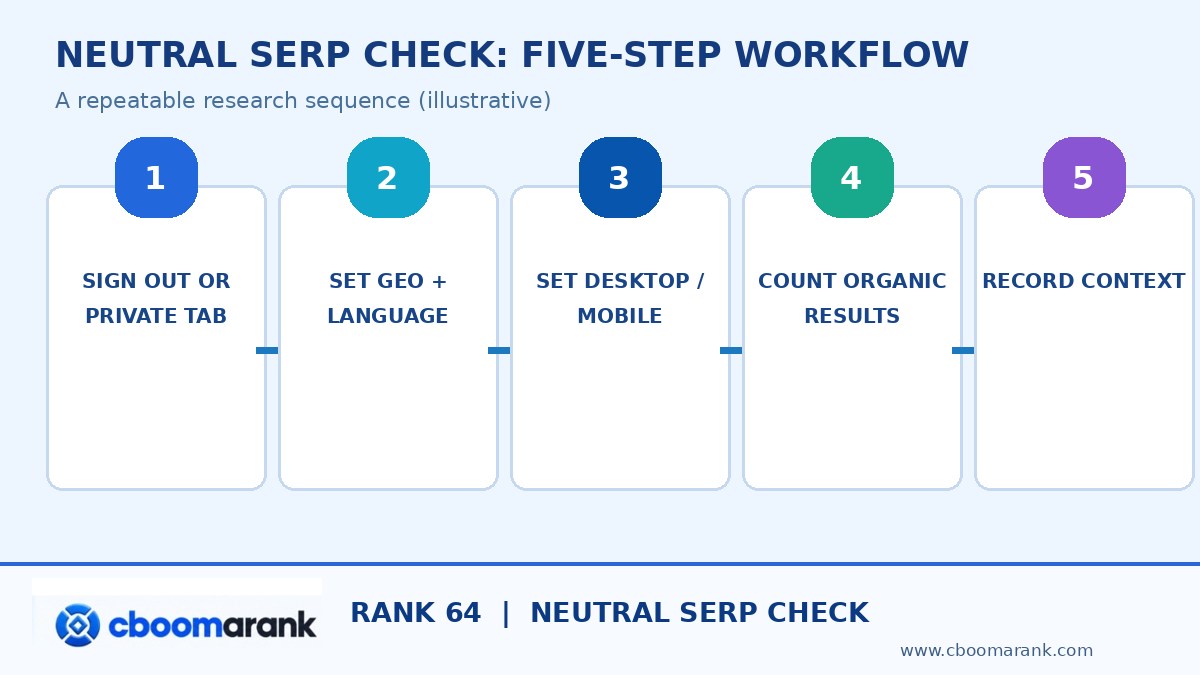
Step 1: Define what “without personalization” really means — Google Rank Checker
The goal is to reduce avoidable personal-account and browser-history bias, not promise an identical search result for the whole internet. Document the conditions you control and the ones you cannot. A good report says “observed for desktop in this country on this date,” rather than “Google ranks this page fourth everywhere.”
Include the exact search phrase in the report header and repeat it only under matched settings. Anything else is an observation about a slightly different experiment rather than a direct comparison.
Step 2: Start with a signed-out or private browser session
Open a private window and verify that you are not signed in to an account changing the experience. Clear any site-level query alterations that may affect the result. This reduces some history and cookie effects but leaves location and contextual ranking signals in play. Do not treat incognito as a guarantee of neutrality.
Check the browser account state before the search and leave location notes next to the screenshot. Personalization can be reduced, but a private window cannot magically make the device or network irrelevant.
What to document in your Google rank checker notes
Include the chosen keyword or offer, the relevant URL, the measurement setting, the important finding and the next decision. If an observation is unavailable, use “not observed” rather than inventing a value.
Step 3: Choose the country, language, and device explicitly — Google Rank Checker
Search results in Paris can differ from those in Toronto. If a rank-checking service lets you target a country or city and mobile/desktop, set it consistently. In manual searching, record the displayed location and language and acknowledge that these controls are less precise than a specialist localized collection process.
For client campaigns in several countries, collect a separate row for each intended market. A result gathered from the investigator’s office is not automatically a representative observation for overseas buyers.
Step 4: Count organic results carefully
Ads, local packs, shopping modules, AI-generated surfaces and ordinary web listings are separate forms of visibility. State exactly whether “position 3” refers to a conventional organic web result or another result type. Include the target URL because Google can surface a different page from the same domain.
Look for the first normal web result from the target URL, and record when it appears inside a special feature instead. Conflating local pack placement with a conventional blue-link position makes the report difficult to interpret.
Step 5: Capture results without endless repeated searching — Google Rank Checker
For a modest list of keywords, collect a single documented observation at a planned time, then repeat later under comparable conditions. Constant refreshing can produce variations without yielding a clearer business conclusion. Automated measurement should use compliant providers rather than access-evasion techniques.
Pick a consistent sampling cadence and do not refresh until a favorable rank appears. Repeated opportunistic checks create selection bias and teach clients to expect false certainty.
Step 6: Cross-check against Search Console impressions
For your verified property, inspect the query, page, country and device in Search Console. Average position summarizes qualifying real impressions. A controlled checker produces a snapshot. Explain why these numbers can differ before blaming inaccurate software.
If the snapshot disagrees with Search Console, match the country, device, page and date window. The two reports can remain different because they measure distinct populations even after those controls are aligned.
What to document in your Google rank checker notes
Include the chosen keyword or offer, the relevant URL, the measurement setting, the important finding and the next decision. If an observation is unavailable, use “not observed” rather than inventing a value.
Step 7: Repeat samples to assess local volatility — Google Rank Checker
For high-value keywords, compare a small, planned set of observations from relevant markets and devices. If results differ sharply, report the range and search-surface differences instead of averaging incompatible data. For local businesses, map-pack position and ordinary organic ranking deserve separate columns.
A small range of values can be an important finding. Document it clearly: for example, a company might appear differently across mobile and desktop, which changes how you prioritize page-layout improvements.
Step 8: Publish an auditable position report
Each row should include query, target URL, country or city, language, device, observed position, result type, provider/method, date and limitations. When a result is not present within the checked depth, mark it as not observed rather than fabricating a low ranking.
Use a standardized report so clients see the observation and its limitations together. “Not present in the first twenty observed results” is more precise and honest than declaring an unknown position number.
Google Rank Checker: Worked Business Example
An online retailer based in Germany searches its main product keyword and sees its page fifth in a personal browser. A separate neutral desktop check configured for the United Kingdom finds it ninth. Search Console shows a monthly average position of 7.3 for the query across several countries and devices. The three outcomes answer different questions; the next step is a market-by-market review, not choosing whichever number sounds best.
The figures or scenarios in this example are illustrative rather than measurements of a named company. A strong implementation distinguishes a recorded observation, a hypothesis, a controlled test and a verified result. That approach protects credibility when someone asks how the conclusion was reached.
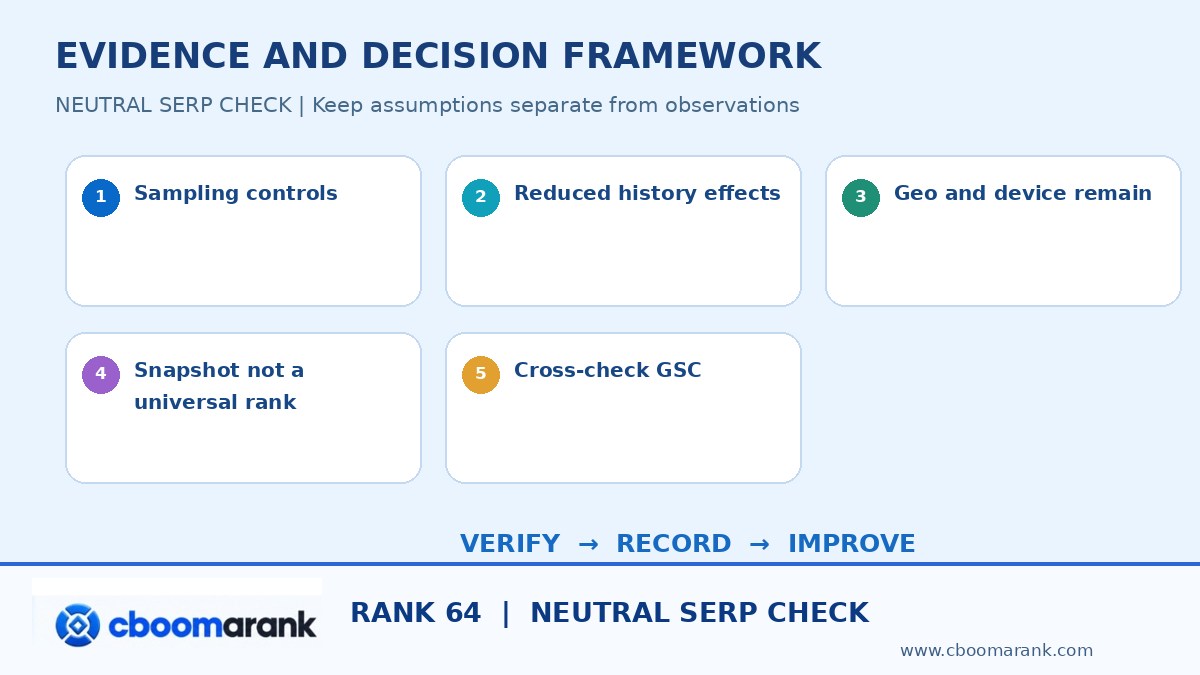
Google Rank Checker: Quality-Control Checklist
Before reporting findings, check the following frequent interpretation errors. Correcting these mistakes is often more valuable than collecting another large export.
1. Incognito is not a global proxy
Location and device still matter. Add a note identifying the exact source and scope of the observation, then revisit it when comparing the next measurement period. This prevents the team from turning a narrow or uncertain signal into a larger unsupported claim.
2. Signed out is not unlocalized
Networks and country settings can influence context. Add a note identifying the exact source and scope of the observation, then revisit it when comparing the next measurement period. This prevents the team from turning a narrow or uncertain signal into a larger unsupported claim.
3. Ads do not consume organic rank positions
Identify which search surface you are counting. Add a note identifying the exact source and scope of the observation, then revisit it when comparing the next measurement period. This prevents the team from turning a narrow or uncertain signal into a larger unsupported claim.
4. A SERP evolves across time
Use recorded timestamps for comparisons. Add a note identifying the exact source and scope of the observation, then revisit it when comparing the next measurement period. This prevents the team from turning a narrow or uncertain signal into a larger unsupported claim.
5. No-data is not position 100
Record search depth and not-found status explicitly. Add a note identifying the exact source and scope of the observation, then revisit it when comparing the next measurement period. This prevents the team from turning a narrow or uncertain signal into a larger unsupported claim.
6. Use separate map and organic columns
The two surfaces answer different business questions. Add a note identifying the exact source and scope of the observation, then revisit it when comparing the next measurement period. This prevents the team from turning a narrow or uncertain signal into a larger unsupported claim.
7. Avoid unsupported claims of perfect neutrality
Reproducible sampling is the real objective. Add a note identifying the exact source and scope of the observation, then revisit it when comparing the next measurement period. This prevents the team from turning a narrow or uncertain signal into a larger unsupported claim.
How to Convert Google rank checker Research into a 30-Day Plan
Days 1–7: Establish a reliable baseline
Choose the highest-value audience segment, define measurement settings, verify access to first-party reports where available, and collect a small number of repeatable observations. Keep a record of missing data and why those gaps matter. Do not change ten different factors before the baseline is clear.
Days 8–14: Prioritize opportunities and limitations
Separate improvements you control from external factors you merely observe. Score candidate actions by expected business impact, confidence in the evidence, effort and risk. Review indexing or tracking integrity before concluding that content or bids must change.
Days 15–21: Run narrow, measurable improvements
Implement the smallest meaningful change to content, targeting, measurement, location coverage or landing-page usability. Record what was changed and when. Preserve the previous state or a backup so the team can reverse mistakes and avoid confusing a technical issue with an SEO result.
Days 22–30: Measure, report and choose the next cycle
Compare consistent time periods and appropriate sample sizes. Explain improvements in clicks, useful visitors and qualified enquiries as well as rankings or visibility. Keep the report honest about uncertainty, and decide which process should repeat next month.
Frequently Asked Questions About Google Rank Checker
Does incognito mode give unbiased Google rankings?
No. It reduces some cookie and history factors but does not standardize geography, device, language or live result features.
Can I disable Google personalization completely?
You can reduce some personal context, but cannot force every searcher to receive an identical universal SERP.
Should I use a VPN for neutral results?
A VPN can affect inferred location but does not guarantee a precise target city or reproduce a searcher’s full context.
Why does Google rank my site differently on mobile?
Device layout, usability signals, location, and page/result features may differ across searches.
Should I count maps as an organic result?
Track map/local pack visibility separately from conventional web rankings for clearer interpretation.
Which rank should I report to clients?
Report the configured snapshot with its parameters and Search Console averages where first-party data is available.
How can I check multiple countries consistently?
Use a tracker supporting explicit location/device settings and documented sampling times rather than repeated ad-hoc searches.
Useful Official References for Google rank checker Research
- Google explanation of search position — consult the source for current definitions and limitations.
- Google Search Console performance guide — consult the source for current definitions and limitations.
- Google local ranking guidance — consult the source for current definitions and limitations.
Explore related analysis: CBOOMARANK guide and related SEO research article. These resources provide broader context; this post is focused on the specific task above.
Final Verdict: Make Google rank checker Useful
A reliable research process documents query intent, measurement settings, sample limitations, business relevance and the action that follows. Be skeptical of rankings or competitor estimates that lack a source. Repeat the process with the same definitions, compare it with qualified visitors and conversions, and prioritize work that improves the user experience rather than chasing a single score.
Find research workflows at www.cboomarank.com, compare CBOOMARANK pricing and access, and download the research workbook to build a repeatable action plan.
Editorial note (October 2026): Software features, search interfaces and plan entitlements change. Vendor statements are not third-party test results. CBOOMARANK publishes this guide and offers SEO research products; verify current features and availability before purchasing.
