

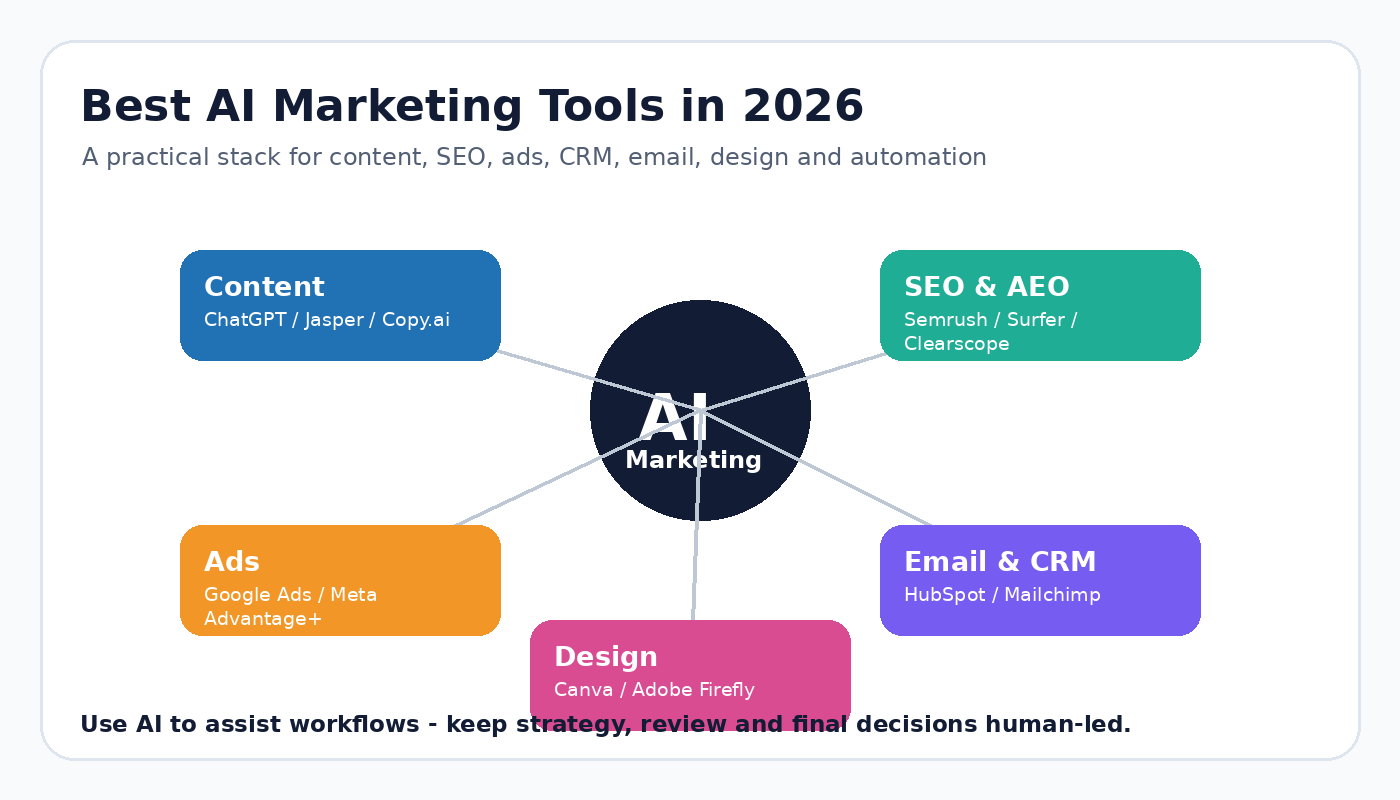
A practical beginner-friendly guide to choosing AI tools for content, SEO, paid ads, email marketing, design, CRM, automation and analytics.
Introduction
AI marketing tools are no longer experimental. In 2026, marketers use AI to research audiences, write briefs, create content, generate ad variations, personalize email campaigns, analyze reports, build automations and improve customer journeys. The opportunity is big, but the wrong tool stack can create duplicated work, low-quality content, privacy risk and poor brand consistency.
This guide compares the best AI marketing tools by real marketing use case. It is written for small businesses, bloggers, ecommerce brands, agencies and marketing teams that want practical software choices instead of hype.
For related CBOOMARANK resources, read AI for Marketing: The Complete Beginner’s Guide, Best Free SEO Tools for Beginners, and Semrush vs Ahrefs.
Quick Comparison: Best AI Marketing Tools in 2026
| Tool | Best For | Main Strength | Best User |
| ChatGPT | Strategy, ideation, copy, research summaries | Flexible assistant for many marketing workflows | Teams, founders, creators, agencies |
| Jasper | Brand-controlled marketing content | Campaign content, brand voice and AI agents | Marketing teams and agencies |
| HubSpot Breeze | CRM-connected AI marketing | AI inside CRM, marketing, sales and service workflows | Businesses using HubSpot |
| Semrush AI Toolkit | SEO and AI visibility | SEO, content and AI search visibility data | SEO teams and agencies |
| Surfer AI | SEO content creation | SEO-friendly article creation and content optimization | Bloggers and content teams |
| Canva Magic Studio | AI design and social creatives | Fast campaign graphics, videos and brand assets | Creators, SMBs and social teams |
| Mailchimp AI | Email marketing and ecommerce insights | Personalization, campaign insights and automation | SMBs and ecommerce brands |
| Google Ads Performance Max | AI-assisted paid advertising | Google AI for bids, placements and conversions | Advertisers and ecommerce brands |
| Zapier AI | Marketing automation | Connects apps and builds AI-assisted workflows | Lean teams and agencies |
| Adobe Firefly | Brand-safe creative production | Generative brand assets and campaign visuals | Creative teams and brands |
1. ChatGPT – Best Overall AI Assistant for Marketers
ChatGPT is one of the most flexible AI marketing tools because it can support many parts of the workflow: campaign planning, customer research summaries, content outlines, email drafts, ad copy, landing page variations, webinar scripts, social media calendars and analytics explanations.
It is especially useful when marketers create reusable prompt templates for specific tasks. For example, an agency can build prompts for SEO briefs, product page rewrites, lead nurture emails and Google Ads headline variations.
Best use cases: brainstorming, campaign briefs, repurposing long-form content, first drafts, customer persona research, competitor summaries and internal marketing operations.
Official reference: openai.com.
2. Jasper – Best AI Marketing Platform for Brand Voice
Jasper is built specifically for marketing teams that need repeatable content production, brand consistency and campaign execution. It is a strong choice when a business wants more structure than a general chatbot.
Jasper is useful for campaign copy, blog introductions, product messaging, social posts, landing pages, ads and content repurposing. The main advantage is brand control: teams can build guidelines and workflows so outputs follow a consistent voice.
Best use cases: agency content operations, enterprise marketing content, brand campaigns, product launches and multi-channel copy production.
Official reference: www.jasper.ai.
3. HubSpot Breeze – Best AI Tool for CRM-Connected Marketing
HubSpot Breeze is useful for businesses that already use HubSpot for CRM, marketing, sales or service. Because the AI works inside the HubSpot environment, it can assist with content, information retrieval, customer context, workflow automation and marketing actions.
This makes it different from standalone AI tools. Instead of copying data into a separate app, marketers can work closer to the customer data, campaigns and sales pipeline they already manage.
Best use cases: lead nurturing, CRM-based personalization, marketing operations, sales handoff, customer journey workflows and campaign reporting.
Official reference: knowledge.hubspot.com.
4. Semrush AI Toolkit – Best for SEO and AI Visibility
Semrush remains a strong platform for SEO, competitor research, content planning and traffic analysis. In 2026, AI visibility has become more important because brands want to understand how they appear across search engines and AI answer experiences.
The Semrush toolkits can help marketers combine classic SEO metrics with emerging AI-search visibility workflows. This is useful for brands that depend on organic search, affiliate traffic or content-led acquisition.
Best use cases: keyword research, competitor analysis, AI visibility checks, SEO content planning, backlink research and agency reports.
Official reference: www.semrush.com.
5. Surfer AI – Best for SEO Content Creation
Surfer AI helps marketers create SEO-focused article drafts and optimize content around search intent. It is useful when a team needs to scale blog production while still using search data, headings, topic coverage and editorial review.
The best way to use Surfer AI is not to publish raw AI drafts immediately. Use it to accelerate outlines and first drafts, then add real expertise, examples, product insight, screenshots, data and internal links.
Best use cases: SEO briefs, blog outlines, long-form articles, content refreshes and ranking-focused editorial workflows.
Official reference: docs.surferseo.com.
6. Canva Magic Studio – Best AI Design Tool for Marketers
Canva Magic Studio is useful for social media graphics, presentation visuals, ad creatives, thumbnails, short videos, brand assets and fast campaign design. It is especially helpful for small businesses without a full design team.
Marketers can use Canva to turn campaign ideas into visuals quickly, but brand review still matters. Use approved templates, colors, fonts and logo rules to avoid inconsistent creative output.
Best use cases: social posts, blog graphics, lead magnets, thumbnails, presentation decks, ad creatives and lightweight video content.
Official reference: www.canva.com.
7. Mailchimp AI – Best for Email Marketing and Ecommerce Insights
Mailchimp’s AI tools help with email content, segmentation, personalization and analytics. Mailchimp has also expanded AI analytics capabilities for ecommerce brands and small to midsize businesses.
This is helpful when a business wants to connect campaign performance, customer behavior and revenue outcomes. AI can surface insights, but marketers should still verify segments, offers and compliance before launching.
Best use cases: email subject lines, personalized email campaigns, ecommerce insights, lifecycle automations and campaign analysis.
Official reference: mailchimp.com.
8. Google Ads Performance Max – Best AI Tool for Paid Search and Shopping Campaigns
Performance Max uses Google AI to optimize bids and placements toward conversion or conversion-value goals. Advertisers provide important inputs such as audience signals, customer data, creative assets and business goals.
This makes it powerful for ecommerce and lead generation, but success depends on tracking quality, offer strength, creative assets, feed quality and conversion data. AI does not fix a weak landing page or bad offer.
Best use cases: ecommerce campaigns, lead generation, shopping ads, cross-channel Google advertising and conversion-focused paid media.
Official reference: support.google.com.
9. Zapier AI – Best for Marketing Automation
Zapier helps marketing teams connect apps and automate repetitive tasks. Its AI features can help users discover automation use cases, build workflows and analyze or return data inside automated processes.
This is valuable for lean teams that use many tools: forms, CRM, email, Slack, Google Sheets, ad platforms, analytics tools and content systems. The goal is not to automate strategy; it is to remove repetitive manual work.
Best use cases: lead routing, form follow-ups, content operations, social publishing workflows, CRM updates, reporting automations and campaign task management.
Official reference: zapier.com.
10. Adobe Firefly – Best for Brand-Safe Creative Production
Adobe Firefly is useful for teams that need generative creative assets while staying close to professional design workflows. It can help marketers move from idea to campaign assets and refine creative concepts using conversational prompts.
For established brands, the key advantage is creative control. Use AI for exploration and variations, then apply human review for brand accuracy, legal suitability and final polish.
Best use cases: campaign visuals, brand concepts, background generation, creative variations, design exploration and professional asset production.
Official reference: helpx.adobe.com.
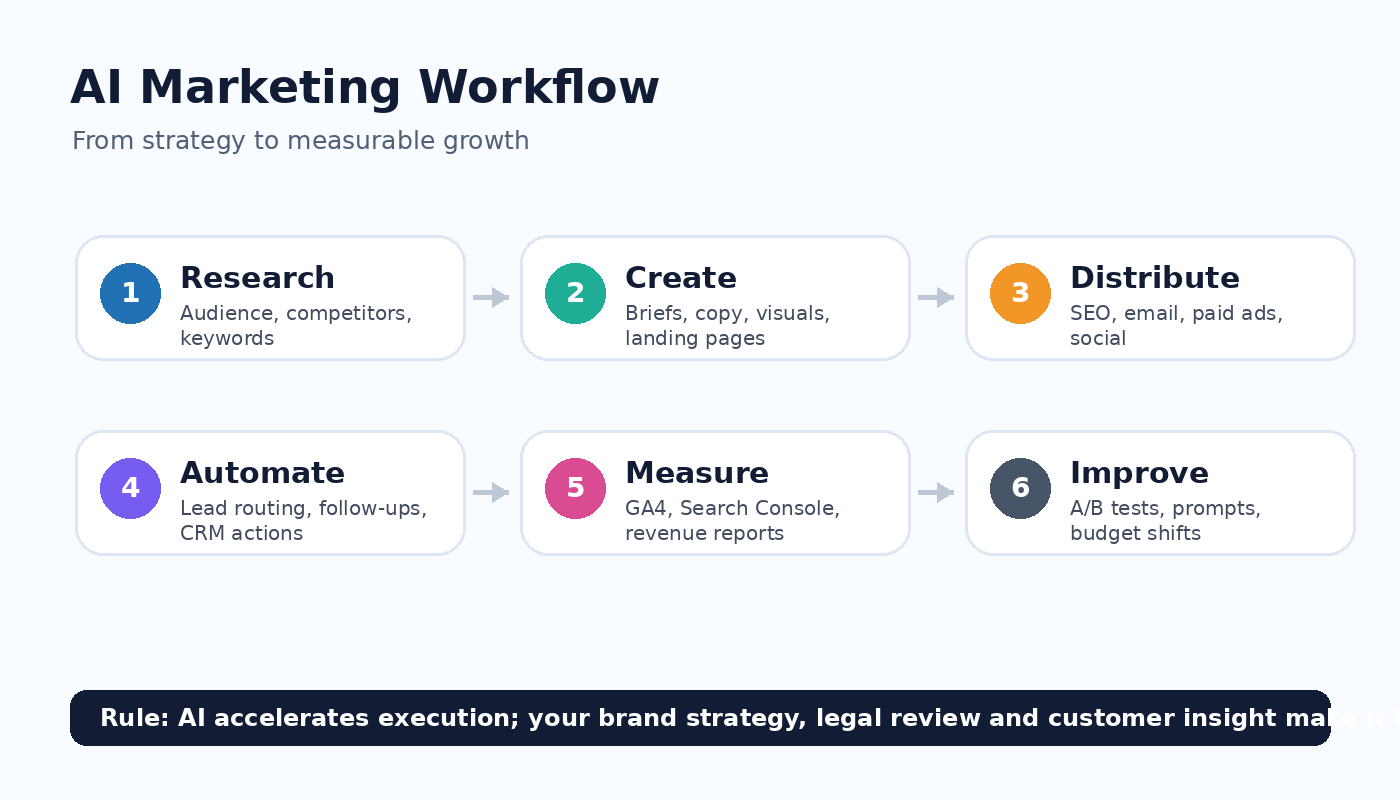
ALT text: AI marketing workflow from strategy and content creation to distribution, automation, analytics and optimization.
Best AI Marketing Tools by Use Case
| Use Case | Best Tools | Recommendation |
| Blog writing and SEO content | ChatGPT, Jasper, Surfer AI, Semrush | Use AI for briefs and drafts, then add expert edits and internal links. |
| Keyword research and AI visibility | Semrush, Surfer, ChatGPT | Use data tools for metrics; use AI to explain insights and build content plans. |
| Email marketing | Mailchimp, HubSpot, ChatGPT | Use AI for subject lines, segments and personalization ideas. |
| Paid ads | Google Ads Performance Max, ChatGPT, Canva | Use AI to generate creative variations and test hooks, but monitor conversion quality. |
| Social media creative | Canva, Adobe Firefly, Jasper | Create graphics and short-form campaign assets from approved brand templates. |
| CRM and lead nurturing | HubSpot Breeze, Zapier AI, Mailchimp | Connect AI to real customer data only with proper permissions and review. |
| Marketing automation | Zapier AI, HubSpot, Mailchimp | Automate repetitive actions like lead routing, notifications and reporting. |
How to Choose the Right AI Marketing Tool
The best AI marketing tool is not always the most popular tool. It is the one that fits your workflow, data, budget, team skill level and growth goals. Use the checklist below before subscribing.
- Start with one painful workflow: content briefs, email campaigns, ad creative, reporting or lead follow-up.
- Check integrations with your CMS, CRM, analytics, email platform, ad accounts and collaboration tools.
- Review privacy controls, admin settings, data usage policies and user permissions.
- Test output quality with real business examples, not generic sample prompts.
- Measure time saved, campaign lift, content quality, speed to publish and revenue impact.
- Choose tools your team will actually use every week. Adoption matters more than features.
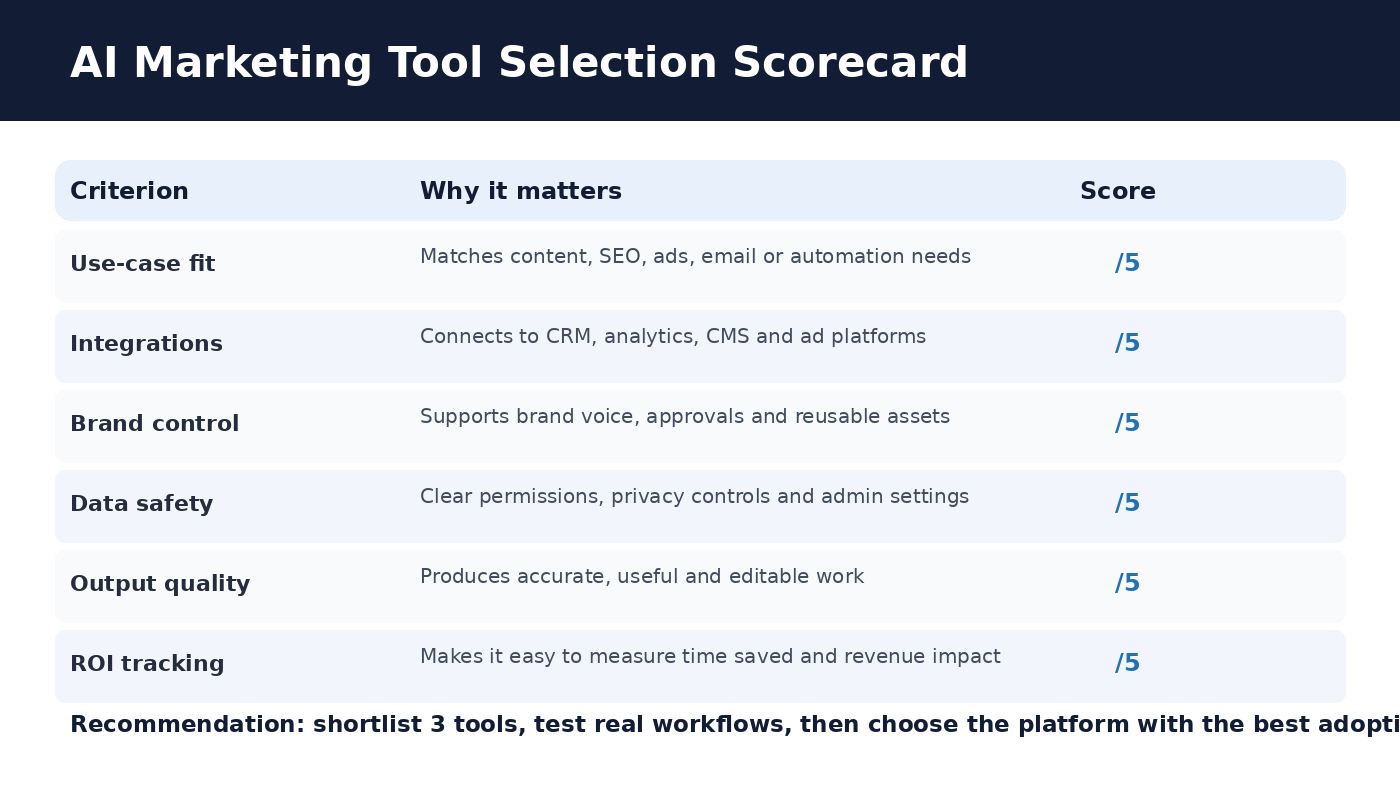
AI Marketing Tool Stack for Beginners
| Business Type | Suggested Starter Stack | Why It Works |
| Beginner blogger | ChatGPT + Canva + Google Search Console + Semrush Free | Low-cost setup for content planning, graphics and SEO measurement. |
| Small business | ChatGPT + Mailchimp + Canva + Google Analytics 4 | Covers email, content, visuals and basic performance reporting. |
| SEO agency | Semrush + Surfer + ChatGPT + Zapier | Supports research, briefs, content production and workflow automation. |
| Ecommerce brand | Google Ads Performance Max + Mailchimp + Canva + ChatGPT | Useful for product ads, email revenue, creative testing and campaign copy. |
| B2B company | HubSpot Breeze + ChatGPT + Jasper + Zapier | Good for CRM-connected campaigns, sales content and lead nurturing. |
Important SEO and Compliance Rules for AI Marketing
Google Search Central says using generative AI content is not automatically against Google Search guidelines, but using automation primarily to manipulate rankings violates spam policies. The practical rule is simple: AI-assisted content should be helpful, accurate, original, reviewed and created for people first. Reference: Google Search guidance on generative AI content.
For AI search and visibility, Google advises website owners to keep building useful, unique and accessible content instead of creating scaled variations only to manipulate generative AI answers. Reference: Google AI optimization guide.
For advertising, reviews, influencer content and testimonials, marketers should follow truth-in-advertising and endorsement rules. Reference: FTC advertising and marketing guidance.
- Do not publish AI-generated claims that you cannot verify.
- Do not invent testimonials, case studies, ratings or customer quotes.
- Do not use AI to create scaled duplicate pages only for rankings.
- Disclose sponsored or affiliate relationships where required.
- Review AI-generated legal, financial, medical or technical claims before publishing.
- Keep human approval for final campaign messaging, pricing, offers and brand claims.
Pros and Cons of AI Marketing Tools
| Pros | Cons |
| Faster content ideation and campaign planning | Outputs can be generic without strong prompts and review |
| More creative variations for ads and social media | Brand inconsistency can happen without guidelines |
| Better personalization and automation opportunities | Data privacy and permission issues must be managed |
| Improved reporting summaries and insights | AI can misread data or overstate conclusions |
| Lower production bottlenecks for small teams | Human expertise is still required for strategy and trust |
Best Value Recommendation
For most beginners, the best value stack is ChatGPT for strategy and copy, Canva for visuals, Google Search Console and GA4 for measurement, and one specialist tool based on the main channel: Semrush or Surfer for SEO, Mailchimp for email, HubSpot for CRM, or Google Ads Performance Max for paid advertising.
For agencies and growing teams, choose a more structured stack: Jasper for brand-controlled content, Semrush for SEO and AI visibility, Zapier for automation and HubSpot Breeze for CRM-connected marketing. This gives the team speed without losing workflow control.
Publishing Checklist for CBOOMARANK
- Use the URL slug: best-ai-marketing-tools-2026.
- Add the focus keyword in the title, first paragraph, one H2 and meta description.
- Upload all three images with the ALT text included in this package.
- Add internal links to AI for Marketing, Best Free SEO Tools, Semrush vs Ahrefs, Google Ads/PPC and Analytics articles.
- Add external links to official vendor and policy pages only where they help the reader.
- Add FAQ schema in WordPress if your SEO plugin supports it.
- Review vendor pricing before publishing because AI tool pricing changes frequently.
Internal Links for CBOOMARANK
- AI for Marketing: The Complete Beginner’s Guide
- Best Free SEO Tools for Beginners
- Semrush vs Ahrefs
- Ubersuggest vs Semrush
- SEO Pricing Guide
- Google Ads and PPC Guides
External Authoritative References
- OpenAI – ChatGPT Work for Marketing Teams
- Google Search Central – AI-generated content guidance
- Google Search Central – AI optimization guide
- Google Ads Help – Performance Max campaigns
- HubSpot Knowledge Base – Breeze AI
- Jasper Platform
- Canva Magic Studio
- Mailchimp AI Marketing Tools
- Semrush Toolkits
- Surfer AI Documentation
- Zapier Marketing Automation
- Adobe Firefly AI Assistant
- FTC Advertising and Marketing Guidance
FAQ
What is the best AI marketing tool in 2026?
The best overall AI marketing tool depends on your workflow. ChatGPT is the most flexible general assistant, Jasper is strong for brand-controlled marketing content, HubSpot Breeze is strong for CRM-connected teams, and Semrush is strong for SEO and AI visibility.
Can AI replace a marketing team?
No. AI can speed up research, drafting, creative variations, automation and reporting, but human marketers still need to set strategy, review claims, understand customers and make final business decisions.
Which AI tool is best for SEO content?
Surfer AI, Semrush and ChatGPT are strong options for SEO content workflows. Use them for research, briefs and drafts, then add human expertise, examples and internal links before publishing.
Which AI tool is best for email marketing?
Mailchimp and HubSpot are strong choices for email marketing because they connect AI with audience data, campaign workflows and customer journeys.
Which AI tool is best for paid ads?
Google Ads Performance Max is useful for AI-assisted Google advertising. Canva, ChatGPT and Jasper can also support ad creative, headlines, descriptions and testing ideas.
Is AI-generated content bad for SEO?
AI-generated content is not automatically bad for SEO. The risk comes from low-quality, inaccurate, unhelpful or scaled content created mainly to manipulate rankings.
How should beginners start with AI marketing tools?
Start with one workflow. For example, use ChatGPT for content briefs, Canva for images, and Google Analytics/Search Console for measurement before adding more tools.
