


Competitor analysis is the systematic way to understand who customers compare you with, why those alternatives win attention, and where your business can create greater value. A useful study does not end with a spreadsheet of rival websites. It connects market evidence, customer needs, products, pricing, visibility and distribution to decisions your team can actually test.
In this complete guide, you will learn how to identify the right competitors, compare their strengths and weaknesses, build a reliable competitor analysis matrix, uncover underserved customer needs and develop a practical 30–60–90-day growth plan. The examples work for business owners, SaaS teams, service providers, publishers, entrepreneurs and digital marketers.
Short answer: start with three to seven relevant competitors; classify them by customer need; gather dated evidence about positioning, offers, pricing, distribution and customer experience; score the opportunities; then run small experiments and measure qualified results. The goal is differentiation, not imitation.
What Is Competitor Analysis and Why Does It Matter?
Competitor analysis, sometimes called competitive intelligence or competitive research, is a structured comparison of businesses and alternatives competing to solve the same customer problem. Instead of asking only “Who sells what I sell?”, you ask “What jobs are buyers trying to complete, what other options do they consider, and why do they choose one?”
The research matters because businesses rarely lose customers for one reason. Buyers may prefer a rival’s clearer pricing, stronger trust evidence, more convenient delivery, faster onboarding, broader distribution, or more relevant content. Moreover, competitors can reveal emerging expectations before those expectations appear in your own support inbox.
Competitor analysis vs market research vs SEO competitor analysis
Market research studies customers, category demand and market conditions. Competitor analysis examines relevant alternatives and converts observed differences into strategic choices. SEO competitor analysis is narrower: it assesses the websites competing for search visibility, such as keyword clusters, ranking pages, backlinks and content gaps. A directory can be your biggest search competitor without selling the same product.
For a technical walkthrough of keywords, backlinks, organic visibility and content gaps, use our separate SEO competitor analysis guide. Keeping these two articles distinct avoids confusing business positioning with search visibility.
Step 1: Identify Your Real Competitors
Begin with the customer job rather than an industry label. For example, a company offering business software may compete with similar SaaS products, consultants, manual spreadsheets and established workflows. Accordingly, include alternatives the customer would actually choose—not every company sharing a keyword.
Direct, indirect and search competitors
Direct rivals serve a comparable audience with a comparable solution. Indirect alternatives solve the same underlying problem differently. Search competitors receive attention for the queries potential buyers use, even when they do not sell competing products. Use the classification to prevent comparisons that look precise but are strategically meaningless.
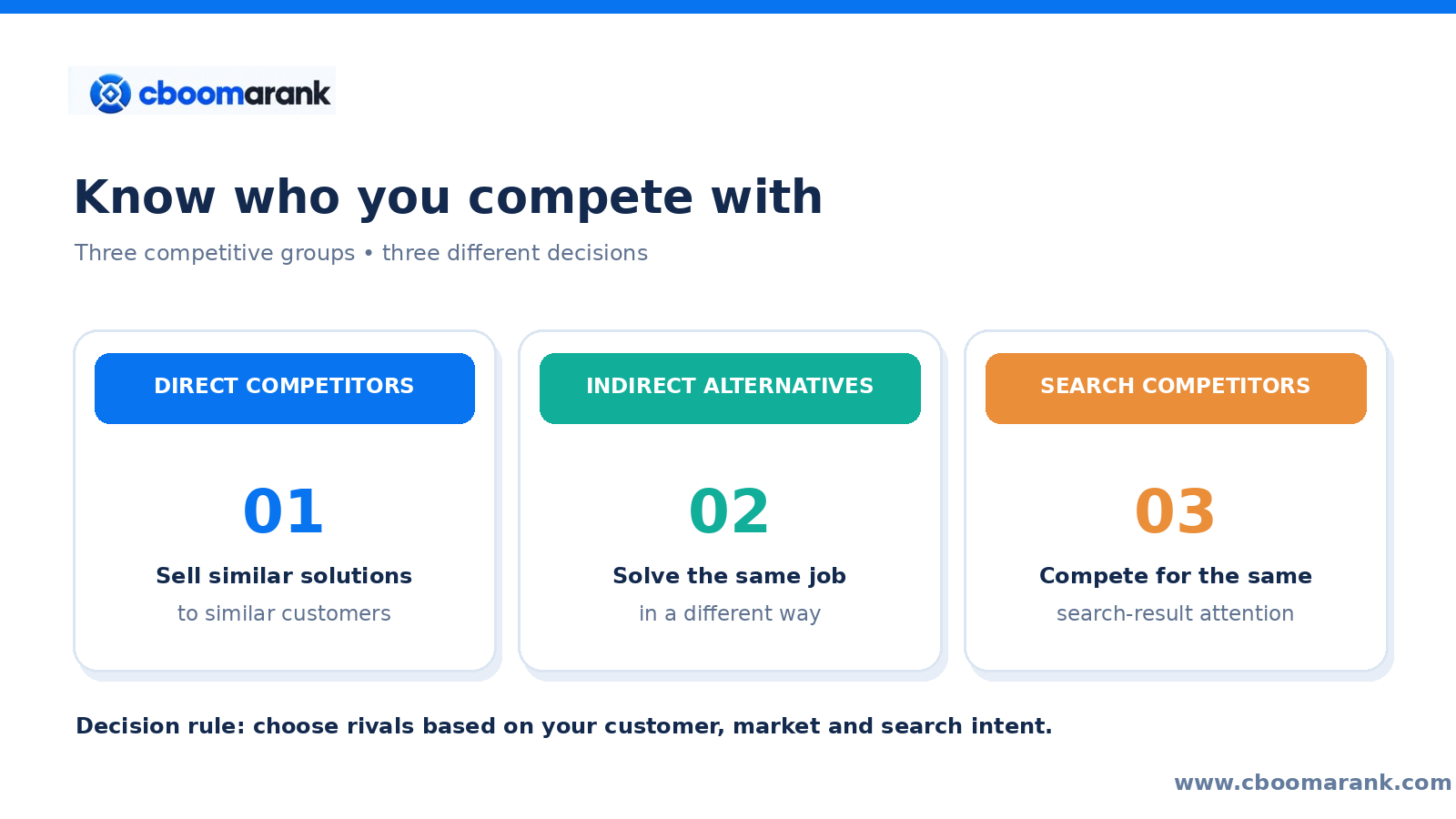
Build a representative competitor shortlist
For most small and medium businesses, choose three to seven competitors for a first pass. Record the buyer segment, country or service area, core offer, purchase scenario and the evidence that the business actually competes for that customer. If a company appears in a search result but not in a buying decision, classify it as a search competitor rather than forcing it into the direct-competitor group.
Use public directories, search results, customer interviews, win–loss notes, trade associations and competitor product pages to discover names. Next, verify that each candidate is still active, serves the relevant market and offers a plausible alternative.
Questions to ask before accepting a competitor
- Would the same buyer realistically compare this offer with ours?
- Does it serve the same region, company size or budget?
- Is the value proposition similar or is the alternative substituting for the same outcome?
- What evidence supports the classification, and when was it last checked?
- Is the competitor meaningful for commercial decisions, search visibility, or both?
Step 2: Set Clear Goals and a Research Baseline
Decide what the competitor analysis must enable. Possible objectives include improving trial activation, increasing qualified leads, defending market share, finding underserved sectors, adjusting service packages or strengthening an existing content hub. Without a decision question, research quickly becomes a collection of screenshots.
Write a one-sentence hypothesis: “Buyers in our target segment need a faster onboarding experience than the alternatives currently explain.” Then list the evidence that would validate or refute it. Record your own baseline metrics, such as assisted conversions, sales-cycle length, win rate, onboarding completion or qualified search traffic. These first-party figures are more dependable than speculative rival revenue or visitor counts.
Step 3: Build a Competitor Analysis Matrix
A competitor analysis matrix keeps findings comparable. Give each competitor one row and use consistent research dimensions. Separate verifiable facts from judgment, cite where information came from and add the observation date. If the public price is promotional or limited to one region, record that limitation rather than silently treating it as universal.
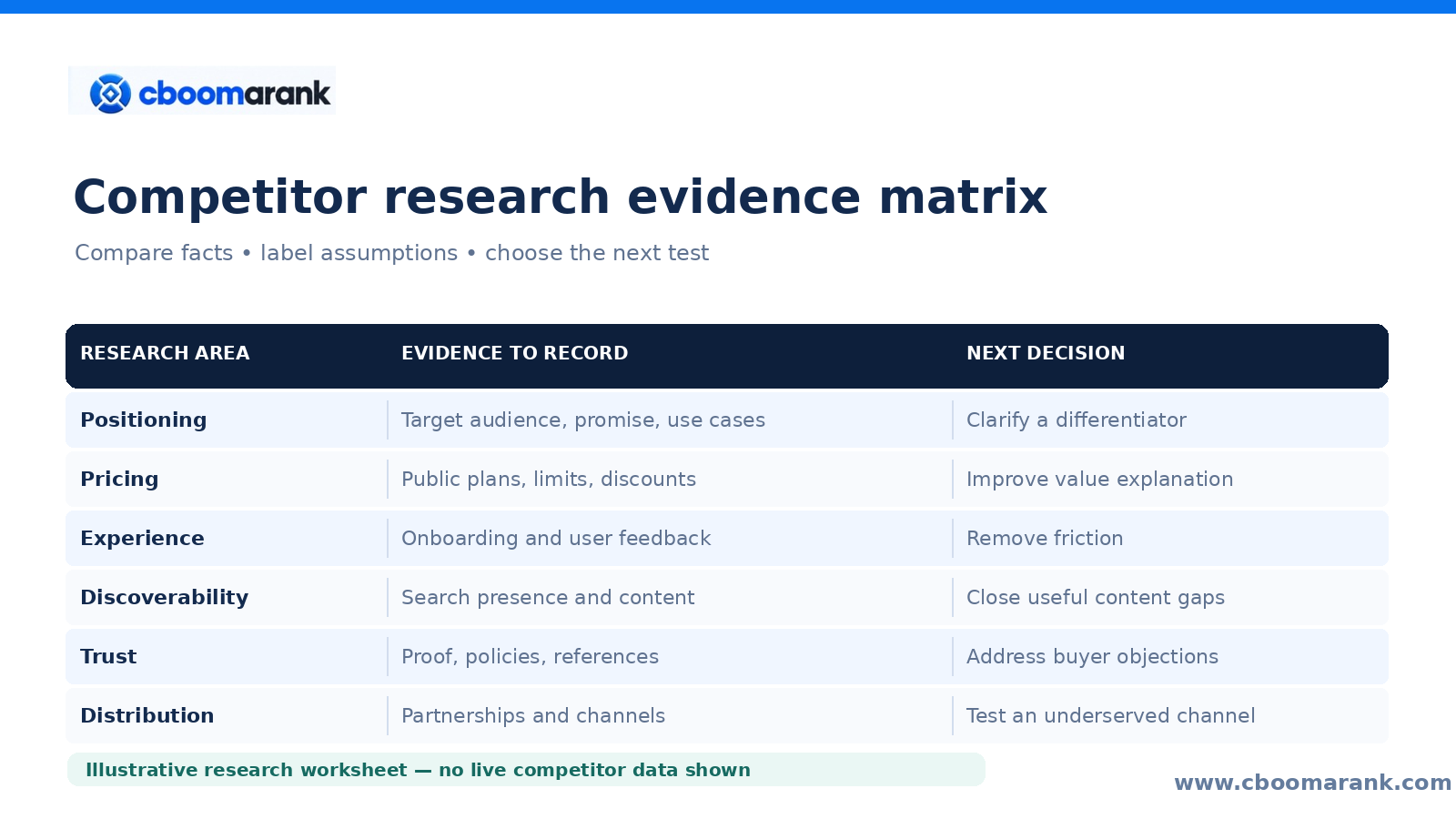
What to compare in every competitor profile
| Dimension | What to record | Strategic question |
|---|---|---|
| Audience and positioning | Buyer persona, message, promise, industry and geographic focus | Which segment or need is underserved? |
| Products and services | Core features, service scope, integrations and delivery model | Where is our offer genuinely different? |
| Pricing and packaging | Public price, billing period, add-ons, limits and trial terms | Can we explain value or reduce buying friction? |
| Customer experience | Observed onboarding, documentation, support access and review themes | Which frustrating task can we simplify? |
| Trust and authority | Policies, verifiable customer proof, authorship and methodology | What evidence would help buyers decide? |
| Distribution | Search, partner programs, social, marketplaces and offline channels | Which channel is relevant but underserved? |
| Content and discovery | Useful guides, comparison pages, search presence and landing-page clarity | Which question deserves a better answer? |
Do not compare features in isolation. A competitor may offer more features but serve a different buyer with a different implementation budget. Therefore, every comparison should say what matters to your chosen segment and the evidence for that judgment.
Step 4: Analyze Competitor Positioning and Value Propositions
Review homepage messaging, product descriptions, campaign landing pages, about pages, demos and onboarding materials. Note what each company claims, who the message addresses and which customer pain point it tries to remove. For a fair assessment, distinguish a marketing claim from something you can independently verify.
Use a positioning map with buyer-relevant axes
A positioning map plots offers on two criteria that customers genuinely value, such as ease of setup versus depth of capability, or guided service versus self-service control. Avoid arbitrary maps that make your company appear best by design. Instead, decide the axes from customer interviews and observable product differences.
For example, a small-business audience may care more about a clear starting path and predictable billing than enterprise-grade configurability. A larger buyer may prioritize integrations, reporting permissions and support processes. The opportunity is not necessarily to beat everyone on every axis; it is to serve a particular job exceptionally well.
Step 5: Compare Products, Pricing and Customer Experience
Pricing research must include what is actually purchased: included users, limits, usage quotas, setup fees, cancellation terms, payment currency, taxes where shown and support tiers. Two products at similar monthly prices may provide different value. In addition, public promotional pricing should not be represented as a permanent market rate.
Examine the complete buying and onboarding journey
Review the path from first discovery to first useful result. How easily can a buyer locate a relevant example, understand the features, compare plans and contact support? If a free or legitimately accessible trial is available, test the journey within the provider’s terms. Do not access private systems or use unauthorized scraping.
Record observed friction in language that an owner can act on: “The mobile plan comparison is difficult to scan” is more useful than “their website is bad.” For your own business, validate whether simplifying that step actually improves activation or leads.
Step 6: Listen to Customers and Identify Unmet Needs
The strongest growth opportunities often come from your buyers rather than competitor speculation. Interview recent wins, lost prospects and active customers. Ask what alternatives they considered, what outcome mattered most, where evaluation was confusing and which reassurance helped them decide. Do not assume a few interviews represent the whole market.
Five questions for a competitor research interview
- What problem made you search for a solution now?
- Which other products, providers or manual methods did you consider?
- What was the hardest claim or feature to verify before buying?
- Which experience felt faster, clearer or more trustworthy, and why?
- If one thing could improve your decision or onboarding, what would it be?
Group the responses into themes and track how often each theme appears. Then compare them with public reviews, support documentation and direct observation. A frequently mentioned barrier may be a stronger opportunity than a fashionable new feature.
Step 7: Evaluate Competitor Marketing and Distribution
Look at the channels that connect rivals with potential customers: organic search, search advertising, email, affiliates, partners, marketplaces, community participation, webinars, social content and industry events. Be cautious about attributing success to a visible campaign. A frequently posted video or a large following is not proof of sales growth.
Analyze content and search without confusing estimates with facts
For content gaps, examine the customer questions competitors address, the intent behind their pages, the freshness of their examples and the completeness of the answer. For search research, CBOOMARANK helps organize website, keyword and competitor intelligence; use CBOOMARANK as a starting point for a connected research workflow and refer to the technical SEO competitor analysis article for deeper keyword and backlink methodology.
Third-party estimates of rival traffic, backlink strength or keyword positions are models with varying coverage, not access to a competitor’s private analytics. Instead, use them directionally and verify your own pages with Search Console and your analytics platform. Google’s people-first content guidance is a useful quality benchmark when refreshing pages for a real audience.
Find a useful content opportunity before publishing another page
Write down the question, audience, intended answer, existing URL on your site, evidence needed and distribution plan. If an existing CBOOMARANK article already addresses the intent, improve that page instead of creating a competing URL. For the audit and implementation side, see our professional SEO audit report guide and technical SEO tools comparison.
Competitor Analysis Example: From Observation to a Growth Experiment
Consider a hypothetical B2B service firm that receives plenty of website visits but too few qualified inquiries. Its initial competitor analysis identifies two direct rivals with clearer service pages, one lower-priced indirect substitute, and a search-first directory that captures comparison questions. None of those observations proves why buyers choose one company over another. Therefore, the team runs a customer interview and reviews its own forms and inquiry records.
Document the observation, interpretation and test separately
Observation: visitors often reach the firm’s general homepage before requesting detailed service information. Interpretation: buyers may not understand which package fits their circumstances. Experiment: publish a concise service-comparison page explaining scope, exclusions, onboarding and next steps, then connect it with the most relevant existing guides. Record the hypothesis and page launch date before measuring outcomes.
During the first month, the firm tracks qualified contact-form completions and asks new inquiries whether the revised explanation answered their questions. In the next month, it compares the quality of inquiries with the baseline, accounting for changes in campaign spend or seasonality. Ultimately, a successful experiment may justify rolling the clearer messaging into sales materials; an inconclusive result tells the team to improve its measurement or test another obstacle.
This example intentionally uses no fabricated market share, revenue or traffic numbers. It shows how to turn an observable difference into a customer-centered test rather than assuming a competing business is succeeding for one obvious reason.
International Competitor Analysis: Compare the Same Market Fairly
For businesses operating across the United States, United Kingdom, Canada, France, Germany or other markets, competitive conditions can differ even when the underlying service is similar. Language, local search results, purchasing power, taxation, buyer expectations, legal requirements and support availability all affect a fair comparison. Consequently, the same company may be a direct rival in one region and an irrelevant alternative in another.
Build separate country-level evidence sheets
Record the market, language, currency, pricing basis, service availability and observation date for each example. Where a competitor advertises a price only to a particular audience, do not convert it into a global standard without noting taxes, billing frequency and included features. For multilingual research, compare the search intent behind local terms rather than assuming one English-language keyword translates into identical buyer demand.
Regional differences may reveal an opportunity: customers in a market might need localized documentation, clear payment information or a reliable implementation partner. However, treat that as a hypothesis until you confirm it through interviews or first-party performance data. Your competitor analysis should help you find credible next tests, not overpromise easy expansion.
Step 8: Use SWOT Without Overstating Competitor Weaknesses
A SWOT review groups strengths, weaknesses, opportunities and threats, but it should not pretend to know a rival’s private operations. Public product features and openly documented support channels are observations. Claims about retention, internal margins, operational efficiency or customer satisfaction require reliable evidence.
Example: SWOT for a hypothetical service business
| Category | Illustrative finding | Action to test |
|---|---|---|
| Strength | Strong reputation for complex projects | Publish a verifiable case study |
| Weakness | Our current onboarding explanation is unclear | Test a simpler first-step walkthrough |
| Opportunity | Buyers request transparent service packages | Trial a clearer scope-and-price comparison |
| Threat | New entrants offer faster self-service options | Test an efficient entry-level offer |
The observations in this example describe a hypothetical situation rather than any named business. For every real SWOT item, attach its source, confidence and responsible owner.
Step 9: Score Growth Opportunities Before Spending
Once competitor analysis reveals gaps, convert them into a ranked action backlog. Use criteria that can be explained: customer demand, strategic fit, evidence quality, expected business value, implementation effort and time to test. A large apparent search volume alone is not a reason to pursue an unrelated topic.
A practical opportunity-scoring method
Score each dimension from one (low) to five (high), then discuss the trade-offs. An optional screening formula is (demand + strategic fit + evidence confidence + expected value) ÷ (effort + dependency risk). This is a prioritization aid, not a forecast of revenue or rankings. High-confidence improvements with manageable effort may deserve earlier testing than speculative high-upside ideas.
| Opportunity hypothesis | Small experiment | Metric to validate |
|---|---|---|
| Buyers cannot quickly compare packages | Improve a pricing explainer | Qualified inquiries and conversion rate |
| First analysis takes too long | Simplify onboarding flow | Time to first value and activation |
| An industry use case lacks practical examples | Refresh the relevant existing guide | Relevant impressions, clicks and leads |
| Trust claims are hard to verify | Add transparent sources and case evidence | Sales objections and decision quality |
Set a baseline and decide what would count as a meaningful improvement before launching each test. If performance does not improve, document the result and revise the hypothesis rather than claiming success from activity alone.
Step 10: Turn Competitor Analysis into a 30–60–90-Day Growth Plan
Good competitive research should produce a calendar, named owners and specific measures. The plan below separates discovery from experimentation and evaluation, helping prevent teams from publishing a large report that nobody uses.
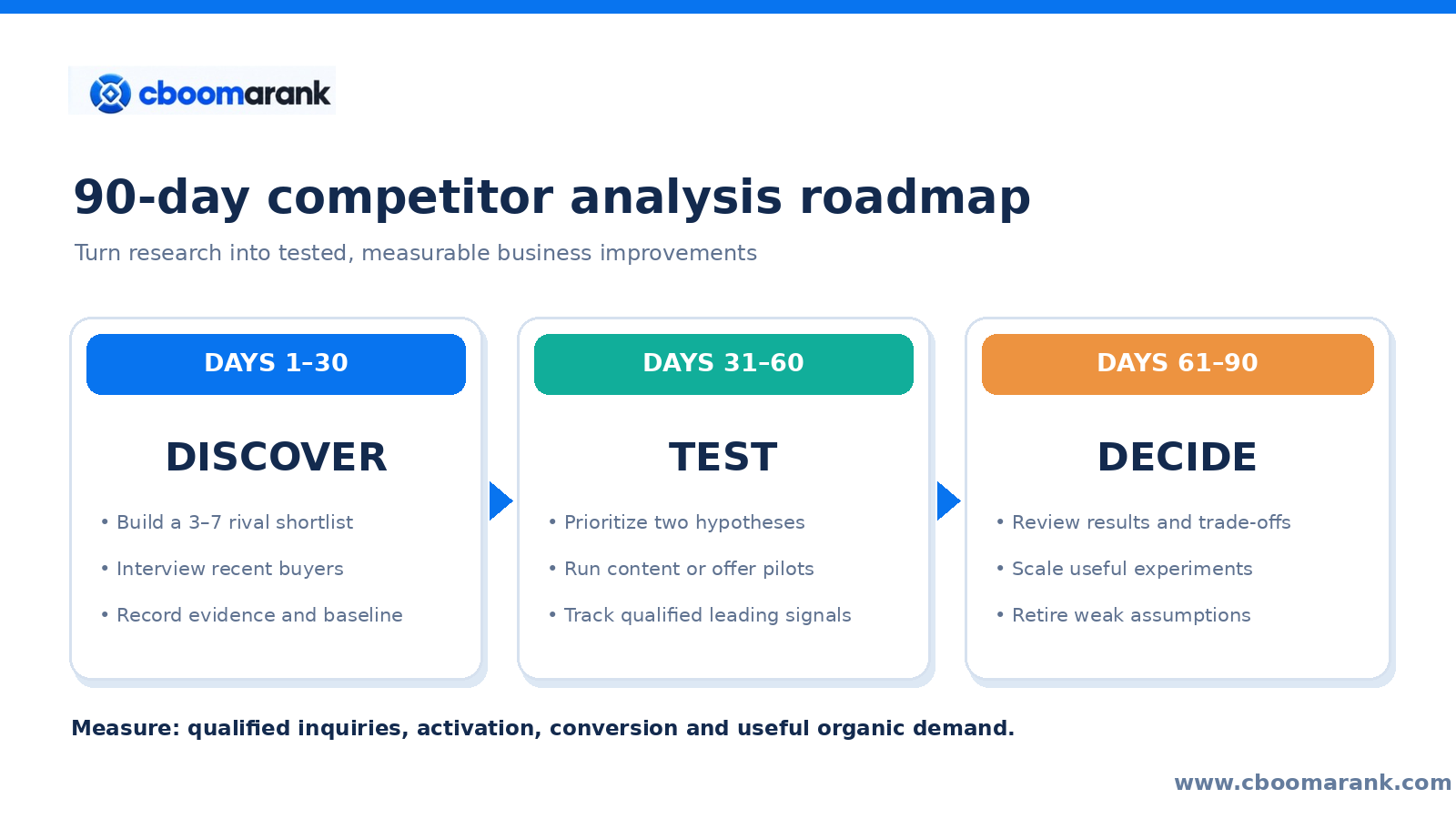
Days 1–30: Discover and establish a baseline
First, finalize your competitor shortlist and agree on the research objectives. Next, collect dated positioning and pricing evidence, interview recent customers, and build the competitor analysis matrix. Before the first month ends, select two or three testable opportunities, assign owners and capture your baseline metrics.
Days 31–60: Launch small, controlled experiments
During the second phase, test one change at a time where practical: clearer messaging, a better onboarding step, a relevant content refresh or a more transparent service description. Measure leading indicators such as qualified click-through, onboarding completion or demo requests. Meanwhile, document external events that could distort a short-term comparison.
Days 61–90: Evaluate, retain or change direction
Finally, compare performance with the original baseline and success criteria. Scale changes that produced credible improvements, revise ambiguous tests and retire ideas unsupported by evidence. Create a short executive summary: what changed, why it mattered, what remains uncertain, what comes next and who owns the next action.
Competitor Analysis Tools: Build a Practical Research Stack
You do not need to purchase a large suite before beginning. Start with publicly available business websites, a spreadsheet, customer interviews and first-party reporting from your own business. Then add specialized tools only where they answer an important question better or save material time.
Use CBOOMARANK for website and SEO research context
CBOOMARANK supports connected website and SEO research workflows, including website analysis, keyword research, competitor context and backlink intelligence. Use those data points to complement—not replace—customer research and product comparisons. For current features and plan options, review CBOOMARANK pricing.
Keep first-party and third-party information separate
Your own conversions, customer feedback, campaign attribution and activation metrics should come from systems you control. A competitor’s private sales funnel or exact revenue is usually unknown. Use documented public prices, observable website changes and clearly labeled third-party estimates only for questions they can reasonably support.
Common Competitor Analysis Mistakes to Avoid
- Copying rivals: relevance and differentiation matter more than feature-for-feature imitation.
- Comparing unlike products: normalize package scope, regions, contract lengths and support.
- Confusing traffic estimates with analytics: modelled visitor counts are not audited company data.
- Ignoring customer evidence: an apparent gap is not an opportunity until buyers care.
- Chasing vanity metrics: prefer qualified leads, activation, retention and customer outcomes.
- Publishing duplicate search content: improve an existing page when intent already overlaps.
- Leaving findings ownerless: assign accountability, test deadlines and success criteria.
- Assuming a competitor campaign succeeded: public activity rarely reveals private return on spend.
- Using questionable data collection: respect privacy, website terms and legitimate access boundaries.
Competitor Analysis FAQs
What is the first step in competitor analysis?
Identify the customer problem and the decision your research must support. Then choose three to seven relevant alternatives rather than collecting an unmanageable list of loosely related companies.
How many competitors should a small business analyze?
Three to seven is often enough for an initial decision-focused study. Include the most relevant direct rivals, an important substitute and search-only competitors if online visibility matters.
How often should I update a competitor analysis?
Review major market assumptions at least quarterly, with more frequent checks when prices, products, search results or buying conditions change quickly. Update the evidence date whenever an important claim is revisited.
Can competitor analysis reveal another company’s exact traffic or revenue?
Usually not. Some public filings provide limited figures, but private-company performance is often unavailable. Search traffic tools estimate visibility from external models and should be labeled accordingly.
What should a competitor analysis report include?
A practical report includes the research objective, competitor shortlist, methods, source dates, comparison matrix, strengths and weaknesses, opportunities, risks, priority recommendations, owner assignments and success metrics.
What is the difference between competitor analysis and SEO competitor analysis?
Business competitor analysis focuses on products, customers, pricing, positioning, service and growth. SEO competitor analysis focuses on search rivals, keywords, links, ranking content and discoverability. Both are useful, but they answer different decisions.
Final Verdict: Make Competitor Analysis an Ongoing Decision Process
Competitor analysis creates value only when it changes a better-informed decision. Start with customer needs, establish what can be observed, flag uncertainty, prioritize a limited number of opportunities and test improvements against outcomes that matter. The strongest plan does not attempt to copy every rival; it makes your own offer easier to understand, buy and recommend.
Explore CBOOMARANK to connect website intelligence with keyword, competitor and backlink research. When you’re ready to compare available plans, visit CBOOMARANK pricing.
Turn competitor research into a clearer growth strategy
Review your website, compare relevant search signals, and prioritize actions worth testing.
