

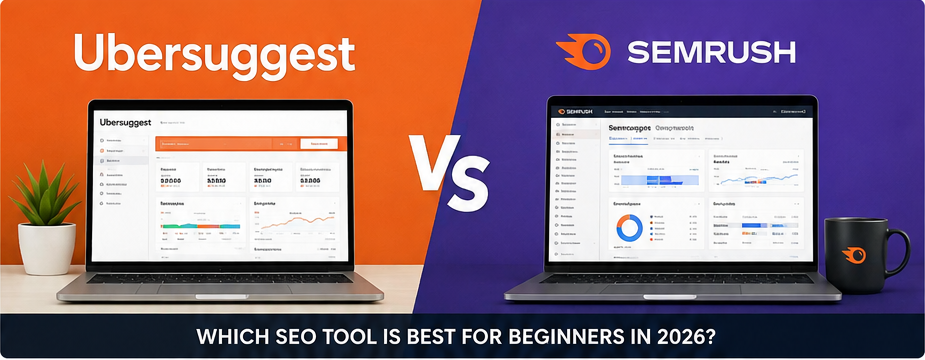
Quick Answer: Ubersuggest Is Better for Most Beginners
If you are learning SEO, building your first content site, running a small business website, or trying to improve organic traffic without adding a large software bill, Ubersuggest is the easier recommendation in 2026. It covers the core jobs a beginner actually needs—keyword research, competitor research, site auditing, rank tracking, backlink analysis, content ideas and basic AI-search visibility—without surrounding those tasks with a large professional marketing suite.
Semrush is the more powerful platform overall. Its SEO research is deeper, its competitor intelligence is more extensive, its tracking and auditing limits are much larger, and its ecosystem stretches well beyond organic search. The trade-off is price and complexity. Semrush’s current entry SEO plan is listed at $139 per month, or $117.33 per month when billed annually, while Ubersuggest’s Individual plan remains $29 per month and also has a $290 lifetime option.
That makes the decision less about which platform has the longest feature list and more about what you will realistically use. For a beginner who needs a clear path from research to action, Ubersuggest usually delivers the better value. For an ambitious freelancer, agency, ecommerce team or marketer who already needs deeper competitive data and larger limits, Semrush can justify its higher cost.
Ubersuggest vs Semrush at a Glance
| Category | Ubersuggest | Semrush | Winner |
| Entry monthly price | $29 Individual | $139 SEO plan | Ubersuggest |
| Free access | Yes, limited | Yes, limited | Tie |
| Lifetime option | Yes, from $290 | No standard lifetime plan | Ubersuggest |
| Ease of use | Simple and focused | Powerful but denser | Ubersuggest |
| Keyword research | Strong and actionable | Deeper and more scalable | Semrush |
| Competitor analysis | Good core insights | Extensive professional depth | Semrush |
| Site audit | Beginner-friendly guidance | Advanced scale and integration | Depends |
| Backlinks | Good for learning and opportunity discovery | Stronger professional workflows | Semrush |
| Rank tracking | Good for small projects | 500 keywords on entry SEO plan | Semrush |
| AI visibility | Entry-level AI visibility included | AI search monitoring included | Depends |
| PPC intelligence | Limited | Strong ecosystem | Semrush |
| Best beginner value | Excellent | Best when advanced features are used | Ubersuggest |
What Is Ubersuggest?
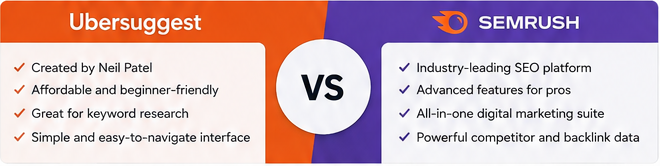
Ubersuggest is an all-in-one SEO platform developed within Neil Patel’s digital marketing ecosystem. It started as a keyword suggestion tool and has grown into a broader SEO workspace with keyword discovery, traffic estimates, competitor research, backlinks, rank tracking, site audits, content ideas and AI-search visibility features.
Its main appeal is accessibility. Reports tend to answer practical questions instead of forcing new users to interpret large amounts of raw data. A beginner can enter a domain, find technical issues, research possible keywords, review competing pages and begin tracking rankings with relatively little setup.
The current Ubersuggest pricing page lists three monthly plans: Individual at $29, Business at $49 and Enterprise at $99. The platform also continues to advertise lifetime plans, making it unusual among mainstream SEO products. For learners and small site owners, that pricing structure keeps the cost of experimentation low.
What Is Semrush?
Semrush is a much broader search and digital-marketing platform. Its SEO products cover keyword research, competitive research, position tracking, site auditing, backlink analysis, on-page optimization and reporting. The wider Semrush ecosystem also extends into AI visibility, advertising, local marketing, content, traffic intelligence and agency workflows.
That breadth is one of Semrush’s biggest strengths. A marketer can use one vendor for a wide range of research and monitoring tasks rather than assembling many smaller tools. The same breadth, however, can be overwhelming when someone is still learning the difference between search volume, keyword difficulty, referring domains, crawl errors and search intent.
Semrush explicitly positions its entry SEO plan for beginners and individual projects. The current plan includes five websites to monitor, 500 keywords to track daily, Site Audit, Position Tracking, keyword and competitor research, plus AI-search performance and visibility reporting.
2026 Pricing: Where the Value Gap Becomes Obvious
For beginners, pricing is not a side issue—it often determines whether an SEO tool is sustainable long enough to produce results. SEO rarely pays back in the first week, so a low recurring cost can matter more than access to enterprise-level features.
Ubersuggest currently lists Individual at $29 per month, Business at $49 per month and Enterprise at $99 per month. The Individual lifetime offer is $290, with higher lifetime tiers also available. The current pricing page shows one project on Individual, seven on Business and fifteen on Enterprise, with report limits and AI-search visibility allowances increasing by tier.
Semrush’s live SEO + AI Search page lists the entry SEO plan at $139 per month, or $117.33 per month with annual billing. It includes five monitored websites and 500 daily tracked keywords. Semrush also offers a free tier with one demo project and ten reports per day across core tools.
At monthly prices, Ubersuggest Individual costs $110 less per month than Semrush’s $139 SEO plan. Over twelve months, that difference is $1,320 before discounts. For a new blogger or small-business owner, that money may be more productive when invested in better content, web development, digital PR, design or conversion improvements.
Semrush is still good value when its extra capability is being used. If you manage several revenue-producing sites, need hundreds of tracked keywords, perform large technical audits, research many competitors or rely on advanced reporting, the higher price can be justified. The key is matching software spend to actual workload.

Ease of Use: Which Platform Is Easier to Learn?
Ubersuggest wins the ease-of-use category for most beginners. Its interface is comparatively focused, and its most important SEO workflows are easy to find. You can move from keyword ideas to content opportunities, from a domain overview to competitor pages, or from a site audit to a list of issues without first mastering a complex navigation system.
That simplicity matters because SEO already has a learning curve. New users are trying to understand technical indexing, internal links, titles, intent, search demand, rankings, backlinks and content quality at the same time. A tool that keeps the interface relatively restrained can reduce the number of decisions required before taking action.
Semrush is polished, but it is built for a broader professional audience. There are more reports, more filtering options and more ways to segment data. Experienced users usually appreciate that control; complete beginners can initially feel as though they are operating software designed for an agency rather than a single site.
If your goal is to become an SEO professional, learning Semrush early is worthwhile. If your goal is simply to grow your own website, Ubersuggest provides a gentler starting point.
Keyword Research: Simplicity vs Research Depth
Both platforms can generate keyword ideas, show estimated search demand, surface related topics, evaluate difficulty and help users understand what ranks in search results. The difference is how much data is exposed and how much control you have over the research process.
Ubersuggest is designed around actionable discovery. A beginner can search a topic, review keyword suggestions, examine volume and difficulty, explore content ideas and save promising terms without building a complicated research workflow. The platform has also expanded its messaging around search behavior beyond traditional Google results, which is useful for creators thinking about discovery across multiple platforms.
Semrush provides the stronger professional keyword-research environment. It is better suited to large keyword sets, extensive filtering, competitive gap analysis, intent segmentation and deeper SERP research. If you are planning hundreds of pages or working in a very competitive niche, that depth becomes important.
For the first months of SEO, however, a smaller number of well-chosen keywords executed with strong content usually matters more than access to the largest possible database. Ubersuggest therefore wins for beginner usability, while Semrush wins for advanced research.
Competitor Research: Semrush Has the Deeper Toolkit
Competitor analysis is one of the strongest reasons to pay for Semrush. The platform is built to show where competing domains receive search visibility, which keywords they rank for, which pages drive traffic, how their backlink profiles compare and where your site has gaps.
Ubersuggest also provides competitor keywords, traffic estimates, top pages and backlink opportunities. Those reports are enough for most first-time users to answer practical questions such as: What topics are working for similar sites? Which competitor pages attract the most organic traffic? Which domains link to competitors but not to me?
Semrush becomes the better choice when competitor research is central to your job. Agencies, SaaS marketers, ecommerce teams and publishers often need more filters, more history and more scalable comparison workflows than a beginner-focused product needs to provide.
Site Audit and Technical SEO
A site audit is often where a beginner gets the fastest value from an SEO platform. It turns technical issues into a prioritized list of things to investigate: crawl problems, metadata issues, broken links, page-speed concerns, duplicate signals and other factors that can reduce search visibility.
Ubersuggest’s audit experience is straightforward and action-oriented. It is a good learning tool because it connects technical problems with understandable explanations. That can help site owners fix obvious errors without feeling that they need to become technical SEO specialists first.
Semrush Site Audit is stronger at scale. According to Semrush’s current SEO Toolkit limits, its entry Pro-level SEO capability can crawl up to 100,000 pages per month. That is far beyond the needs of a small blog, but it becomes valuable for ecommerce stores, large publishers, agencies and sites with complex technical architecture.
For a small site, ease of interpretation usually matters more than crawl capacity. For a large site, Semrush’s scale and integration make it the more capable option.
Backlink Analysis and Link Building
Backlinks are still useful signals for discovering authority, relationships and competitive opportunities. Both products can help users see who links to a site, identify referring domains and compare competitors.
Ubersuggest gives beginners the main information needed to understand a backlink profile. Its backlink opportunity workflow can surface sites linking to competing domains but not yours, which provides a practical starting point for outreach or digital PR.
Semrush provides a more mature professional backlink ecosystem. It is better suited to users who want deeper link auditing, larger datasets, gap analysis and recurring outreach workflows. Agencies and link-focused SEOs are more likely to benefit from that extra sophistication.
For a beginner, the biggest risk is not missing a complex backlink metric. It is spending too much time chasing links before the site has strong pages worth linking to. Ubersuggest provides enough data to learn the process without making link analysis feel like a separate discipline.
Rank Tracking: Both Work, Semrush Scales Further
Rank tracking shows whether target pages are improving or declining for chosen search terms. Ubersuggest’s Individual plan currently includes daily rank tracking with plan-specific limits, while higher tiers expand project capacity and reporting.
Semrush’s entry SEO plan includes 500 keywords tracked daily, which gives it much more capacity for sites that monitor large keyword portfolios. It also provides richer segmentation and professional reporting options.
A beginner rarely needs to track hundreds of keywords immediately. Tracking a focused group tied to important pages and business goals is usually more useful. On that basis, Ubersuggest is sufficient for many small projects even though Semrush offers the stronger scale.
AI Search Visibility in 2026
SEO software is changing because users increasingly discover brands through AI-generated answers as well as classic search results. In 2026, both Ubersuggest and Semrush have moved AI visibility into their product story.
Ubersuggest’s current pricing table includes AI Search Visibility allowances by project and highlights insights for ChatGPT and Gemini. This gives beginners a relatively inexpensive way to start thinking about whether a brand is being surfaced in generative results.
Semrush’s entry SEO plan now includes AI-search performance tracking, sentiment monitoring and AI visibility reports, while its higher SEO + AI Search tiers add more prompt tracking and brand-performance capabilities across multiple AI experiences.
For beginners, the practical advice is to avoid treating GEO or AI visibility as a replacement for fundamentals. Helpful content, clear site structure, strong brand signals, relevant mentions and technically accessible pages remain the foundation. Ubersuggest is the cheaper learning environment; Semrush provides more room for advanced monitoring.
Content Ideas and On-Page Optimization
Beginners often struggle less with collecting data than with deciding what to publish next. Ubersuggest’s content and keyword idea workflows are useful because they connect search demand with pages that are already receiving attention. That makes it easier to build a realistic editorial calendar instead of choosing topics randomly.
Semrush has more extensive content optimization capabilities and fits better into team-based content operations. Its broader ecosystem is useful when writers, editors and SEO specialists collaborate across many pages and campaigns.
For a solo blogger or small team, Ubersuggest’s simpler discovery process is usually enough. For a content department publishing at scale, Semrush’s depth and integrations become more valuable.
PPC and Broader Marketing: Semrush Wins Easily
If your needs go beyond organic SEO, Semrush has a clear advantage. Its product family includes dedicated advertising and market-intelligence capabilities in addition to SEO. That matters for marketers who want to research paid competitors, understand broader acquisition channels or manage integrated search strategies.
Ubersuggest is primarily an SEO product. That narrower focus is actually useful for beginners who do not want to pay for a broad marketing platform. But if paid search, competitor advertising and cross-channel intelligence are important, Semrush is the better long-term choice.
Which Tool Is Best for Different Types of Beginners?
New blogger: Choose Ubersuggest. Its price, keyword research, content ideas and site audit tools are well matched to a first content site.
Small-business owner: Choose Ubersuggest unless you operate in an extremely competitive market or need professional paid-search and competitor intelligence.
Freelance SEO learner: Start with Ubersuggest if budget is tight, but learn Semrush as your clients and research needs grow. Familiarity with both is valuable.
Affiliate marketer: Ubersuggest works well for low-cost research and content planning. Semrush becomes more attractive as you operate multiple sites or compete in difficult commercial niches.
New agency: Semrush is often the better long-term platform when you already have paying clients and need larger tracking limits, advanced reporting and deeper competitor analysis. A solo agency with limited revenue may still prefer Ubersuggest initially.
Small ecommerce store: Ubersuggest can cover the basics. Semrush becomes more compelling as catalog size, technical complexity, paid search activity and competitive research needs increase.
Pros and Cons of Ubersuggest
Advantages include a very low entry price, lifetime purchase options, a simpler interface, useful free access, approachable keyword research, practical site auditing, competitor analysis, backlinks, rank tracking and increasingly visible AI-search features.
The limitations are mostly about scale and depth. Professional users may eventually want larger datasets, more advanced competitive intelligence, more sophisticated reporting and a broader marketing stack. Ubersuggest is strongest when the priority is getting the core SEO jobs done without paying for enterprise complexity.
Pros and Cons of Semrush
Semrush’s advantages are depth, scalability and breadth. It provides mature keyword and competitor research, robust technical SEO, strong backlink workflows, daily rank tracking, AI-search monitoring and a much wider digital-marketing ecosystem.
Its main drawbacks for beginners are price and cognitive load. Paying more than one hundred dollars per month makes sense only when the user is extracting enough value from the platform. Someone managing one small website may spend more time learning reports than acting on them.
Final Verdict: Start with Ubersuggest, Grow into Semrush When Needed
For most beginners in 2026, Ubersuggest is the better first SEO tool. The reason is not that it beats Semrush in every technical category—it does not. The reason is that it combines the essential SEO workflows with a price and interface that are easier to justify while you are still learning what actually moves rankings and traffic.
Semrush is the stronger overall platform. If you already manage multiple sites, work with clients, need deep competitor research, track hundreds of keywords or want SEO integrated with broader marketing intelligence, it is the more capable investment.
A sensible progression is to start with Ubersuggest, master the fundamentals and upgrade only when your workload proves that you need more depth. That approach keeps software costs aligned with growth rather than paying for advanced capacity before it becomes useful.
CBOOMARANK recommendation: Ubersuggest wins for beginner value and ease of use. Semrush wins for professional depth, scalability and broader marketing capability.
Frequently Asked Questions
Is Ubersuggest better than Semrush for beginners?
For most beginners, yes. Ubersuggest is cheaper, easier to learn and covers the essential SEO workflows. Semrush is more powerful overall, but many first-time users do not need its full depth.
How much does Ubersuggest cost in 2026?
Ubersuggest currently lists Individual at $29 per month, Business at $49 per month and Enterprise at $99 per month. It also advertises lifetime plans, including $290 for Individual.
How much does Semrush cost in 2026?
Semrush’s live SEO + AI Search pricing page lists the entry SEO plan at $139 per month, or $117.33 per month when billed annually.
Can I use Ubersuggest for free?
Yes. Ubersuggest provides free limited access, which is useful for testing keyword research and other basic workflows before subscribing.
Does Semrush have a free plan?
Yes. Semrush currently lists a free tier with one demo project and ten reports per day across core tools.
Which tool is better for keyword research?
Semrush is better for large-scale, advanced keyword research. Ubersuggest is easier for beginners who want a smaller, more actionable set of ideas.
Which tool is better for backlinks?
Semrush is stronger for professional backlink research and link-building workflows. Ubersuggest is sufficient for learning backlink analysis and identifying basic opportunities.
Which tool is better for site audits?
Both are useful. Ubersuggest is easier for a beginner to interpret, while Semrush offers substantially more scale and deeper integration for complex sites.
Which is better for AI search visibility?
Both now include AI-search features. Ubersuggest provides a lower-cost introduction, while Semrush offers more advanced monitoring and prompt-tracking options as plans scale.
Can I start with Ubersuggest and switch to Semrush later?
Yes. That is a practical path. SEO fundamentals transfer between tools, so you can learn with Ubersuggest and move to Semrush when your projects or client work justify the additional cost.
Recommended Internal Links
- SE Ranking vs Semrush: Which SEO Tool Offers Better Value in 2026?
- Semrush vs Ahrefs: Which SEO Tool Is Better in 2026?
- CBOOMARANK Free Site SEO Audit
- CBOOMARANK Blog
External Sources Checked
- Ubersuggest pricing
- Ubersuggest vs Semrush comparison updated April 24, 2026
- Semrush SEO + AI Search pricing
- Semrush SEO Toolkit pricing and limits
Pricing note: Vendor prices, billing cycles, usage limits and feature packaging can change. The figures in this rewrite were checked against vendor pages available on August 7, 2026.
