

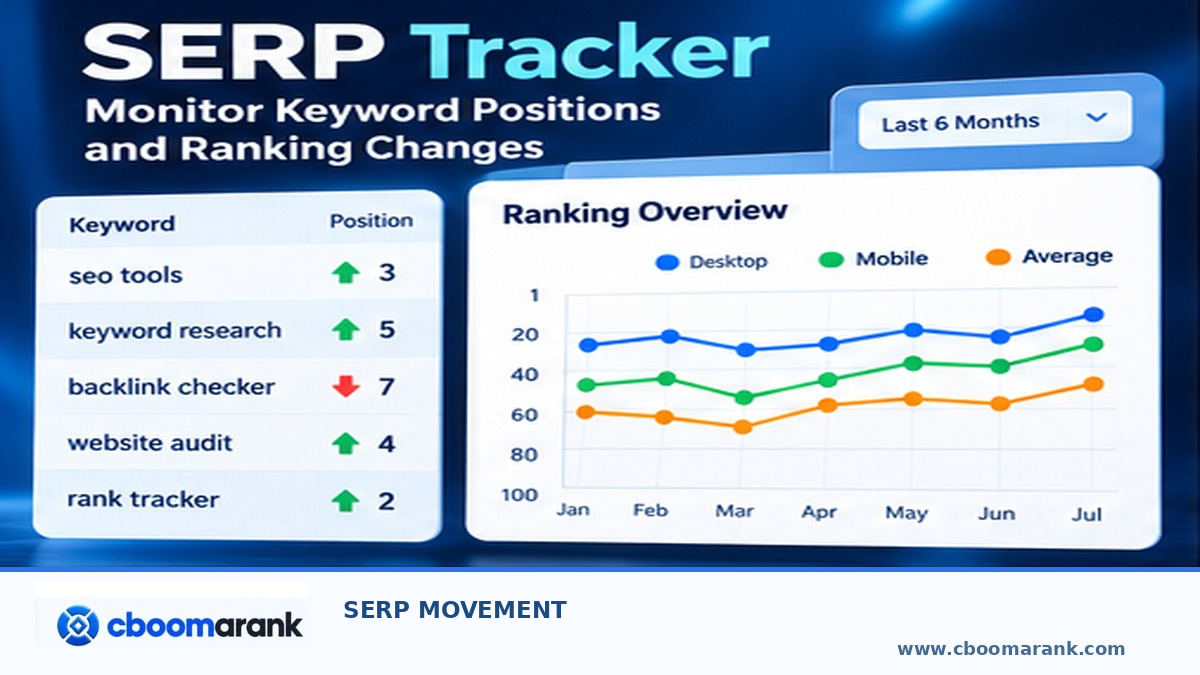
A SERP tracker records how a specified website or URL appears for selected keywords over time. Its value is not a colourful up-or-down arrow; it is the ability to determine what changed, whether the measurement conditions match, and which business decision follows. This guide focuses on evidence-based change monitoring, not a promise that everyone sees the same Google result.
Practical scope: Change-detection and alert triage rather than a general rank-checker walkthrough. The instructions below distinguish actual first-party metrics, observed search results, and third-party estimates. Their meaning changes with location, date, device, and source, so a useful decision begins by documenting those inputs.
Explore CBOOMARANK, review the CBOOMARANK pricing options, or use the Ranks 66–74 research workbook to record your research and next actions.
What Is Serp Tracker? Quick Explanation
A SERP tracker records how a specified website or URL appears for selected keywords over time. Its value is not a colourful up-or-down arrow; it is the ability to determine what changed, whether the measurement conditions match, and which business decision follows. This guide focuses on evidence-based change monitoring, not a promise that everyone sees the same Google result.
At a Glance: Evidence You Need Before Making a Decision
| Stage | What to do | Why it matters |
|---|---|---|
| 1 | Build an observation specification | Choose the exact keyword, canonical landing URL, country, language, city if needed, device, search engine and checking cadence. |
| 2 | Create a starting benchmark | Record a baseline across multiple observations where practical. |
| 3 | Measure URL-level movement | A domain can appear at a similar position while the ranking URL changes. |
| 4 | Separate SERP features from traditional positions | Organic results, local packs, paid ads, featured snippets and AI-generated elements may change layout and visibility. |
| 5 | Investigate volatility before reacting | Compare at least two matched checks and inspect competitors, indexing, canonical URLs, site availability, recent redirects and content changes. |
| 6 | Design useful alerts | An alert should require a defined condition: for example a tracked commercial query moving outside your chosen top-ten range for repeated checks,. |
| 7 | Report results alongside customers | Link rank movement with organic clicks, relevant enquiries, registrations and conversions. |
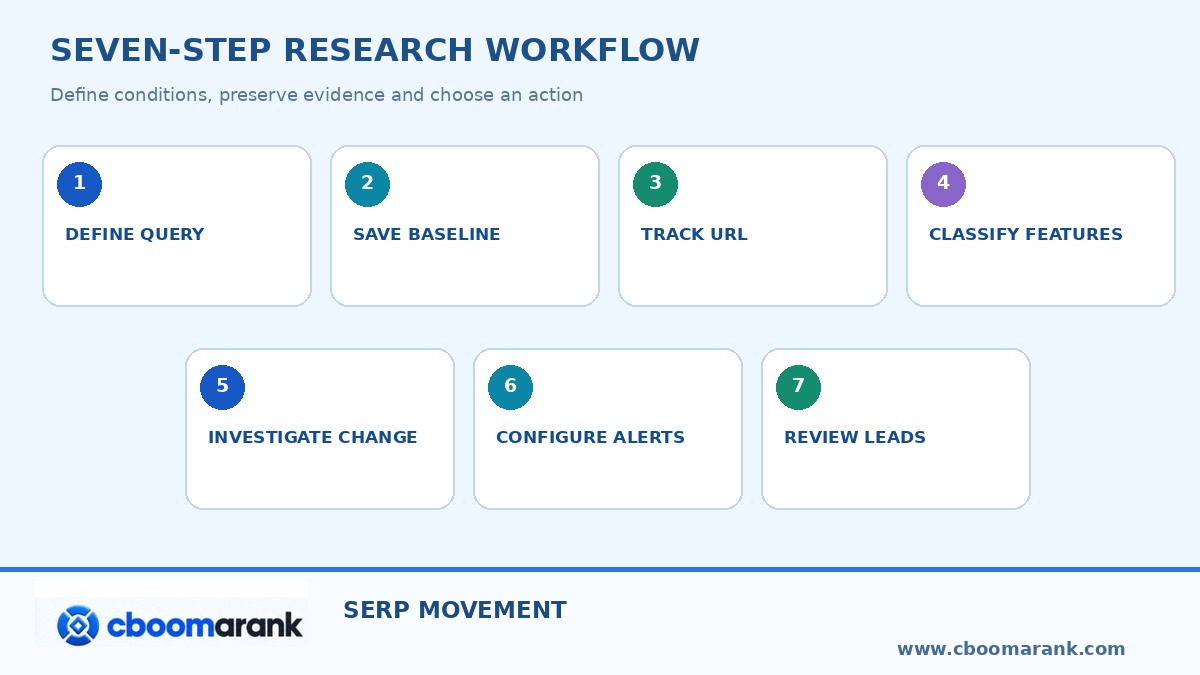
How to Use Serp Tracker: A Seven-Step Method
Step 1: Build an observation specification
Choose the exact keyword, canonical landing URL, country, language, city if needed, device, search engine and checking cadence. Group branded, nonbranded, informational and commercial phrases separately. A position measured on desktop in the United Kingdom should not be compared directly to a mobile observation from India. Log the date and provider before interpreting any line chart.
For this stage, make your evidence traceable: record the scope of “build an observation specification,” the source you consulted, what remains uncertain, and the next action you would take. If the available data is incomplete, mark it as an assumption rather than filling the gap with an unsupported ranking, conversion rate or advertising cost. This extra discipline makes SERP tracker work easier to audit when another analyst repeats the exercise next month.
Step 2: Create a starting benchmark — Serp Tracker
Record a baseline across multiple observations where practical. Add Google Search Console impressions, clicks, CTR and average position for the same page and query. Search Console reports impressions across eligible searches; it is not a laboratory snapshot. A tracker’s sampled SERP position can therefore differ without either source necessarily being defective.
For this stage, make your evidence traceable: record the scope of “create a starting benchmark,” the source you consulted, what remains uncertain, and the next action you would take. If the available data is incomplete, mark it as an assumption rather than filling the gap with an unsupported ranking, conversion rate or advertising cost. This extra discipline makes SERP tracker work easier to audit when another analyst repeats the exercise next month.
Step 3: Measure URL-level movement
A domain can appear at a similar position while the ranking URL changes. Record the specific page for every observation, including cannibalization cases where a category replaces a product page. Mark a result as unobserved if the provider cannot confidently locate it; do not label an absent result as position 101 unless the tool actually searched that far.
For this stage, make your evidence traceable: record the scope of “measure url-level movement,” the source you consulted, what remains uncertain, and the next action you would take. If the available data is incomplete, mark it as an assumption rather than filling the gap with an unsupported ranking, conversion rate or advertising cost. This extra discipline makes SERP tracker work easier to audit when another analyst repeats the exercise next month.
Quality check for step 3
Confirm that the observation is relevant to the user’s real task and that a different location, date, device, page, or audience would not change its meaning. Document any exception in the research workbook so it does not become an unexplained outlier in a later presentation.
Step 4: Separate SERP features from traditional positions
Organic results, local packs, paid ads, featured snippets and AI-generated elements may change layout and visibility. Decide whether your dashboard reports first classic organic position, first appearance anywhere, or individual feature ownership. Keep those columns separate so a map-pack appearance does not disguise a lost organic link.
For this stage, make your evidence traceable: record the scope of “separate serp features from traditional positions,” the source you consulted, what remains uncertain, and the next action you would take. If the available data is incomplete, mark it as an assumption rather than filling the gap with an unsupported ranking, conversion rate or advertising cost. This extra discipline makes SERP tracker work easier to audit when another analyst repeats the exercise next month.
Step 5: Investigate volatility before reacting — Serp Tracker
Compare at least two matched checks and inspect competitors, indexing, canonical URLs, site availability, recent redirects and content changes. A sharp movement for one query could be normal reshuffling, while simultaneous drops across a folder could indicate a technical issue. Record the hypothesis and confidence, not only the dramatic percentage movement.
For this stage, make your evidence traceable: record the scope of “investigate volatility before reacting,” the source you consulted, what remains uncertain, and the next action you would take. If the available data is incomplete, mark it as an assumption rather than filling the gap with an unsupported ranking, conversion rate or advertising cost. This extra discipline makes SERP tracker work easier to audit when another analyst repeats the exercise next month.
Step 6: Design useful alerts
An alert should require a defined condition: for example a tracked commercial query moving outside your chosen top-ten range for repeated checks, or a high-value URL becoming unobserved. Avoid flooding a team with one-position fluctuations on low-priority queries. Give each alert an owner, expected response, and a reversible action.
For this stage, make your evidence traceable: record the scope of “design useful alerts,” the source you consulted, what remains uncertain, and the next action you would take. If the available data is incomplete, mark it as an assumption rather than filling the gap with an unsupported ranking, conversion rate or advertising cost. This extra discipline makes SERP tracker work easier to audit when another analyst repeats the exercise next month.
Quality check for step 6
Confirm that the observation is relevant to the user’s real task and that a different location, date, device, page, or audience would not change its meaning. Document any exception in the research workbook so it does not become an unexplained outlier in a later presentation.
Step 7: Report results alongside customers
Link rank movement with organic clicks, relevant enquiries, registrations and conversions. A higher rank accompanied by fewer qualified prospects may reflect seasonality, irrelevant intent or a broken sales funnel. Share the baseline, period, device, geography and source in each report so clients can reproduce the context.
For this stage, make your evidence traceable: record the scope of “report results alongside customers,” the source you consulted, what remains uncertain, and the next action you would take. If the available data is incomplete, mark it as an assumption rather than filling the gap with an unsupported ranking, conversion rate or advertising cost. This extra discipline makes SERP tracker work easier to audit when another analyst repeats the exercise next month.
Serp Tracker in Practice: Worked Example
An agency tracks the phrase “technical SEO audit software” on mobile in London and Toronto. London drops from an illustrative position 5 to 11, while Toronto remains stable. Before declaring a Google-wide decline, the analyst checks the London-specific results, confirms the same ranking URL, reviews indexing and compares Search Console clicks filtered to the United Kingdom. A new rival comparison page appears in London. The agency plans an evidence-led content update, not a sitewide emergency rewrite. These example positions are hypothetical.
Evidence rule: Any example figures in this article are hypothetical teaching inputs, not CBOOMARANK customer results, a current Google Ads auction, or a measurement of a named competitor. Use your own collected records before drawing a commercial conclusion.
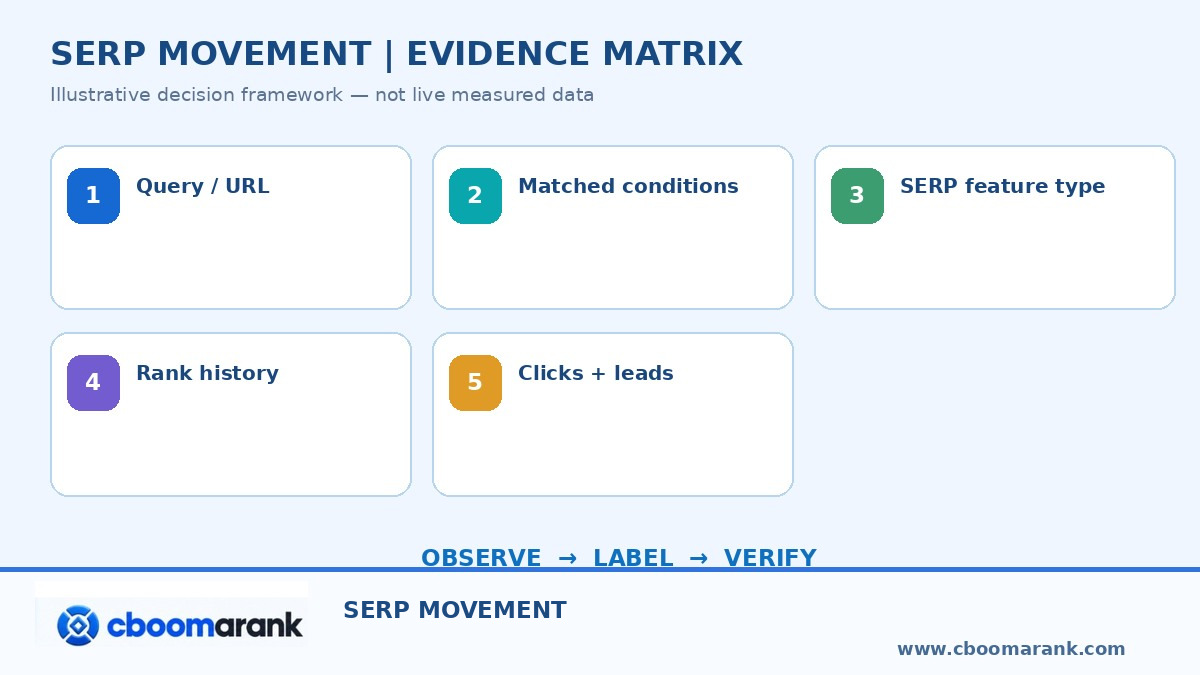
Common Serp Tracker Mistakes and How to Avoid Them
1. A single position change is not a business outcome.
A single position change is not a business outcome. A more reliable approach is to label the exact source, period, market and limitations beside the observation, then state what the user should do next. This matters because stakeholder decisions can become expensive when a narrow sampled signal is promoted into an unsupported universal claim. Keep the correction tied to the reader’s goal and check whether the evidence changes after the next consistent measurement.
2. Sampled snapshots and Search Console averages have different definitions.
Sampled snapshots and Search Console averages have different definitions. A more reliable approach is to label the exact source, period, market and limitations beside the observation, then state what the user should do next. This matters because stakeholder decisions can become expensive when a narrow sampled signal is promoted into an unsupported universal claim. Keep the correction tied to the reader’s goal and check whether the evidence changes after the next consistent measurement.
3. Record ranking URLs, not only a domain score.
Record ranking URLs, not only a domain score. A more reliable approach is to label the exact source, period, market and limitations beside the observation, then state what the user should do next. This matters because stakeholder decisions can become expensive when a narrow sampled signal is promoted into an unsupported universal claim. Keep the correction tied to the reader’s goal and check whether the evidence changes after the next consistent measurement.
4. Keep organic, ads and local-pack placements distinct.
Keep organic, ads and local-pack placements distinct. A more reliable approach is to label the exact source, period, market and limitations beside the observation, then state what the user should do next. This matters because stakeholder decisions can become expensive when a narrow sampled signal is promoted into an unsupported universal claim. Keep the correction tied to the reader’s goal and check whether the evidence changes after the next consistent measurement.
5. Do not trust an alert unless its measurement settings match.
Do not trust an alert unless its measurement settings match. A more reliable approach is to label the exact source, period, market and limitations beside the observation, then state what the user should do next. This matters because stakeholder decisions can become expensive when a narrow sampled signal is promoted into an unsupported universal claim. Keep the correction tied to the reader’s goal and check whether the evidence changes after the next consistent measurement.
6. Disclose missing observations and query-depth limits.
Disclose missing observations and query-depth limits. A more reliable approach is to label the exact source, period, market and limitations beside the observation, then state what the user should do next. This matters because stakeholder decisions can become expensive when a narrow sampled signal is promoted into an unsupported universal claim. Keep the correction tied to the reader’s goal and check whether the evidence changes after the next consistent measurement.
Turn Serp Tracker Findings into a 30-Day Action Plan
Week 1 — Collect a reproducible baseline
Agree which keywords, audience, countries, languages, URLs, and conversion goals belong to the project. Verify analytics and search reporting access. Save a dated baseline and label unknown values rather than pretending the available dataset is complete. If source settings differ, create separate rows rather than averaging incompatible results.
Week 2 — Prioritize the evidence
Group queries by shared intent and mark where an existing page already answers the need. Rate opportunities by relevance, feasibility, customer value, confidence and effort. Discuss apparent contradictions before moving budget or restructuring content. Choose one hypothesis that the team can test within its technical and editorial constraints.
Week 3 — Implement one controlled improvement
Improve the most relevant landing page, clarify its answer, fix a tracking problem or test an appropriate paid campaign if authorized. Record what was changed, when, and how success will be measured. Preserve backups and avoid simultaneous changes that make the outcome hard to interpret.
Week 4 — Measure qualified outcomes
Compare equivalent observation windows, review search impressions and clicks, and measure meaningful leads or registrations where tracking is configured. Distinguish correlation from causation. Keep changes that benefit customers, discard weak assumptions and set the next review cadence based on the business value of the finding.
Frequently Asked Questions About Serp Tracker
Is a SERP tracker the same as Search Console?
No. A tracker observes configured SERPs; Search Console aggregates actual impressions and clicks across searches in your verified property.
How often should I check positions?
Match cadence to risk and resources. Daily can help volatile commercial terms, while weekly is often adequate for stable informational content.
Why do rankings differ between devices?
Layout, relevance, search context and the results shown can vary. Keep mobile and desktop measurements separate.
Can I prove a Google update caused a movement?
Timing alone cannot prove causality. Inspect indexing, site changes, competitors and multiple queries before reaching that conclusion.
What if the tool reports “not found”?
Confirm its depth, location and failure states, then check the URL and first-party impressions before assigning a numeric rank.
Official References and Further Reading
- Google Search Console: how clicks, impressions and position are counted. Check the provider’s current definitions and limitations.
- Google Search Console: performance reports. Check the provider’s current definitions and limitations.
- Google Search Central: creating helpful content. Check the provider’s current definitions and limitations.
Continue researching with this related CBOOMARANK SEO guide and another practical CBOOMARANK resource. Related articles support this narrower task rather than replacing it.
Final Verdict: Make Serp Tracker Measurable
The point of SERP tracker is not to collect impressive-looking metrics without context. Use a clear measurement specification, original evidence where available, defensible assumptions, and an action tied to a real customer need. A smaller, well-understood result can be more valuable than a broad ranking, search-volume or CPC estimate that cannot be reproduced.
Explore www.cboomarank.com for SEO and competitor research, compare CBOOMARANK plans, and download the nine-topic workbook to document the decision and supporting evidence.
Editorial review: October 2026. Tools, search layouts, plan limits and advertising costs can change. Examples are explicitly illustrative. This CBOOMARANK article is commercial editorial content; verify current third-party facts and product access before making a purchase.
