

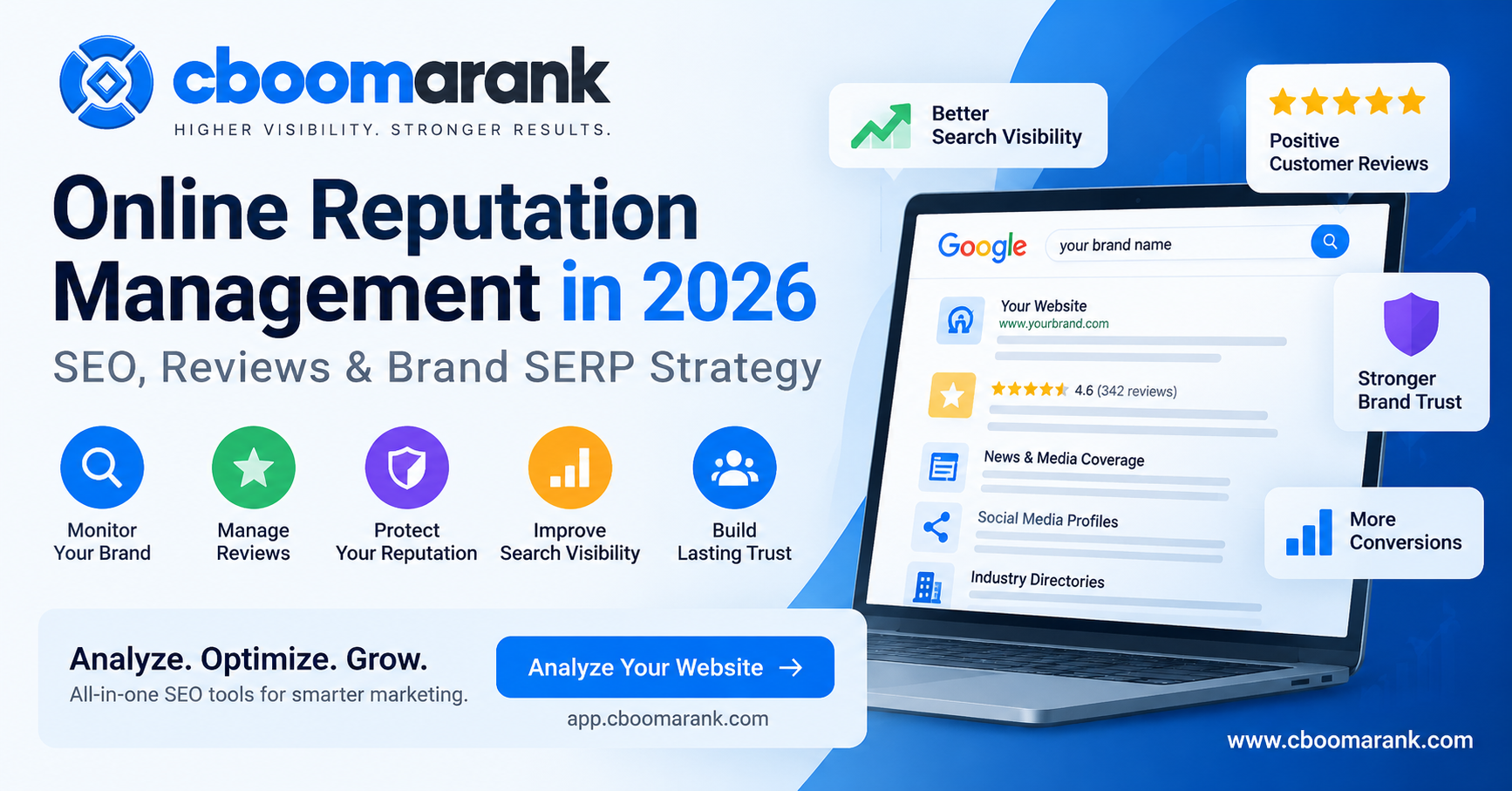
Online reputation management is the process of monitoring, protecting, and improving how a business or brand appears across search engines, customer review platforms, websites, social networks, forums, news publications, and other digital channels.
In 2026, online reputation management is no longer limited to replying to negative reviews. Prospective customers may search your company name, compare ratings, inspect discussion forums, read independent articles, visit social profiles, and encounter AI-generated summaries before they ever reach your website.
That makes reputation management an SEO issue, a customer-experience issue, a brand-trust issue, and a conversion issue at the same time.
A strong online reputation management strategy combines search engine optimization, genuine customer reviews, professional review responses, brand monitoring, digital PR, accurate business information, competitor research, and continuous measurement.
The goal is not to manufacture a perfect reputation. Instead, the objective is to make accurate, useful, and trustworthy information about your brand easy to discover.
What Is Online Reputation Management?
Online reputation management, often abbreviated as ORM, is the structured process of understanding what people find when they research a business online and improving that information where appropriate.
A modern ORM program normally covers search results, customer reviews, news coverage, forums, directories, social media, company-owned content, inaccurate information, and emerging reputation risks.
SEO is especially important because search engines frequently act as the gateway to all those sources.
When someone searches for your company, they may see your official website, review profiles, social accounts, news stories, comparison pages, and third-party discussions before making a purchase decision.
That collection of results is commonly known as the brand SERP.
What Is a Brand SERP?
A brand SERP is the search engine results page displayed when someone searches for a company name or a closely related branded query.
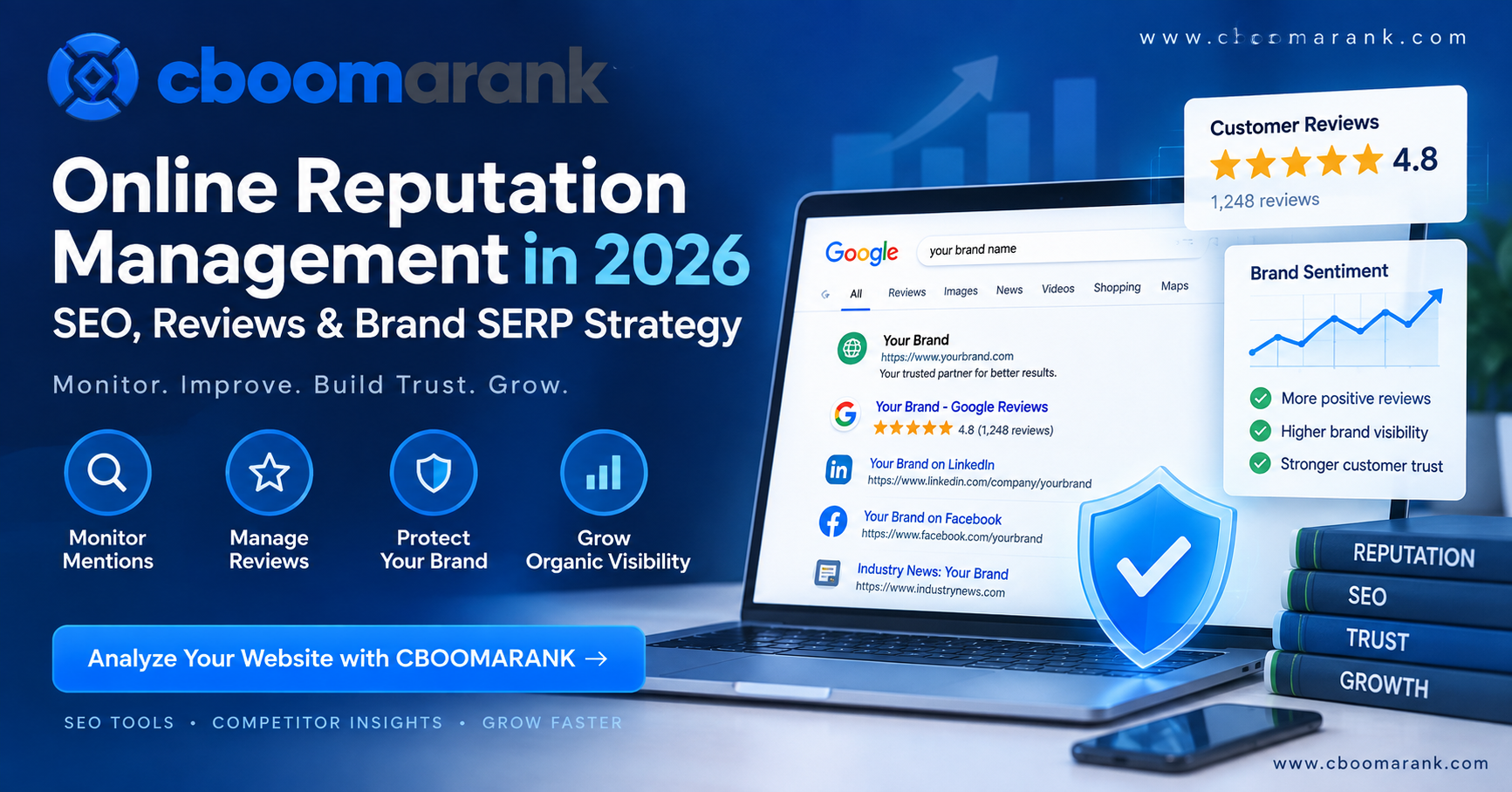
Examples include:
- Brand name
- Brand name reviews
- Brand name pricing
- Brand name complaints
- Brand name alternatives
- Brand name vs competitor
- Is brand name legitimate?
These searches often happen close to a commercial decision.
Therefore, an online reputation management strategy should evaluate more than whether the official website ranks first. You should study what the entire search results page communicates about the business.
For example, a strong brand SERP may contain the official website, useful company resources, verified social profiles, legitimate customer reviews, accurate directories, and credible independent coverage.
However, a weak brand SERP may contain outdated information, abandoned social accounts, unresolved complaints, inaccurate business details, or negative discussions that have received no meaningful response.
Why Online Reputation Management Matters in 2026
Digital reputation is now distributed across many platforms rather than controlled by a single website.
Google explains that customer reviews can help businesses stand out and provide useful information to prospective customers. Google also recommends requesting genuine reviews and responding to customer feedback.
Read Google’s official guidance on getting more Google reviews.
This distinction matters. Therefore, effective reputation management is not about manipulating ratings. Instead, it is about building systems that encourage authentic feedback, improve customer experiences, and make reliable information easier to find.
The U.S. Federal Trade Commission also addresses deceptive review practices through its Consumer Reviews and Testimonials Rule.
Businesses operating in the United States can review the FTC Consumer Reviews and Testimonials Rule guidance. Companies serving other markets should also review relevant local laws and platform policies.
1. Audit Your Current Online Reputation
Before trying to improve your reputation, establish a clear baseline.
Search Google for your company name and important branded variations. Review the first page carefully.
For every result, ask two questions:
- Who controls this result?
- What will a prospective customer learn from it?
For instance, the result may belong to your business, a review platform, an independent publisher, a social network, a directory, a forum, or another third party.
Do not automatically classify every critical result as something that must disappear. Genuine criticism can reveal weaknesses in delivery, communication, pricing, customer support, or product quality.
The goal of the audit is to discover patterns and determine which issues are genuinely important.
2. Audit Branded Search Keywords
Your company name is only the beginning of reputation SEO.
Customers often combine a brand name with modifiers such as reviews, pricing, complaints, competitors, alternatives, refunds, customer service, product names, or location names.
Keyword research can reveal these high-intent reputation queries.
Then inspect which pages rank for each query.
If customers repeatedly search for your pricing but the strongest result contains outdated information, creating a clear and accurate pricing resource can improve both customer experience and brand search quality.
If users frequently compare your company with a competitor, publishing a factual and balanced comparison may provide useful first-party information while still allowing independent sources to appear.
For broader optimization guidance, read the CBOOMARANK SEO Optimization Guide.
3. Monitor Customer Reviews
For many local businesses, ecommerce companies, software providers, and professional services, customer reviews are among the most visible elements of online reputation.
Monitoring should focus on platforms that genuinely influence customers rather than creating accounts everywhere simply to increase the number of listings.
In particular, Google Business Profile is especially important for eligible local organizations.
Google recommends valuing authentic customer feedback, replying to reviews, and using legitimate review-request links or QR codes.
Buying positive reviews is not a sustainable reputation strategy. Manipulated feedback can violate platform policies and create additional legal or trust risks.
4. Build an Ethical Review Request Process
Businesses do not need to wait passively for customer feedback.
A legitimate review-generation workflow can be integrated into the customer journey.
After a real transaction, completed service, resolved support case, or other meaningful customer interaction, make it easy for customers to provide honest feedback.
The request should remain neutral.
For example, do not tell only satisfied customers to leave public reviews. Likewise, avoid compensating customers specifically for positive ratings. Finally, never pressure customers to remove legitimate criticism.
Instead, make the process simple, consistent, transparent, and easy to access.
5. Respond Properly to Negative Reviews
However, a negative review does not automatically become a reputation crisis.
The quality of the company’s response may matter almost as much as the original complaint.
A useful response should acknowledge the customer’s concern, avoid defensive arguments, protect private information, and provide a practical path toward resolution.
Never publish confidential order information, personal data, account details, health information, or other sensitive customer information in a public review response.
If investigation is required, move the detailed conversation into an appropriate private support channel.
Most importantly, investigate recurring patterns. If many customers complain about the same problem, writing polished responses is not enough. The underlying issue should be corrected.
What Should You Do About Fake or Policy-Violating Reviews?
There is an important difference between a negative review and a review that violates platform rules.
A business should not attempt to remove legitimate criticism merely because it is uncomfortable.
However, Google provides a reporting process for reviews that may violate its policies.
See Google’s official documentation on reporting inappropriate Google reviews.
Document the issue carefully before escalating it. Keep screenshots, dates, transaction records, and other relevant evidence where appropriate.
Do not organize retaliatory reviews or encourage employees to attack a reviewer. Reputation management should reduce risk, not create a second problem.
6. Strengthen the Content You Control
Owned digital assets are among the most durable components of reputation SEO.
Your organization should maintain accurate and useful versions of important pages such as:
- Homepage
- About page
- Product and service pages
- Pricing information
- Contact information
- Customer support resources
- Company information
- Trust and legal pages where appropriate
The objective is not to fill Google’s first page with low-quality company pages.
The objective is to make genuinely useful information available for important branded questions.
In addition, technical health matters. Broken pages, duplicate content, crawl problems, or poor internal linking can weaken the visibility of pages you want customers to find.
Use the Top Technical SEO Tools guide to strengthen the technical side of your search presence.
7. Improve Brand and Organization Signals
Search engines need to understand which website, business name, logo, and company information belong to the same organization.
Consistency helps.
Use the same core business name and accurate company information across important owned profiles. Maintain legitimate social profiles and keep contact information up to date.
Google also supports Organization structured data.
Review the official Google Organization structured data documentation.
Of course, structured data cannot guarantee control of a knowledge panel or search result. However, accurate machine-readable organization information supports a technically sound brand-presence strategy.
8. Earn Credible Third-Party Mentions
Online reputation cannot be built entirely on websites and profiles controlled by the company.
Independent references matter because potential customers often want perspectives beyond a company’s own marketing.
For example, credible third-party visibility may come from industry publications, professional organizations, interviews, partner websites, research reports, expert commentary, relevant directories, and legitimate editorial mentions.
This is where digital PR, authority building, link earning, and reputation SEO overlap.
The objective should be relevance and credibility rather than simply acquiring the largest possible number of backlinks.
A relevant editorial mention from a respected publication can support discovery, referral traffic, brand recognition, and trust at the same time.
9. Monitor Competitors’ Reputation Footprints
Your reputation strategy should not be evaluated in isolation.
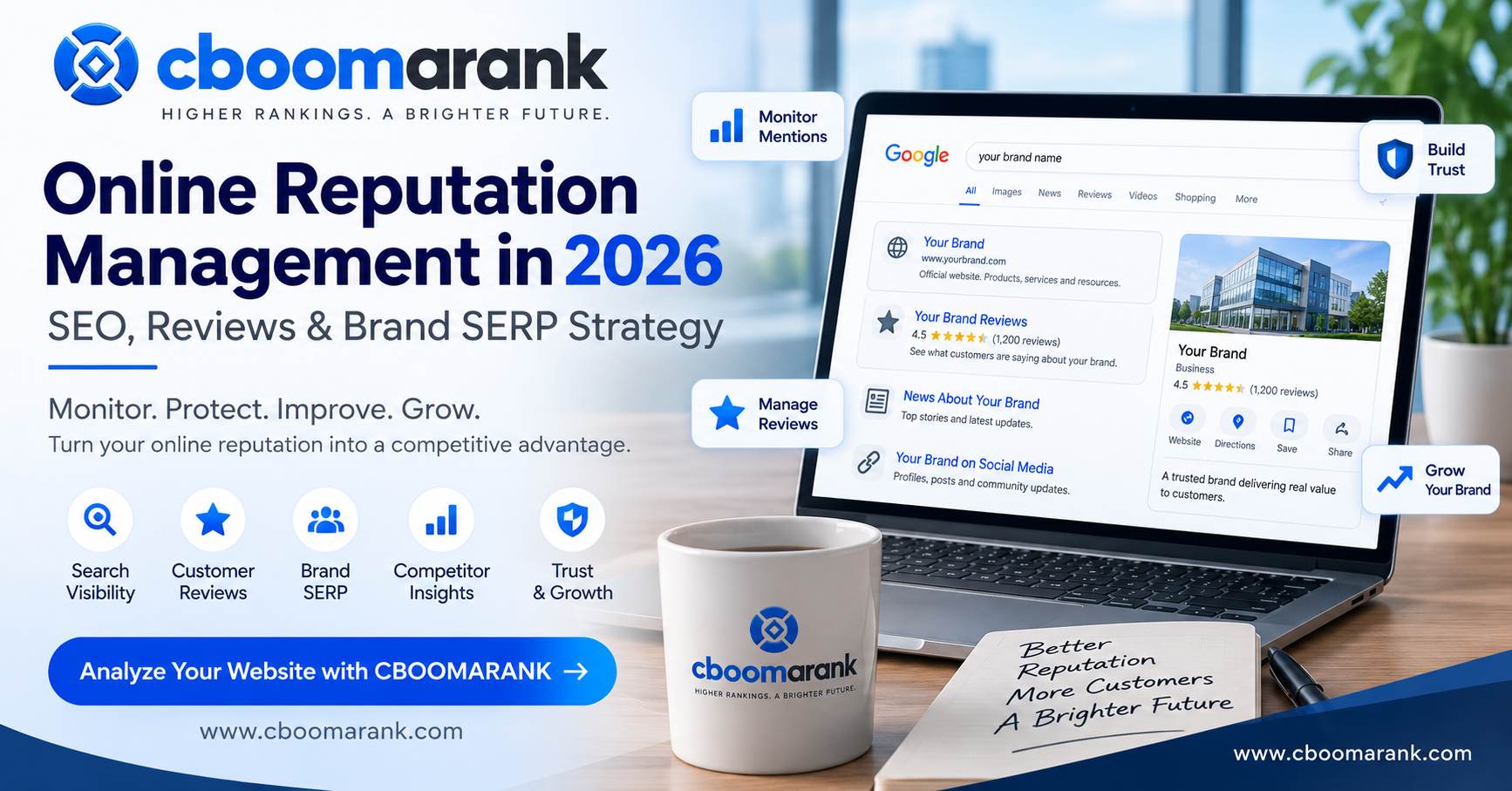
Search the same commercial and reputation-oriented queries for important competitors.
In particular, compare which websites rank for their brand, which review platforms appear prominently, what questions customers ask, how the company responds to criticism, and what content exists around pricing, support, and comparisons.
However, competitor research should never be used to manufacture negative content about another company.
Its purpose is to understand the standard of transparency, authority, and customer information users already encounter within the market.
10. Create a Brand SERP Content Strategy
Once the reputation audit reveals gaps, prioritize them.
For example, if customers repeatedly search for pricing, improve pricing information.
Similarly, when support questions dominate branded searches, strengthen documentation.
In addition, when comparison searches are important, publish accurate comparison content.
Meanwhile, if company information is inconsistent, correct the primary sources.
As a result, update or consolidate outdated pages when they rank prominently.
Finally, if an independent publisher contains incorrect factual information, contact the publisher with verifiable corrections instead of demanding the removal of legitimate opinions.
This creates a reputation strategy built around useful information rather than suppression.
Online Reputation Management and Site Reputation Abuse Are Different
The terminology can be confusing.
Google’s site reputation abuse policy is not a judgment about whether a company has a good or bad public reputation.
It relates to certain situations in which third-party content is published on an established website primarily to exploit that site’s ranking signals.
That search-spam policy is different from online reputation management.
How AI Search Changes Reputation Management
Meanwhile, search behavior is expanding beyond traditional search result pages.
Users increasingly ask AI-powered systems questions about companies, products, competitors, and alternatives.
These systems may summarize information from official websites, independent publications, reviews, directories, and other sources.
Therefore, modern reputation management should prioritize accurate source information across the web.
The fundamentals remain familiar: publish accurate information, maintain consistent organization details, earn credible third-party mentions, correct misinformation through legitimate processes, and create content that answers real customer questions.
However, trying to manipulate every possible AI-generated response is not a practical strategy. Instead, improving the information ecosystem surrounding the brand is more sustainable.
Online Reputation Management KPIs
Reputation management should be measurable.
| KPI | What It Measures |
|---|---|
| Brand SERP composition | Which owned and third-party sources dominate branded searches |
| Branded keyword visibility | Whether accurate company resources appear for important searches |
| Review volume | The amount of customer feedback being generated |
| Review recency | Whether feedback reflects recent customer experiences |
| Average rating | Overall review-platform sentiment |
| Response rate | How consistently the business acknowledges customer feedback |
| Response time | How quickly reputation issues are addressed |
| Complaint themes | Recurring operational issues that need attention |
| Earned brand mentions | Independent visibility and authority |
| Branded conversions | Whether reputation-focused searches contribute to business results |
Therefore, no single number can summarize an online reputation accurately. Instead, use several metrics together.
Should Reputation Management Be In-House or Outsourced?
In practice, either approach can work.
An internal team usually has closer access to customer support information, product teams, and decision-makers.
An external SEO, digital PR, or reputation specialist may provide additional monitoring tools, search expertise, content production, and experience handling complicated visibility problems.
However, the important issue is ownership.
Someone should own monitoring, customer responses, technical SEO corrections, serious communications issues, and measurement.
Be cautious of providers promising guaranteed removal of legitimate criticism or instant control of Google’s first page.
Therefore, sustainable reputation work normally depends on improving the real sources that influence what customers find.
A 30-Day Online Reputation Management Plan
Week 1: Establish the Baseline
Audit the main brand SERP, branded search terms, review platforms, social profiles, organization information, and competitor results.
Week 2: Fix Controllable Problems
Update inaccurate business information, strengthen important pages, repair technical problems, create an ethical review-request workflow, and respond to unresolved feedback.
Week 3: Close Content and Authority Gaps
Create or improve pages that answer high-intent branded questions, strengthen internal links, and identify credible outreach opportunities.
Week 4: Measure the Results
Record review activity, branded rankings, recurring complaint themes, third-party mentions, organic traffic, and conversions.
Then turn the process into a recurring monthly workflow.
Analyze Your Reputation SEO With CBOOMARANK
Online reputation management works best when website health, keyword demand, competitor visibility, and authority signals are analyzed together.
Start with CBOOMARANK Website Analysis and use the platform to investigate important SEO and competitor signals.
Analyze your website with CBOOMARANK →
Need the right plan for your workflow? View CBOOMARANK pricing →
How CBOOMARANK Fits Into Reputation SEO
Online reputation management becomes more useful when search information is connected rather than analyzed in isolation.
Start with CBOOMARANK Website Analysis to understand the health of your website and important pages.
Next, use keyword research to uncover reputation-focused queries and competitor research to compare branded visibility and content opportunities.
In addition, authority and backlink analysis can help identify credible third-party visibility opportunities, while SEO auditing can reveal technical problems affecting the pages customers need to find.
The connected workflow is:
Audit the website → research branded demand → analyze competitors → improve important pages → build credible authority → monitor results.
You can also explore more SEO strategy resources in the CBOOMARANK Blog.
Frequently Asked Questions
What is online reputation management?
Online reputation management is the process of monitoring and improving how a business, brand, or individual appears across search engines, review platforms, websites, social media, and other digital sources.
Is online reputation management part of SEO?
Partly. Reputation management is broader than SEO, but SEO plays an important role because branded search results determine which information customers discover when researching a company.
Can SEO remove negative reviews?
No. SEO does not delete legitimate customer reviews. Reviews that violate platform policies may be reported through the platform’s official process.
Should businesses buy positive reviews?
No. Fake or manipulated reviews can violate platform policies and applicable consumer-protection rules. Businesses should build legitimate systems for obtaining authentic customer feedback.
How do you improve a brand SERP?
Audit existing search results, correct inaccurate owned information, improve useful branded content, strengthen organization signals, earn credible third-party mentions, and address genuine customer problems.
How often should online reputation be monitored?
The appropriate frequency depends on the size and risk profile of the organization. High-volume businesses may need daily monitoring, while smaller companies may combine automated alerts with weekly and monthly reviews.
Can negative Google reviews be removed?
Google allows businesses to report reviews that violate its policies. A review is not eligible for removal simply because it is negative.
What is reputation SEO?
Reputation SEO applies search-engine optimization principles to branded searches. It focuses on making accurate, trustworthy, and useful information easier to discover for searches involving a company, product, executive, or other branded entity.
Final Thoughts
Online reputation management in 2026 is not a campaign to manufacture praise or hide every criticism.
It is an ongoing system for making sure customers can find accurate information about a business, genuine feedback receives appropriate attention, important branded pages remain visible, and recurring problems are addressed at their source.
SEO helps businesses understand what people search for and which information gains visibility.
Review management provides direct customer evidence.
Competitor research reveals the standards customers see elsewhere in the market.
Digital PR and authority building create credible independent references.
Monitoring connects all of those areas over time.
Ultimately, the strongest strategy is not to control every online conversation. Instead, build a business whose digital presence consistently gives customers accurate reasons to trust what they find.
