


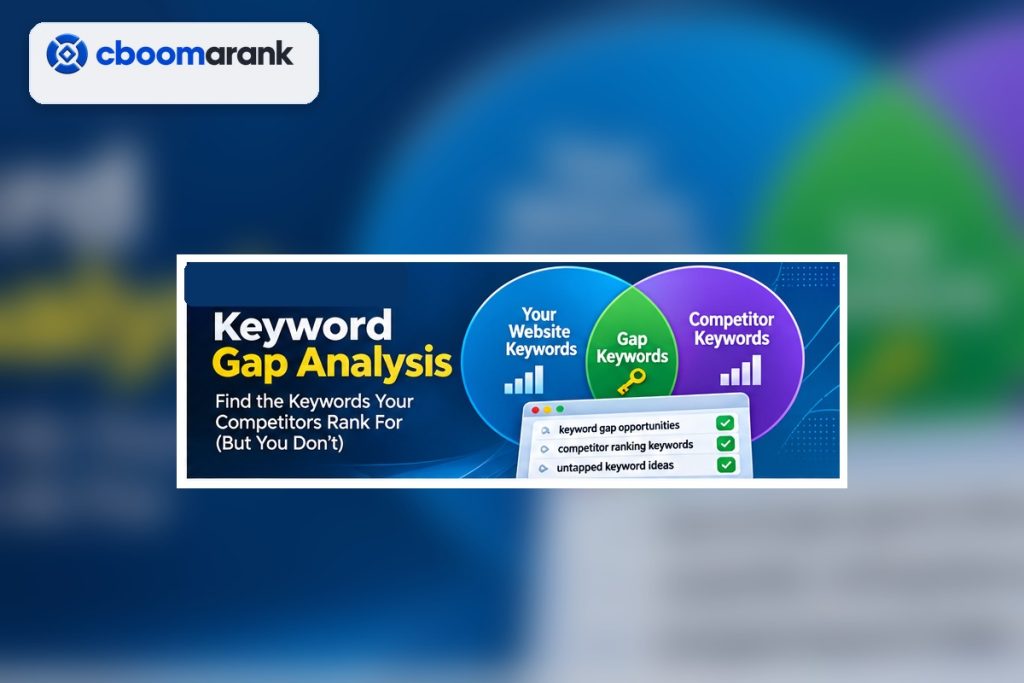
A keyword gap is a search query or topic where relevant competitors earn organic visibility and your site does not, or where they rank materially better for an intent that matters to your audience. A useful keyword gap analysis goes beyond exporting thousands of missing terms. It identifies the gaps that are strategically relevant, realistically addressable and connected to a page you can create or improve.
The most important decision is competitor selection. If you compare your site with giant publishers that serve a different audience, the export will be full of noise. Start with search competitors that repeatedly appear for the same customer problems and commercial queries you want to win.
Keyword Gap Analysis: The Quick Answer
Choose three to five relevant competitors, collect the keywords where they rank and you are absent or weaker, then classify each gap by intent, topic, page type, business value and attainable next action. Remove navigational queries, unrelated products, countries you do not serve and topics outside your strategy. The final output should be a short prioritized roadmap, not an impressive spreadsheet.
| Gap type | Meaning | Typical action |
|---|---|---|
| Missing | Competitors rank; your site has no meaningful visibility | Create a new page only if the intent fits your strategy. |
| Weak | Your page ranks, but competitors are substantially stronger | Improve the existing page, supporting content, internal links or authority. |
| Untapped | Several competitors rank and you have no dedicated answer | Validate the topic and decide whether it deserves a cluster or commercial page. |
| Strong | You already outperform the comparison set | Protect the page, update it and avoid unnecessary duplication. |
| Shared | You and competitors all rank | Look for differentiation, intent fit and conversion improvements rather than simply adding words. |
Choose the Right Competitors Before You Export Anything
A business competitor and a search competitor are not always the same. A SaaS company may compete in search with review sites, marketplaces, media publishers and documentation pages. Use the method in CBOOMARANK’s competitor discovery guide: start with customer-intent searches, identify domains that recur, then classify direct business rivals separately from content competitors.
For each candidate, record audience overlap, geography, repeated SERP presence and product relevance. If a domain appears for one broad informational query but nowhere else, it may be a poor primary comparison target. A smaller site that overlaps across the exact topics your buyers search can produce a much more actionable gap set.
Build a Clean Keyword Gap Dataset
Run the comparison at the domain level first, but keep the ranking URL for every term. The URL reveals the page type that search engines currently reward. A competitor may rank with a product page, category, calculator, documentation page, long-form guide or comparison article. That distinction determines your response.
Keep country, language and device context consistent. A term can have different competitors and different intent across markets. If the business targets the United States, United Kingdom, Canada, India, France and Germany, do not merge every market into one undifferentiated export. Segment first, then look for patterns that travel across regions.
Filter Out Keyword Gaps That Are Not Opportunities
Remove branded navigational terms belonging to competitors unless you have a legitimate comparison use case. Exclude unrelated product lines, careers, support queries and topics outside the audience you serve. Also remove terms whose search results clearly demand assets you do not plan to provide, such as live data, templates, local inventory or a free tool.
This filtering step often removes more rows than it keeps. That is healthy. The value of a gap analysis is not the number of missing keywords; it is the quality of the decisions that remain.
Classify Each Gap by Search Intent
Use search intent to separate informational learning from commercial investigation and transactional action. Then inspect the actual ranking pages. Tool-based intent labels are a starting point, but mixed SERPs are common. A query may show tutorials, product pages and comparisons because users have more than one plausible next step.
Write down the dominant page pattern and whether your site already has a page that could satisfy it. If an existing page is close, improvement is usually safer than publishing a near-duplicate. If the intent is genuinely different, a new page may be justified.
Cluster the Gap Before Creating a Content Calendar
Many exported terms are variations of one underlying need. Use keyword clustering to group phrases that share SERP overlap and search intent. A cluster gives you a page-level unit of work: one target page, its supporting subtopics, internal links and success criteria.
Clustering also prevents the classic gap-analysis mistake of creating one article for every keyword row. That approach can lead directly to keyword cannibalization, duplicated explanations and weak internal architecture.
Prioritize Keyword Gaps With Business and SERP Evidence
Score each cluster rather than each phrase. A practical model uses five dimensions: audience fit, business value, existing authority, SERP attainability and content leverage. Content leverage asks whether one investment can strengthen several related pages or product workflows.
| Factor | Low priority | High priority |
|---|---|---|
| Audience fit | Peripheral or wrong geography | Core buyer/problem |
| Business value | No meaningful next step | Clear connection to revenue or retention |
| Existing authority | No topical support | Strong related content and internal links |
| SERP attainability | Results demand a different asset or exceptional authority | You can build a credible, differentiated answer |
| Content leverage | One isolated page | Strengthens a cluster, product page or strategic topic |
Turn a Keyword Gap Into a Page Brief
The brief should state the target audience, search intent, primary cluster, existing page to update or new page to create, key questions, required evidence, internal links and conversion path. Add the competitor pages as research references, not templates to copy. Your page should improve the experience or information, not reproduce their structure.
For commercial gaps, include the decision criteria a buyer actually needs. For informational gaps, define the action the reader should be able to take after the article. For mixed-intent gaps, decide whether a guide, comparison and product page need to work together.
Use Backlink Gaps to Validate Content Gaps
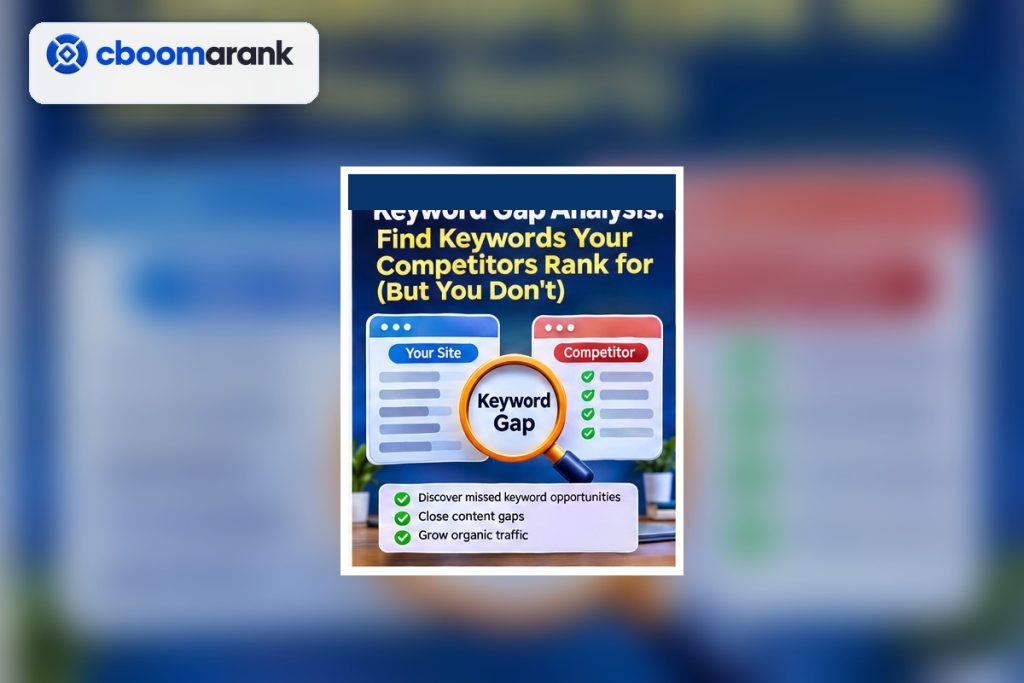
A keyword gap tells you where competitors are visible. A backlink gap can help explain why certain pages are difficult to displace or reveal promotion opportunities after you publish. Review the competing page’s referring domains and most linked-to assets. If the result is supported by strong editorial links, plan distribution and authority-building rather than assuming content edits alone will close the gap.
CBOOMARANK’s broader workflow connects competitor research with backlink intelligence and publisher opportunities, so research can move toward execution instead of ending in an export. Use backlink data carefully: vendor metrics and modeled traffic are directional signals, not independent proof of quality.
Compare competitor opportunities and turn missing, weak and untapped gaps into a focused action plan.
Common Keyword Gap Analysis Mistakes
- Comparing against famous brands that do not serve the same audience or search intent.
- Treating every competitor keyword as a topic your site should target.
- Creating a new page when an existing page already serves the same intent.
- Prioritizing volume before business value and SERP fit.
- Ignoring geography and language.
- Copying competitor structure instead of improving on the user experience.
- Assuming a tool’s traffic estimate equals measured competitor analytics.
- Failing to connect the gap to internal links, promotion and measurement.
A 60-Minute Keyword Gap Workflow
- Define the audience, market and business outcome.
- Choose three to five recurring search competitors.
- Export missing, weak, shared and untapped terms with ranking URLs.
- Remove branded noise, unrelated topics and wrong-market queries.
- Classify intent and dominant page type.
- Cluster overlapping terms into page-level opportunities.
- Score each cluster for audience fit, value, authority, attainability and leverage.
- Decide update versus new page.
- Write a page brief with internal links and distribution needs.
- Set a review date and measure visibility plus business outcomes.
Worked Example: From Raw Gap Export to Action Plan
Imagine an SEO platform comparing itself with three competitors. The export contains 8,000 missing terms. After removing branded queries, careers, unrelated products and wrong-market terms, 2,100 remain. Intent grouping reduces those to 340 meaningful topic groups. SERP and business filtering leaves 42 clusters worth reviewing, and only 12 become high-priority work for the next quarter.
That reduction is not a loss of opportunity; it is the purpose of the analysis. The final 12 clusters might include three pages to create, five existing pages to improve, two commercial pages needing stronger evidence and two topics to defer because the SERP is dominated by assets the company cannot realistically produce yet.
Decide: Create a New Page or Improve an Existing One?
Before approving a new URL, search your site for the cluster and compare the existing page with the ranking competitors. If the current page already matches the intent but lacks depth, examples or internal support, improve it. If the current page serves a different audience or intent, keep it and create a distinct page only when the separation is clear.
A useful rule is to write the purpose of both pages in one sentence each. If the sentences are nearly identical, the pages probably should not both exist. This simple test prevents gap analysis from turning into duplicate-content production.
Connect Keyword Gaps to Existing Authority
A topic can look attractive in isolation but be expensive if your site has no supporting content, links or expertise around it. Review the pages you already rank for near the gap. A cluster adjacent to an established topic may be easier to support with internal links and subject-matter expertise than a completely new vertical.
This is where authority should be interpreted as a network, not just a score. Existing relevant pages, useful internal links, first-party experience, citations and backlinks can all make a new page more credible. When none of those foundations exist, the gap may still be worthwhile, but it should be treated as a larger investment.
Measure Whether the Keyword Gap Is Closing
For owned-site evidence, use Google Search Console’s Performance report to compare impressions, clicks, queries and landing pages before and after the update.
Define the baseline before making changes. Record the target cluster, current ranking distribution, impressions, clicks and the competitor pages you are comparing. After publishing or updating, watch whether the target URL gains impressions across the cluster, whether rankings consolidate on the intended page and whether qualified traffic increases.
For commercial clusters, also track downstream behavior. A gap can close in search visibility while failing to create meaningful enquiries or trials. That may indicate a mismatch between the keyword opportunity and business value, or a page that ranks but does not help the visitor decide.
Build a Quarterly Gap Review Instead of a One-Time Audit
Competitors publish new content, products change and search results evolve. Maintain a small recurring review rather than starting from zero each time. Re-run the gap for the same core competitor set, compare the changes, then add or remove competitors when the market shifts.
Document why a cluster was accepted, deferred or rejected. That record stops the team from repeatedly debating the same low-value opportunities and makes future strategy more consistent.
Frequently Asked Questions
How many competitors should a keyword gap analysis include?
Three to five well-chosen competitors are often enough for a first pass. Add more only when a distinct market segment or search competitor contributes genuinely different opportunities.
What is the difference between a content gap and a keyword gap?
A keyword gap is usually query-level visibility. A content gap is broader: a missing topic, format, audience need or decision resource. Keyword data can reveal content gaps, but the two are not identical.
Should I target every missing keyword?
No. Most raw gap exports contain irrelevant, low-value or duplicate opportunities. Filter aggressively.
Can keyword gap analysis help existing pages?
Yes. Weak and shared gaps are especially useful for finding subtopics, intent mismatches and internal-link opportunities on pages you already own.
How often should I repeat the analysis?
Repeat it when competitors, products or markets change, and on a scheduled cadence for strategic topics. The right interval depends on how quickly your SERPs move.
Final Checklist
A strong keyword gap analysis is a decision system. Choose relevant competitors, keep ranking URLs, classify intent, cluster overlapping terms and prioritize gaps that matter to the business. The final deliverable should tell your team exactly which page to create or improve, why the opportunity matters and what evidence will show whether the work succeeded.
