


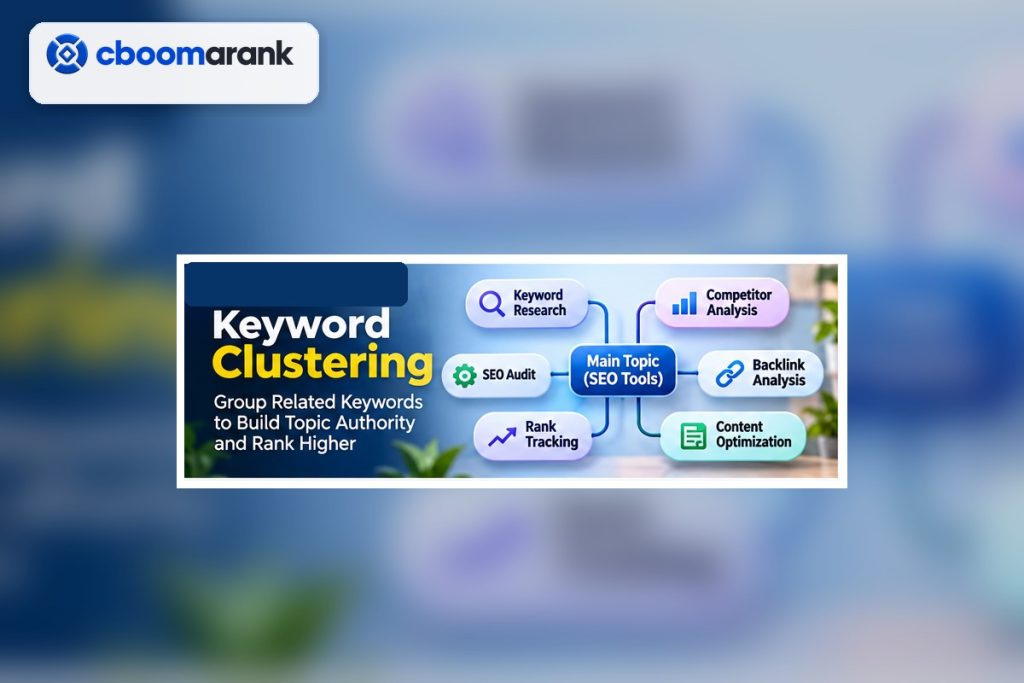
Keyword clustering groups search queries that can be satisfied by the same page or by a tightly connected set of pages. The objective is not to organize a spreadsheet neatly. It is to decide where one comprehensive page is enough, where a separate page is justified, and how related pages should connect without competing for the same search intent.
The most reliable clusters combine semantic similarity with SERP evidence. Two phrases can sound similar but produce different result types. Conversely, two phrases can use different words while Google repeatedly ranks the same pages for both. Treat the search results as evidence about user expectations, then apply editorial judgment.
Keyword Clustering: The Quick Answer
Normalize your keyword list, remove obvious duplicates, label search intent, compare SERP overlap, then group terms that point to the same page purpose. Give each cluster one primary topic, supporting subtopics and a target page type. Before creating anything new, compare the cluster with pages already on your site.
| Clustering signal | What it tells you | Use |
|---|---|---|
| Semantic similarity | The phrases discuss related concepts | Useful first-pass grouping |
| SERP overlap | The same URLs rank for multiple terms | Strong evidence the terms can share a page |
| Intent | Searchers want the same outcome | Prevents mixing tutorials with product pages |
| Page type | Results favor guides, tools, categories, comparisons or products | Shapes the content brief |
| Existing URL | Your site may already have a page for the cluster | Prevents duplication and cannibalization |
Start Keyword Clustering With a Clean Keyword Set
Combine sources such as keyword research, Google Search Console, competitor gaps, internal site search and customer questions. Keep source and market fields so you can trace where each term came from. Normalize capitalization and obvious duplicates, but do not erase meaningful modifiers such as country, audience, product type or “free” versus paid intent.
A keyword list collected from several countries should retain geography until you know whether the results behave similarly. “Best accounting software” can produce different vendors, regulations and pricing expectations across markets. Clustering too early can hide those differences.
Use Intent as a Keyword Clustering Boundary
Separate informational, commercial investigation, transactional and navigational needs before doing fine-grained grouping. A user asking “what is backlink analysis” needs education; “best backlink checker” expects comparison; “backlink checker free” often expects a tool or immediate result. Those phrases are related, but a single page may not satisfy all of them.
Use the complete search intent guide to define the desired page outcome. When the SERP is mixed, record the mix rather than forcing a label. Mixed results can justify a hub-and-spoke architecture where a guide, comparison and tool page support one another.
Measure SERP Overlap for Keyword Clustering
For each keyword pair or candidate group, record the top ranking URLs and calculate how many overlap. You do not need a complicated machine-learning model to make useful decisions. A simple rule can work: high overlap suggests one page; moderate overlap requires intent review; low overlap suggests separate pages.
The exact threshold depends on the niche and the depth of the result set you compare. A five-of-ten overlap is stronger evidence than one shared result. Also inspect which URLs overlap. If only giant homepages appear across both terms while the rest of the SERP differs, the relationship may be weaker than the raw percentage suggests.
Create Cluster Types Instead of One Giant Bucket
Primary page clusters
These contain a central keyword and close variants that should be served by one strong URL. The page can cover definitions, examples, steps and related questions while maintaining one clear purpose.
Supporting article clusters
These answer narrower problems that deserve their own pages and link back to a hub or commercial page. Supporting pages should add information that would make the primary page unwieldy or should address a genuinely different intent.
Commercial decision clusters
Comparisons, alternatives, pricing, “best” and buyer-specific modifiers often belong to commercial investigation. Keep them separate from broad tutorials when the SERP consistently rewards decision content.
Build a Page Map From Keyword Clustering Results
Assign one target URL to each cluster before writing. For an existing site, map clusters to current URLs first. Mark each as keep, improve, consolidate or create. This prevents the common failure where a research project accidentally creates several pages for the same topic.
| Cluster | Primary URL decision | Supporting content | Internal-link role |
|---|---|---|---|
| Long-tail keyword research | One main guide | Examples by industry or use case | Support keyword research hub |
| Keyword gap | Competitor research guide | Gap templates and workflows | Link to competitor research product |
| Backlink checker | How-to guide | Free checker and tool comparison | Link to backlink intelligence |
| Search intent | Foundational guide | Intent by industry or page type | Support keyword clustering and content planning |
How Clustering Prevents Keyword Cannibalization
Clustering creates a deliberate ownership model: every important intent has a preferred page. When several existing URLs map to the same cluster, investigate before adding another. The correct fix may be consolidation, differentiation or internal-link cleanup rather than new content.
Use the keyword cannibalization guide for the diagnostic workflow. Cannibalization is not simply “two pages mention the same keyword.” The problem is overlapping intent and unclear page ownership.
Add Business Priority to Your Keyword Clustering Map
A cluster can be topically relevant but strategically low value. Score the cluster by audience fit, business value, current authority, SERP opportunity and content leverage. High-leverage clusters support several pages, product features or internal pathways. This helps you build a publishing roadmap that strengthens the site instead of chasing isolated traffic.
For high-priority clusters, define the conversion path early. An informational page may lead to a comparison, a free analysis or a product workflow. A commercial page may lead directly to pricing or signup. The path should feel like the next useful step, not a forced sales interruption.
Use CBOOMARANK to Connect Keywords, Competitors and Execution

CBOOMARANK’s keyword and competitor workflows can help surface candidate terms, intent and competitive gaps. Use that data as input to the cluster map, then connect the selected pages with internal links, authority research and publisher opportunities where relevant.
Do not treat automated clustering as unquestionable truth. Search results change, tool databases differ and language is ambiguous. Review strategically important clusters manually, especially before creating or consolidating pages.
Turn keyword lists into page-level opportunities and connect them to competitor and backlink research.
Common Keyword Clustering Mistakes
- Grouping only by shared words while ignoring the search results.
- Mixing informational and transactional intents because the subject is related.
- Creating one enormous page for every phrase in a topic.
- Splitting every variation into a separate page.
- Clustering several countries together before checking local SERPs.
- Ignoring the site’s existing URLs.
- Using the exact primary keyphrase in too many headings instead of writing naturally.
- Failing to define internal links and page ownership.
Keyword Clustering Workflow
- Collect keywords with source, country and intent fields.
- Normalize obvious duplicates without removing meaningful modifiers.
- Create an initial semantic grouping.
- Label or review search intent.
- Compare top results and calculate SERP overlap.
- Split groups where page type or intent differs.
- Assign one primary topic and target URL to each cluster.
- Map existing pages before approving new content.
- Score clusters for business value and feasibility.
- Build internal links between hubs, supporting articles and commercial pages.
- Review performance and re-cluster when SERPs change.
Manual vs Automated Keyword Clustering
Manual clustering works well for a few hundred high-value terms because an analyst can inspect intent and SERP nuance directly. Automated clustering becomes useful when the dataset reaches thousands of terms. The best workflow often combines both: automate the first pass, then manually review strategic clusters, commercial topics and any group where the SERP evidence is mixed.
Do not let a clustering algorithm decide your site architecture without review. Similar embeddings can group phrases that sound alike but require different assets, while SERP-overlap models can be distorted by dominant authority sites that rank broadly. Automation accelerates pattern detection; editorial judgment decides page ownership.
Calibrate Your SERP-Overlap Threshold
A fixed threshold such as “four shared URLs out of ten” can be a useful starting point, but it should be tested against your niche. In a mature B2B category, strong commercial intent may produce consistent overlap. In news, ecommerce or local search, results can be more volatile. Create a small validation set of known same-page and separate-page examples, then see which overlap threshold best reproduces sensible decisions.
Record the threshold and the depth of results compared. Comparing the top five URLs is different from comparing the top twenty. Consistency matters because the percentage is only meaningful when the method is stable.
Turn Keyword Clustering Results Into Content Briefs
A finished cluster should contain more than a list of keywords. Add the intended audience, primary query, supporting questions, dominant page type, required evidence, internal-link destinations and conversion path. Note which competing pages were reviewed and what your page will do differently.
For example, a “backlink checker” cluster might require a how-to guide, while a “best backlink checker” cluster needs a comparison methodology and decision table. The words overlap heavily, but the content brief should be different because the user outcome is different.
Govern Keyword Clustering as the Site Grows
Store the cluster map in a shared sheet or content system and update it whenever a new article is proposed. Editors should be able to search the map by topic, intent and target URL. This turns keyword clustering from a one-time research exercise into a publishing control that protects the site from accidental duplication.
Add columns for status, owner, last review date and related commercial page. When an article is consolidated or redirected, update the map so future writers do not recreate the retired topic under a new title.
Measure Cluster Performance at Page Level
Success should be evaluated across the cluster rather than by one exact phrase. Track the number of relevant queries producing impressions, the distribution of ranking positions, organic clicks, engagement and the intended business action. A strong page often earns visibility for dozens or hundreds of related phrases that were never in the original spreadsheet.
If multiple URLs begin appearing for the same cluster, investigate whether the architecture is becoming unclear. That early warning can prevent a future cannibalization problem.
Example: Cluster a Backlink Research Topic
Suppose the list contains “backlink checker,” “check backlinks,” “free backlink checker,” “best backlink checker,” “competitor backlinks” and “backlink analysis tool.” A semantic model might group all six together. The SERP review would probably split them. “Backlink checker” and “check backlinks” can support a how-to page; “free backlink checker” often expects immediate tool access; “best backlink checker” is commercial comparison intent; “competitor backlinks” may belong in a gap-analysis workflow.
The final architecture can still connect the pages through one backlink-intelligence hub. The value of clustering is not forcing every related phrase onto one URL. It is creating the smallest set of pages that fully serves the distinct intents while preserving a clear relationship between them.
Use Cluster Confidence Levels
Mark each cluster as high, medium or low confidence. High confidence means semantic similarity, SERP overlap and intent all agree. Medium confidence means one signal is mixed. Low confidence means the group exists mainly because the words look similar. This helps editors know where manual review is essential.
Confidence levels also make automation safer. Large datasets can be processed quickly while the team spends time only on the ambiguous groups that could affect site architecture.
Frequently Asked Questions
What percentage of SERP overlap means keywords belong together?
There is no universal percentage. Use overlap as evidence alongside intent and page type. Higher overlap generally strengthens the case for one page, but always inspect which URLs are shared.
Can AI cluster keywords automatically?
Yes, but semantic grouping alone can miss SERP and intent differences. Use automation for scale and manual review for strategic clusters.
Should synonyms always be on one page?
Usually when they express the same intent, but not always. Check the live results and user expectation.
How many keywords belong in a cluster?
As many as can be served naturally by one page purpose. Cluster size is an output of intent and SERP evidence, not a target number.
What happens when an existing page covers two clusters?
Decide whether it can serve both without becoming unfocused. Otherwise split the intents carefully and create clear internal links between the pages.
Final Checklist
Keyword clustering is architecture work disguised as keyword research. The best cluster map tells you which intent belongs to which URL, what not to publish, how pages should support one another and where the site still has meaningful gaps. Combine semantic similarity with SERP overlap, then make the final decision based on users and business strategy.
