

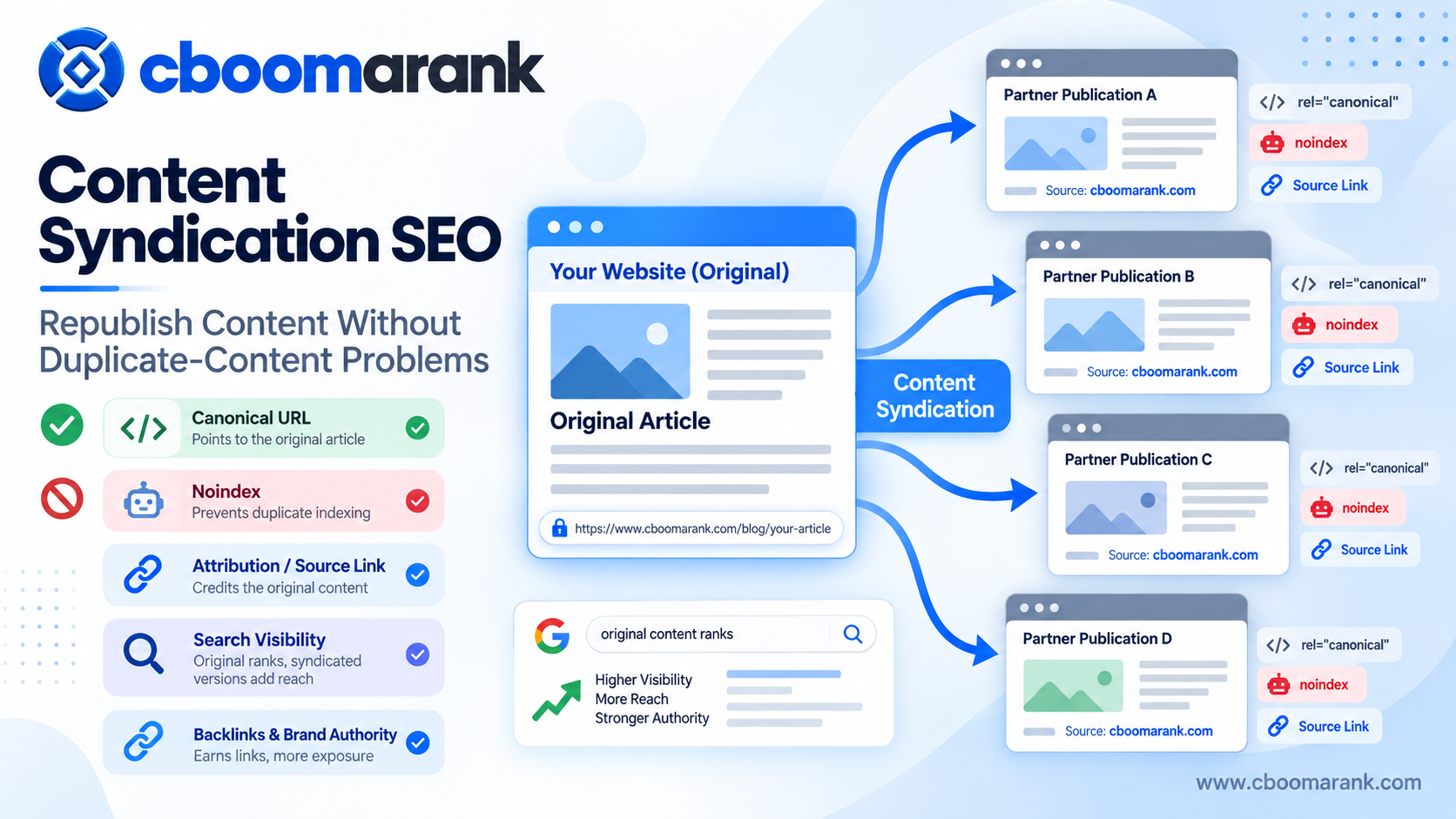
Content syndication allows a business to republish or distribute existing content through other websites, publications, platforms, newsletters, and partner networks to reach a larger audience.
Done carefully, content syndication can extend the life of strong content, generate referral traffic, create brand exposure, support authority building, and introduce your business to audiences you may not reach through your own website alone.
However, syndication also creates an important SEO question: what happens when substantially similar or identical content appears on more than one URL?
The answer is more nuanced than the common warning that “duplicate content causes a Google penalty.” In most ordinary cases, duplicate content is not a spam-policy violation. Instead, search engines try to determine which URL is the most representative version and which one should appear in search results.
Therefore, the real content syndication SEO challenge is usually canonicalization, indexing control, attribution, ranking signals, and protecting the visibility of the original article.
This guide explains how content syndication works, how it affects SEO, when to use canonical signals, when syndicated copies should use noindex, how to structure partner agreements, and how to measure whether syndication actually produces business value.
What Is Content Syndication?
Content syndication is the practice of republishing previously published content on another website, platform, publication, or distribution channel.
The syndicated version may be:
- An exact copy of the original article
- A shortened version
- An excerpt linking back to the original
- A slightly adapted version for a new audience
- A translated or localized version
- A newsletter edition
- A partner or media republication
The original publisher normally retains ownership or attribution, while the syndication partner receives useful content for its audience.
For marketers, the appeal is straightforward: one strong piece of content can reach multiple audiences without requiring an entirely new article for every channel.
Content Syndication SEO: What Actually Happens?
When the same or very similar content is available through multiple URLs, Google may group those pages together and select what it considers the canonical version.
Google describes canonicalization as the process of selecting a representative URL from a set of duplicate or very similar pages.
See Google’s official canonicalization documentation.
Therefore, content duplication does not automatically mean a penalty.
Instead, the important questions become:
- Which URL will Google treat as canonical?
- Which version will appear in search results?
- Where will ranking signals be consolidated?
- Can the syndicated version outrank the original?
- Does the syndication partner need to be indexed at all?
Those questions should be answered before syndication begins rather than after ranking problems appear.
Is Duplicate Content a Google Penalty?
Ordinary duplicate content is generally not a Google spam-policy violation.
Google explains that duplicate pages are common across the web and that its systems usually select one representative URL for search results.
For example, duplication can occur because of tracking parameters, print versions, protocol differences, mobile URLs, regional pages, filters, and other normal website functions.
The SEO problem is therefore usually not a manual “duplicate-content penalty.”
Instead, unnecessary duplication can create:
- Unclear canonical signals
- Competing URLs
- Fragmented measurement
- Wasted crawling
- Unpredictable search-result selection
- Ranking signals being associated with a different URL than expected
This distinction is essential when planning a content syndication strategy.
Content Syndication vs Duplicate Content
Duplicate content describes the condition: substantially similar content exists at multiple URLs.
Content syndication describes the distribution method that intentionally created some of those copies.
Therefore, syndicated content may be duplicate or near-duplicate content, but duplication itself does not mean the strategy is automatically harmful.
The risk depends on how the syndicated copies are indexed, attributed, linked, and technically configured.
Content Syndication vs Guest Posting
Content syndication and guest posting are also different.
A guest post is normally an original article written specifically for another publication.
A syndicated article has usually appeared somewhere else first.
Guest posting can be useful for reaching a new audience and earning relevant exposure, while syndication can expand the reach of content that has already proven valuable.
For broader authority-building strategies, see the CBOOMARANK guide to advanced link building.
Should the Original Article Be Published First?
In most planned syndication campaigns, publish the original article on your own website first.
This gives your site a clear original URL, establishes the page in your content architecture, and allows you to promote and measure the original before distributing copies.
However, publishing first does not create an absolute technical guarantee that Google will always select your original page as canonical.
Google uses multiple signals when choosing a canonical URL, and a canonical preference is not an absolute command.
Therefore, syndication partners should also follow the agreed indexing and attribution rules.
Does rel=”canonical” Solve Content Syndication?
The rel="canonical" element is an important SEO tool, but its role in content syndication needs careful explanation.
Google describes rel="canonical" as a strong canonicalization signal for duplicate or very similar URLs.
See Google’s canonical URL implementation guide.
However, Google’s current canonicalization troubleshooting guidance specifically says that the canonical link element is not recommended as the primary solution for avoiding duplication by syndication partners.
The reason is that syndicated pages can differ from the original in meaningful ways, and Google may still make its own canonical selection.
Therefore, if the goal is to prevent syndicated copies from appearing in Google Search, indexing control is more reliable than relying only on cross-domain canonical tags.
Google’s Current Recommendation for Syndicated Content
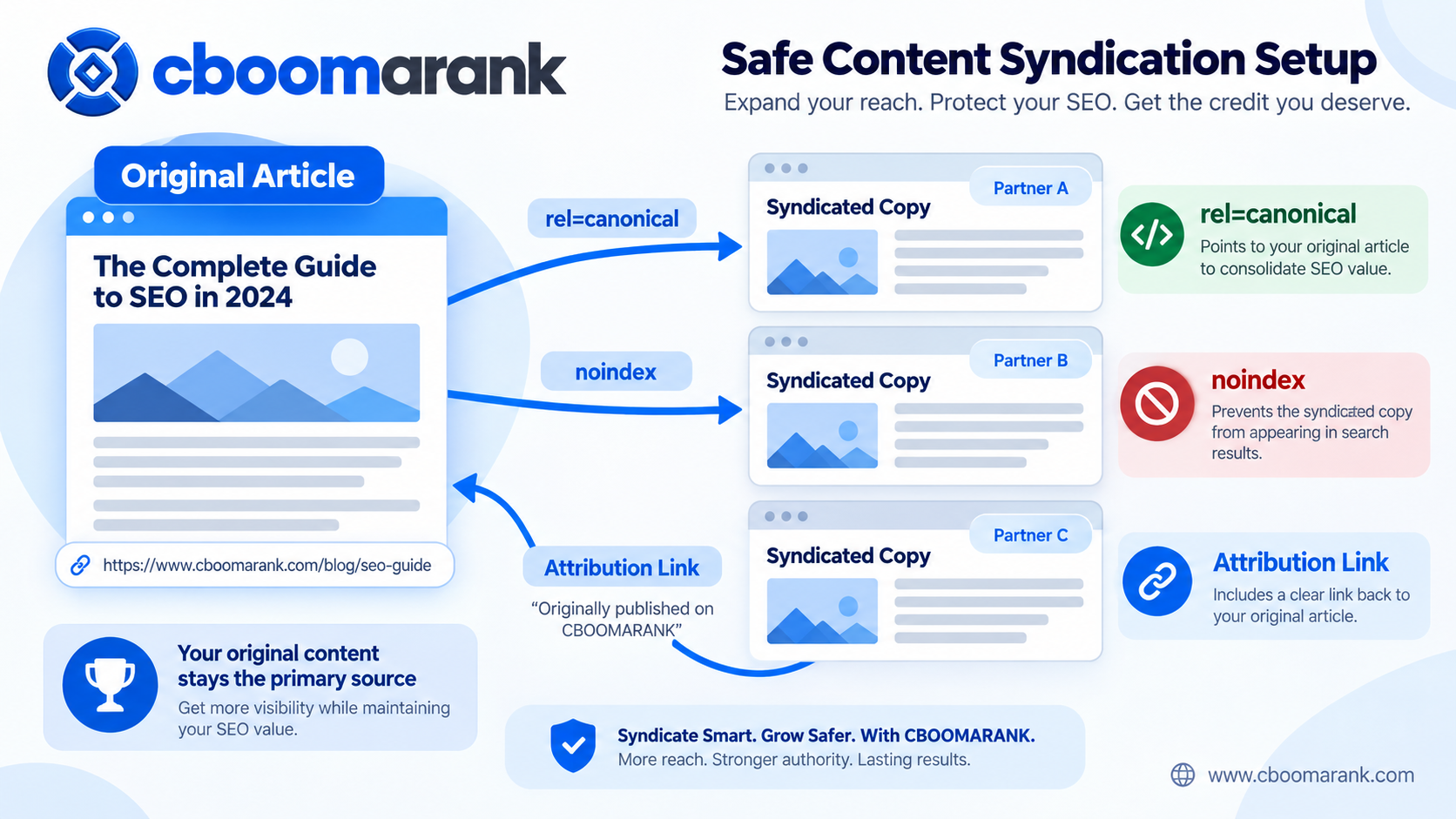
If you do not want a syndication partner’s copy appearing in Google Search, Google recommends that the partner block indexing of the syndicated copy.
See Google Search Central’s canonicalization troubleshooting guidance.
In practical terms, the partner can use:
<meta name="robots" content="noindex">or an equivalent X-Robots-Tag: noindex HTTP response header.
Google documents both methods in its noindex documentation.
One important technical detail is that Googlebot must be allowed to crawl the URL in order to see the noindex directive.
Therefore, do not block the syndicated URL in robots.txt and simultaneously expect Google to discover its noindex tag.
When Should a Syndicated Copy Use noindex?
A syndicated copy should be a strong candidate for noindex when:
- The original publisher wants its own article to remain the main search result.
- The partner is republishing nearly identical content.
- Search traffic to the partner copy is not a strategic objective.
- The primary goal is referral traffic, audience reach, or brand exposure.
- The partner agrees that the copy exists for readers rather than independent search rankings.
This approach can be especially useful for publishers that want the reach of syndication without asking search engines to choose between several near-identical indexed articles.
When Might an Indexed Syndicated Version Make Sense?
Not every syndicated article needs to be removed from search results.
In some partnerships, the syndicated version may be intentionally designed as a distinct resource.
For example, the partner might add substantial original commentary, local data, unique interviews, new analysis, or another meaningful contribution.
At that point, the page is no longer simply a duplicate copy.
However, if both versions are meant to rank independently, they should provide genuinely distinct value instead of making superficial wording changes to the same article.
Do Not Rely on robots.txt for Canonicalization
A common technical mistake is attempting to control duplication by blocking the syndicated page with robots.txt.
Google explicitly advises against using robots.txt as a canonicalization mechanism.
A blocked URL can still potentially appear in search results if Google discovers references to it elsewhere because Google may know that the URL exists even when it cannot crawl the page content.
If the objective is to prevent indexing, use a proper noindex directive and allow the crawler to access it.
Should Syndicated Content Link Back to the Original?
Yes. A clear attribution link is useful for readers and publishers.
A syndication partner can include a statement such as:
This article was originally published on CBOOMARANK.
The attribution should link directly to the original article rather than the homepage whenever possible.
This helps readers identify the original source and creates a useful referral path.
However, a backlink alone does not guarantee that the original page will be selected as canonical.
That is why attribution, indexing policy, and technical configuration should work together.
Can Content Syndication Build Backlinks?
Content syndication can generate backlinks, but link building should not be the only reason for syndicating content.
A quality syndication placement can produce:
- Referral traffic
- Brand discovery
- Audience growth
- Expert positioning
- Newsletter exposure
- Social sharing
- Relevant citations
- Business relationships
In some cases, the syndicated page may also link to resources within the original article.
However, backlinks are most useful when they are editorially relevant and genuinely helpful to readers.
For broader backlink strategy, see How to Get Backlinks and Build a Backlink Profile.
How to Choose Content for Syndication
Do not syndicate every article automatically.
Start with content that already demonstrates value.
Strong syndication candidates often include:
- Evergreen tutorials
- Original research
- Industry analysis
- Data-driven articles
- Detailed guides
- Expert commentary
- High-performing educational content
Use keyword and traffic data to identify which topics have proven demand.
CBOOMARANK Keyword Research can help identify relevant commercial and informational topics before you invest in content production and distribution.
How to Choose Syndication Partners
The quality of the syndication partner matters more than the number of websites accepting the article.
Evaluate potential partners based on:
- Audience relevance
- Editorial quality
- Topical alignment
- Real traffic
- Brand reputation
- Content quality
- Indexing practices
- Attribution policy
- Link policy
- Distribution reach
A small publication with a highly relevant audience may produce better business results than a large unrelated website.
Content Syndication Partner Checklist
Before approving a syndication relationship, confirm the following:
| Requirement | What to Confirm |
|---|---|
| Original source | The partner clearly identifies the original publisher and URL |
| Indexing | You agree whether the syndicated page should be indexed or noindexed |
| Canonical handling | Any canonical configuration matches the agreed strategy |
| Backlinks | Attribution links are clear, relevant, and not misleading |
| Content edits | You know whether the partner may alter headlines, links, or body copy |
| Publication timing | The original URL is live before or according to the agreed schedule |
| Tracking | Referral traffic and campaign performance can be measured |
| Removal | There is a process for removing outdated or incorrect syndicated copies |
How to Avoid Content Syndication Cannibalization
Content cannibalization occurs when multiple pages compete for substantially the same search intent.
Syndication can make this more complicated because one of the competing pages may live on another domain.
To reduce risk:
- Publish a strong original page.
- Use a stable canonical URL on your own site.
- Agree on indexing policy before syndication.
- Request
noindexon near-identical partner copies when appropriate. - Use clear attribution linking back to the original.
- Monitor which URL Google selects.
- Track ranking changes after syndication begins.
Do not wait until a partner version starts outranking the original before discussing the technical setup.
How to Check Which URL Google Selected as Canonical
Google Search Console’s URL Inspection tool can show the Google-selected canonical for URLs within properties you control.
If an unexpected URL becomes canonical, investigate:
- Canonical tags
- Redirects
- Sitemap signals
- Internal links
- Page similarity
- Indexing directives
- Technical configuration
Google notes that canonicalization is based on multiple signals and that a declared canonical is a preference rather than an absolute rule.
Should You Rewrite Syndicated Content?
Rewriting a syndicated article does not automatically solve the underlying problem.
A lightly rewritten page may still serve the same intent and provide little additional value.
Instead, decide what role the partner page should play.
If it is intended simply to distribute the original content, use a clear syndication setup.
If it is intended to become a standalone resource, add substantial unique value such as:
- New research
- Different examples
- Local market information
- Expert interviews
- Additional analysis
- A different target audience
- Unique multimedia
Content Syndication and Site Reputation Abuse
Content syndication should also be distinguished from site reputation abuse.
Google’s spam policies recognize that legitimate news syndication, editorial contributions, user-generated content, and other third-party material can be normal publishing practices.
The risk arises when third-party content is hosted primarily to exploit a site’s ranking signals rather than to serve the publication’s audience.
See Google’s Search spam policies.
Therefore, syndication should have a genuine editorial or audience purpose rather than being designed purely as a ranking manipulation tactic.
How to Measure Content Syndication Performance
A syndication program should be measured like any other marketing channel.
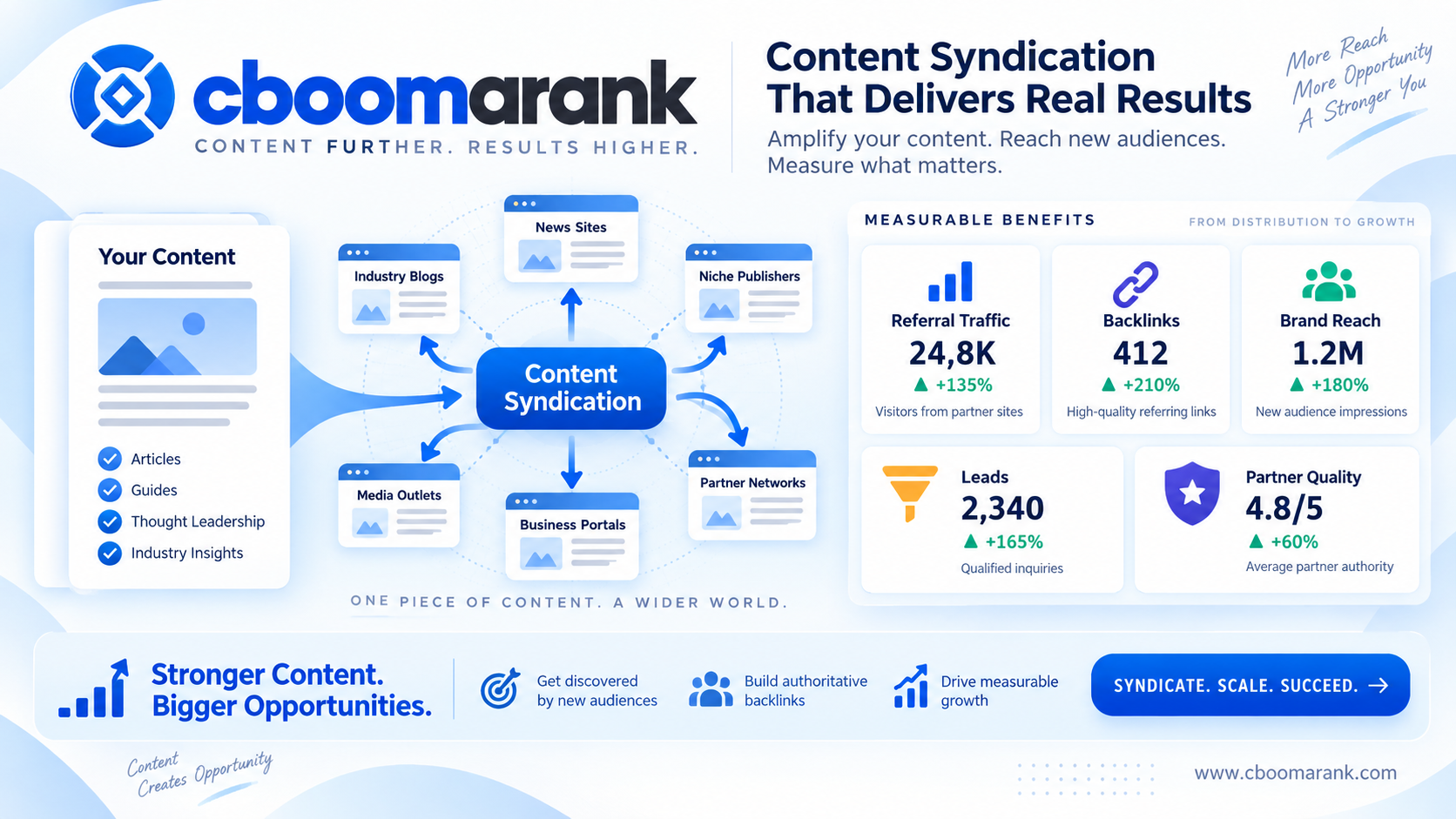
Track metrics such as:
| Metric | Why It Matters |
|---|---|
| Referral traffic | Shows how many users visit from syndication partners |
| Conversions | Measures leads, signups, or purchases generated |
| Branded searches | Can indicate increased brand awareness |
| Backlinks | Shows whether distribution creates useful citations |
| Original-page rankings | Helps detect unexpected visibility changes |
| Canonical selection | Shows which URL Google treats as representative |
| Partner quality | Helps identify the publications producing real value |
A syndication campaign that produces dozens of copies but no relevant visitors, links, leads, or brand value may not be worth continuing.
Content Syndication Mistakes to Avoid
Publishing Everywhere Without a Strategy
More placements do not automatically produce better results. Prioritize relevant audiences and credible publications.
Assuming Canonical Tags Are Absolute
A canonical is a strong signal, but Google can still select another URL.
Ignoring noindex for Near-Identical Partner Copies
If the partner copy does not need independent search visibility, noindex can provide clearer indexing control.
Blocking a noindex Page in robots.txt
If Google cannot crawl the page, it cannot reliably see the noindex instruction.
Using Syndication Only for Links
The best partnerships provide real audience exposure and editorial value, not merely another backlink.
Failing to Monitor Canonical Selection
Check performance after syndication begins rather than assuming the original URL will always remain dominant.
A Practical Content Syndication Workflow
Step 1: Select Proven Content
Choose useful evergreen or high-performing content with clear audience demand.
Step 2: Identify Relevant Partners
Research publications whose audience overlaps with your target market.
Step 3: Agree on the SEO Setup
Decide whether the partner version should be indexed, noindexed, excerpted, or substantially adapted.
Step 4: Define Attribution
Ensure the original publisher and original article URL are clearly credited.
Step 5: Publish and Verify
Check the live partner page, links, robots directives, canonical tags, and content changes.
Step 6: Measure Results
Track referral traffic, leads, links, rankings, and canonical selection.
Step 7: Improve the Partner List
Continue working with partners that create meaningful business value and stop low-quality distribution.
Find Better Content and Syndication Opportunities With CBOOMARANK
Strong content syndication starts before distribution.
Use CBOOMARANK Keyword Research to identify topics with real search demand, then use backlink and authority research to understand where competitors earn relevant mentions and which publishers may be worth investigating.
Start Keyword Research with CBOOMARANK →
Analyze backlinks and authority opportunities →
Need the right plan? View CBOOMARANK pricing →
How CBOOMARANK Fits Into Content Syndication SEO
CBOOMARANK can support syndication planning before and after publication.
Keyword Research helps identify topics with meaningful search demand.
Competitor Research can reveal which publications mention or republish competing brands.
Backlink and authority analysis helps evaluate publishers and monitor links created through distribution.
SEO auditing can help identify canonicalization, indexing, and internal-linking issues on the original site.
Website Analysis gives you a broader view of how the original content fits into your overall SEO performance.
The workflow becomes:
Research → publish original → select partners → define indexing → syndicate → monitor → measure.
Frequently Asked Questions About Content Syndication SEO
What is content syndication?
Content syndication is the practice of republishing or distributing existing content through other websites, publications, platforms, newsletters, or partner networks.
Is content syndication bad for SEO?
Not automatically. The main SEO considerations are canonicalization, indexing, attribution, ranking signals, and whether syndicated copies compete with the original article.
Does duplicate content cause a Google penalty?
Ordinary duplicate content is generally not a spam-policy violation. Google normally selects a representative canonical URL when it finds duplicate or very similar pages.
Should syndicated content use a canonical tag?
A canonical can provide a useful signal, but Google currently does not recommend relying on canonical tags alone to prevent syndicated copies from competing in Search. When the partner version should not appear in Search, Google recommends blocking indexing of that copy.
Should syndicated content use noindex?
If the goal is to keep the partner copy accessible to readers while preventing it from appearing in Google Search, noindex is an appropriate option.
Can syndicated content outrank the original?
Yes, it can happen because Google makes its own canonical and ranking decisions. That is why publishers should agree on indexing and attribution rules before syndication.
Can content syndication generate backlinks?
Yes. Syndication partners often include attribution links to the original source, and useful syndicated content may also generate additional editorial citations. However, audience value should remain the primary reason for the partnership.
What is the best content to syndicate?
Evergreen guides, original research, industry analysis, expert commentary, and proven high-performing articles are often strong candidates.
Final Thoughts
Content syndication can be an effective way to expand the reach of high-quality content, strengthen brand visibility, generate referral traffic, and create new authority-building opportunities.
However, successful content syndication SEO requires more than copying an article onto another website.
You need a clear original URL, a defined partner strategy, an agreed indexing policy, useful attribution, reliable tracking, and ongoing monitoring.
Most importantly, do not assume that a canonical tag alone will always protect the original page.
If a near-identical syndicated copy does not need to rank independently, work with the partner to control indexing appropriately.
Ultimately, the best syndication strategy is one that expands your audience without creating unnecessary competition between your own content and its distributed copies.
